
Choosing the Best Portable Chargers for Travel
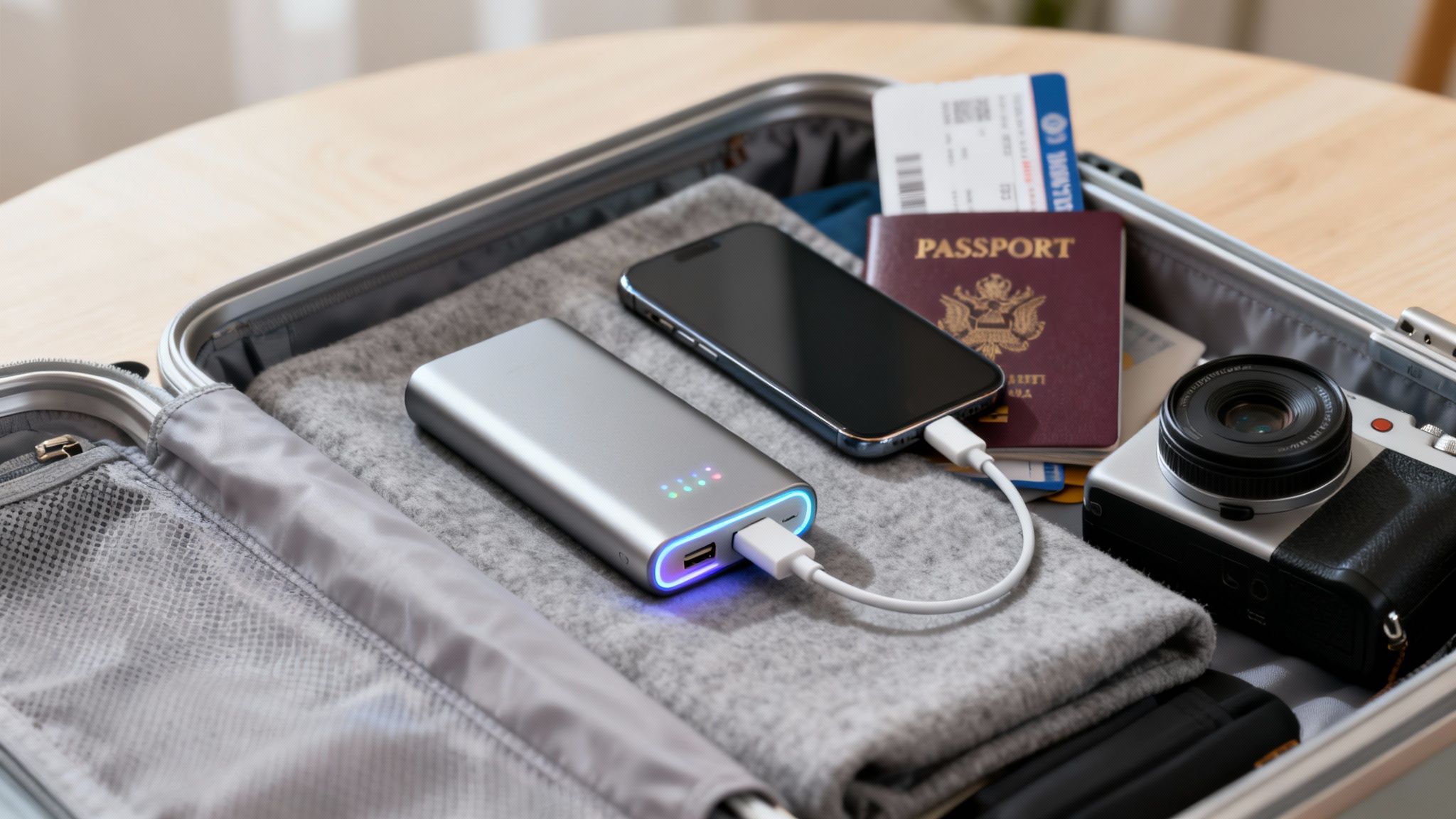
The sweet spot for the best portable chargers for travel is a capacity of at least 10,000 mAh, fast charging through a USB-C Power Delivery port, and a design that’s small enough to disappear into your carry-on. That combination gives you enough juice for at least two full phone recharges without adding a brick to your bag.
Why a Portable Charger Is Your Most Important Travel Gadget
We’ve all been there. You’re standing at the gate, fumbling for your phone to pull up your boarding pass, and you see it: the dreaded 1% battery warning. A dead device is no longer just a minor hiccup; it can throw your entire trip into chaos.
Our phones are our maps, our tickets, our cameras, and our connection to everything. A reliable power bank is the antidote to that low-battery anxiety. It means you’re not tethered to the one working outlet in the airport terminal, and you can explore a new city without constantly worrying about your phone dying. This guide is all about preventing that panic.
Ditching the Jargon for Practical Advice
Forget the confusing tech specs for a moment. Instead of just throwing a list of products at you, my goal is to help you understand what actually matters when you're on the road.
We'll focus on what you need to know to pick the right power bank for your trip, including:
- Real-World Capacity: What do numbers like mAh and Watts actually mean for keeping your specific devices charged?
- TSA & Airline Rules: How to fly without worrying that your charger will be confiscated at the security checkpoint.
- Charging Speeds: Why some chargers can get your phone from zero to 50% in 30 minutes, while others seem to take all day.
The shift from a "nice-to-have" gadget to an absolute travel essential is obvious when you look at the numbers. The global market for portable chargers was valued at around USD 11.5 billion in 2023 and is projected to nearly double to about USD 21.4 billion by 2032. As we rely more and more on our devices, it’s no wonder a backup power source is as crucial as a passport. If you're curious about the industry trends, you can explore the full portable chargers market report.
At the end of the day, the best portable chargers give you more than just power—they give you peace of mind. And speaking of digital peace of mind, just as you organize your travel documents, learning how to use cloud storage can also save you from a different kind of disaster on the road.
How to Match Charger Capacity to Your Trip
Picking the right portable charger can feel a bit like Goldilocks trying to find the perfect bowl of porridge—too small is useless, too big is a burden. It’s actually much simpler than that. Think of it like packing a water bottle for a hike. For a short stroll, a small bottle is perfect. For an all-day trek in the mountains? You’re going to need a lot more capacity.
Power bank capacity, measured in milliamp-hours (mAh), works exactly the same way. A smaller number means a lighter, more pocketable charger but fewer top-ups for your devices. A bigger number means more power on tap, but it also means more weight in your bag. The real trick is finding that sweet spot for your kind of travel, so you have just enough juice without feeling like you’re carrying a brick.
Not sure if you even need one? This handy little flowchart pretty much sums it up for modern travelers.
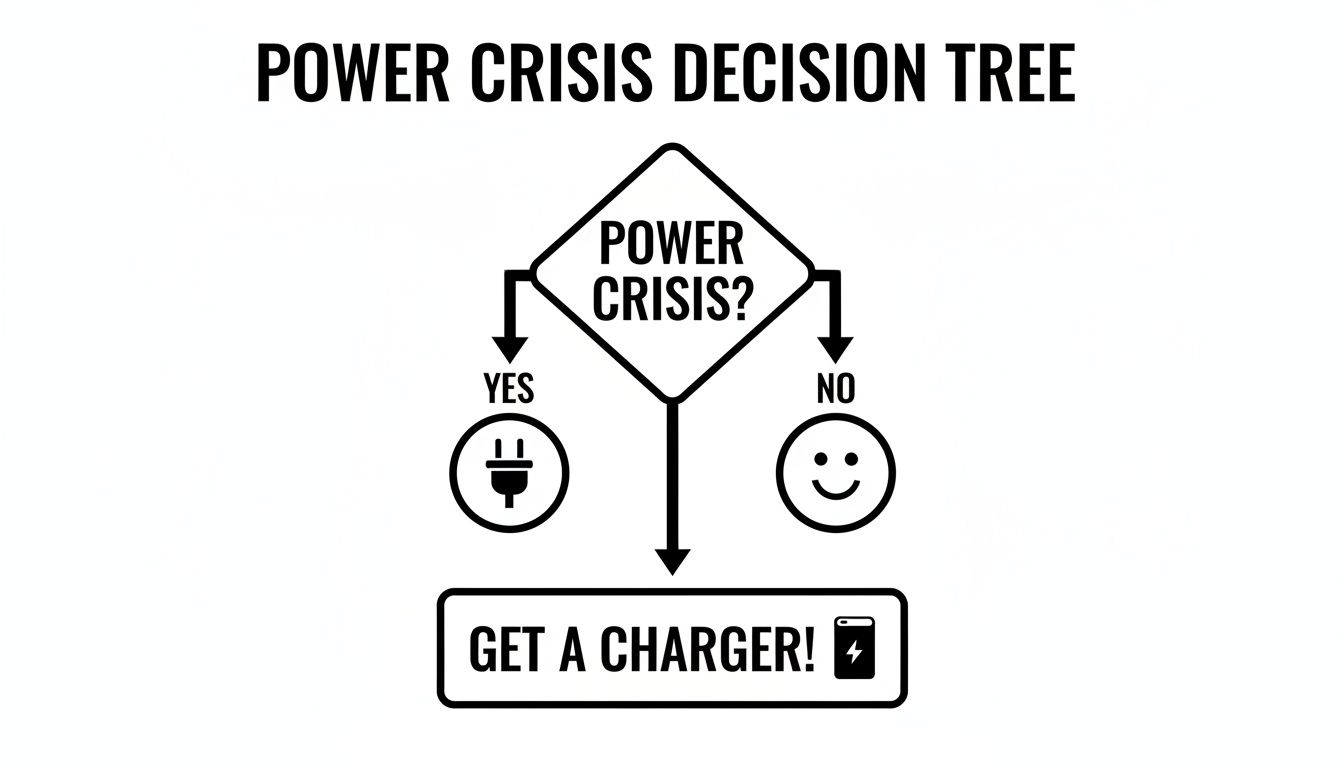
As you can see, the answer is almost always yes. A power bank is less of a "just in case" item and more of an essential piece of travel gear these days.
Understanding Capacity in the Real World
Let's get practical and translate those mAh numbers into something that actually makes sense: how many times can it charge your phone?
5,000 to 10,000 mAh: This is your lightweight, grab-and-go range. A 10,000 mAh charger is slim enough to slip into a pocket or small purse and will typically give a modern smartphone like an iPhone or Samsung Galaxy about two full recharges. It’s perfect for a long day of sightseeing or a quick weekend getaway.
10,001 to 20,000 mAh: This is the sweet spot for most people. A 20,000 mAh unit hits the perfect balance of power and portability, giving you roughly four phone recharges. It has enough juice to get you through a long-haul flight or to keep both your phone and a tablet alive during a family trip.
20,001 to 27,000 mAh: Welcome to the powerhouse category. These are for serious digital nomads, photographers, or anyone venturing off-grid. This much capacity can charge a phone several times over and even give a small laptop, like a MacBook Air, a significant boost. For heavy users who need to keep a laptop running, learning how to extend laptop battery life can make this power go even further.
To make it even easier, here’s a quick-glance table to help you line up your trip with the right charger capacity.
Choosing Your Charger Capacity by Trip Type
| Trip Type | Recommended mAh Range | Typical Recharges (for a modern smartphone) | Best For |
|---|---|---|---|
| Day Trip / Weekend | 5,000 - 10,000 mAh | 1-2 | A day out, short business trips, or as an emergency backup. |
| Week-Long Vacation | 10,000 - 20,000 mAh | 2-4 | The all-rounder for most vacations and long-haul flights. |
| International / Backpacking | 20,000 - 27,000 mAh | 4-6 | Digital nomads, off-grid adventures, or charging multiple devices. |
This table should give you a solid starting point. Just remember to account for any extra gadgets you might be bringing along, like a camera, headphones, or an e-reader.
What’s the Most Popular Size for Travelers?
If you're still undecided, it helps to see what most other travelers are choosing. The market data is pretty clear: the mid-range is king. Power banks in the 8,001–20,000 mAh class are on track to make up an estimated 69% of the market by 2025.
Why? Because it’s the do-it-all capacity that perfectly balances size with the power needed for multiple devices, making it a reliable choice for just about any trip. You can dig into the numbers yourself in this power bank market analysis.
Pro Tip: While you'll see mAh on the box, airlines and the TSA care about Watt-hours (Wh) for safety rules. Don't worry, most chargers under 27,000 mAh fall safely below the 100Wh flight limit, but it never hurts to double-check the fine print on the device itself.
In the end, choosing the best portable charger really comes down to this: match the size of your "power tank" to the length and demands of your journey.
Flying Without Fear: Navigating TSA & Airline Charger Rules
Nothing kills your travel buzz faster than a surprise holdup at the airport security line. When it comes to power banks, the rules are actually pretty straightforward, but knowing them ahead of time is the difference between a smooth takeoff and a stressful scramble.
Let’s get you through that checkpoint without a hitch.
The number one, non-negotiable rule is this: all portable chargers must fly in your carry-on luggage. Never, ever pack them in a checked bag. This is a critical fire safety rule—the lithium-ion batteries inside are a potential hazard in the unmonitored cargo hold.
Just toss your power bank in your backpack, purse, or whatever bag you're bringing on board. Easy peasy.
The 100Wh Magic Number
Here’s where a lot of people get confused. The TSA and airlines don't care about the mAh number you see advertised everywhere. They measure battery capacity in Watt-hours (Wh).
For nearly every traveler, the only figure you need to burn into your memory is 100Wh. Any power bank at or below this limit is good to go, no questions asked.
So how does that translate to the mAh ratings you’re used to?
- A 100Wh limit is roughly equal to a 27,000mAh portable charger.
- This means your standard 10,000mAh or even a hefty 20,000mAh unit is perfectly fine.
- Luckily, most chargers have the Wh rating printed right on the device, making it simple for security to check.
This generous cap covers the vast majority of power banks on the market, so you're probably already in the clear. But if you’re a photographer or videographer lugging around a monster battery for your gear, you’ll need to do a little more prep.
What About Bigger Batteries?
It's possible to bring a larger power bank, but you can't just show up with it. You'll need to get a green light from the airline before your flight.
The official FAA regulation allows for up to two larger spare batteries (100-160Wh) with airline approval. Anything over 160Wh is strictly forbidden.
One final pro tip: make sure the capacity markings (both mAh and Wh) on your charger are clearly printed and not rubbed off. If a TSA agent can’t read the label to verify its size, they have the authority to confiscate it. A legible label is a tiny detail that prevents a major headache.
Why Charging Speed and Ports Matter for Travelers
A massive battery capacity is great, but it’s only half the story. If your power bank takes all night to charge your phone, that power isn’t very useful when you have a 6 AM flight to catch.
Think of it like this: charging speed is the difference between filling a swimming pool with a garden hose versus a fire hose. Both will eventually get the job done, but one is dramatically faster and more practical for a traveler on the move.
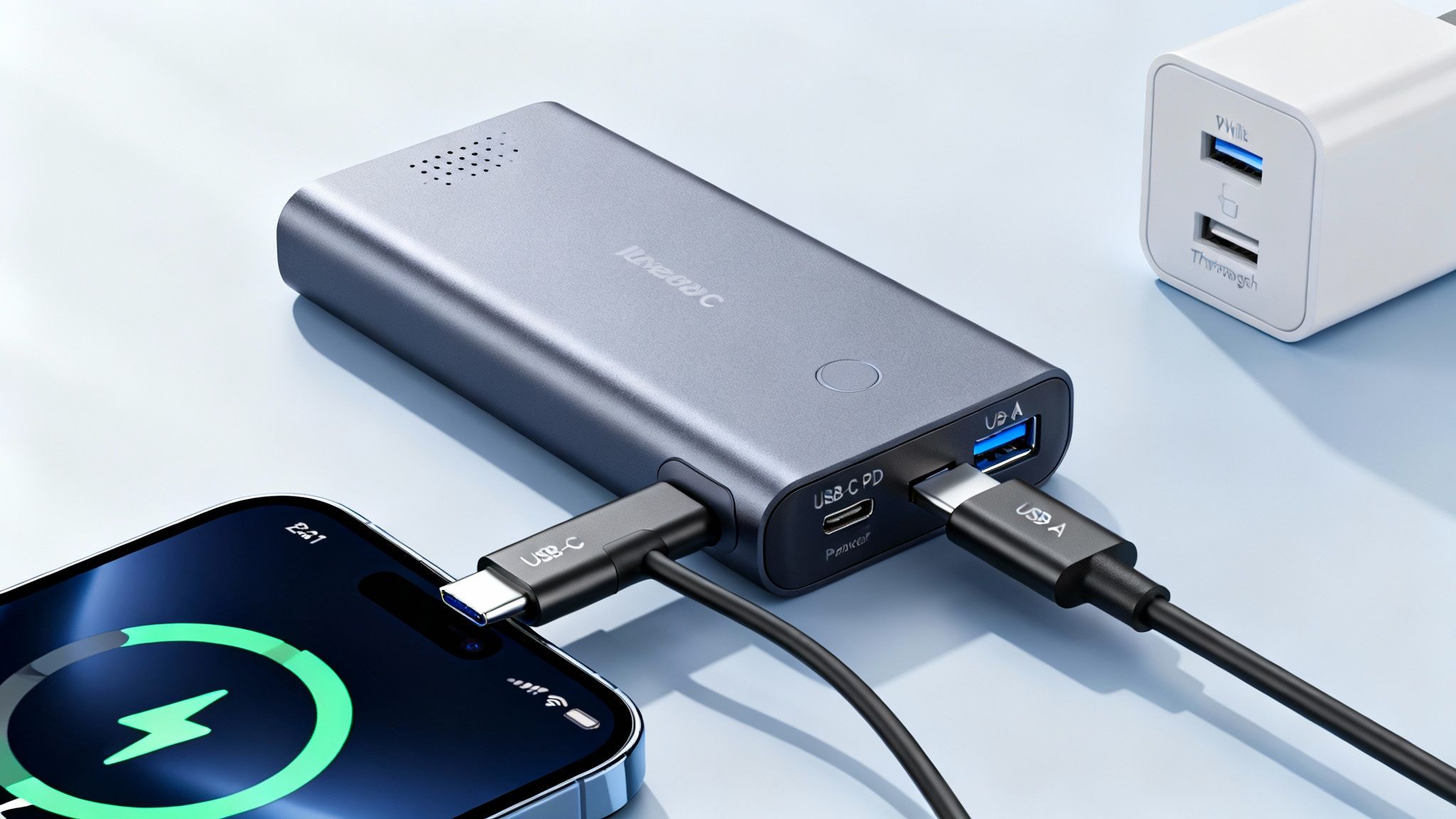
This is where a little bit of tech knowledge goes a long way. The real goal is to spend less time tethered to an outlet and more time actually enjoying your destination.
Your Fast-Charging Friend: USB-C Power Delivery
If you see one feature on a power bank’s spec sheet, make it USB-C Power Delivery (PD). This is the current gold standard for fast charging and, frankly, a non-negotiable for modern travel gear.
So, what does it actually do? In simple terms, it’s a smart charging technology that lets the power bank "talk" to your device to deliver the absolute maximum power it can safely handle.
In the real world, this means a charger with USB-C PD can rocket a new smartphone from 0% to 50% battery in about 30 minutes. That’s a total game-changer during a short layover or a quick coffee stop between sights.
It's also crucial for anything bigger than a phone. A standard, old-school USB-A port might trickle-charge a tablet or laptop, but it won't keep up if you're actually using it. USB-C PD, on the other hand, packs enough punch for phones, headphones, a Nintendo Switch, and even many laptops. For anyone who brings their work on the road, knowing how to choose the right laptop that supports USB-C charging can streamline your entire tech kit down to one or two cables.
Matching Ports to Your Gear
Having the right ports is what lets you tap into all that speed. Most good power banks today come with a mix of outputs to cover all your gadgets, old and new.
- USB-C Port: This is your high-speed lane. It handles both fast-charging your devices (output) and, just as importantly, rapidly recharging the power bank itself (input).
- USB-A Port: The classic rectangular port. It’s still handy for older accessories like smartwatches, Kindles, or anything that doesn’t need a ton of power.
Just remember, to get those blazing-fast speeds, you have to use a quality USB-C to USB-C cable connecting the PD port to your device. Plugging in an old USB-A cable will bottleneck the power and slow everything right down.
The Traveler’s Secret Weapon: Passthrough Charging
Finally, let's talk about a clever feature called passthrough charging. This is an absolute lifesaver in those hotel rooms or airport lounges with only one free outlet. It lets you charge the power bank and your devices at the same time, from a single plug.
Here's how it works: you plug your power bank into the wall, then plug your phone into the power bank. The electricity flows from the wall, through the power bank, and prioritizes charging your phone first. Once your phone is full, the power bank starts topping itself up.
This little trick means you can wake up every morning with a fully charged phone and a fully juiced-up power bank, ready for the day. It’s a small detail that makes a huge difference on the road.
Finding the Right Charger for Your Travel Style
Let's be honest, the "best" portable charger isn't a one-size-fits-all device. The perfect one for you is the one that actually matches your trip. Your travel habits are the single biggest factor in determining what you need, whether it's a tiny charger for your pocket or a beast that can power multiple gadgets for days.
Think of it like packing shoes—you wouldn't bring hiking boots for a beach trip. Let's figure out what kind of traveler you are so you can choose a power bank you'll be glad you brought along.
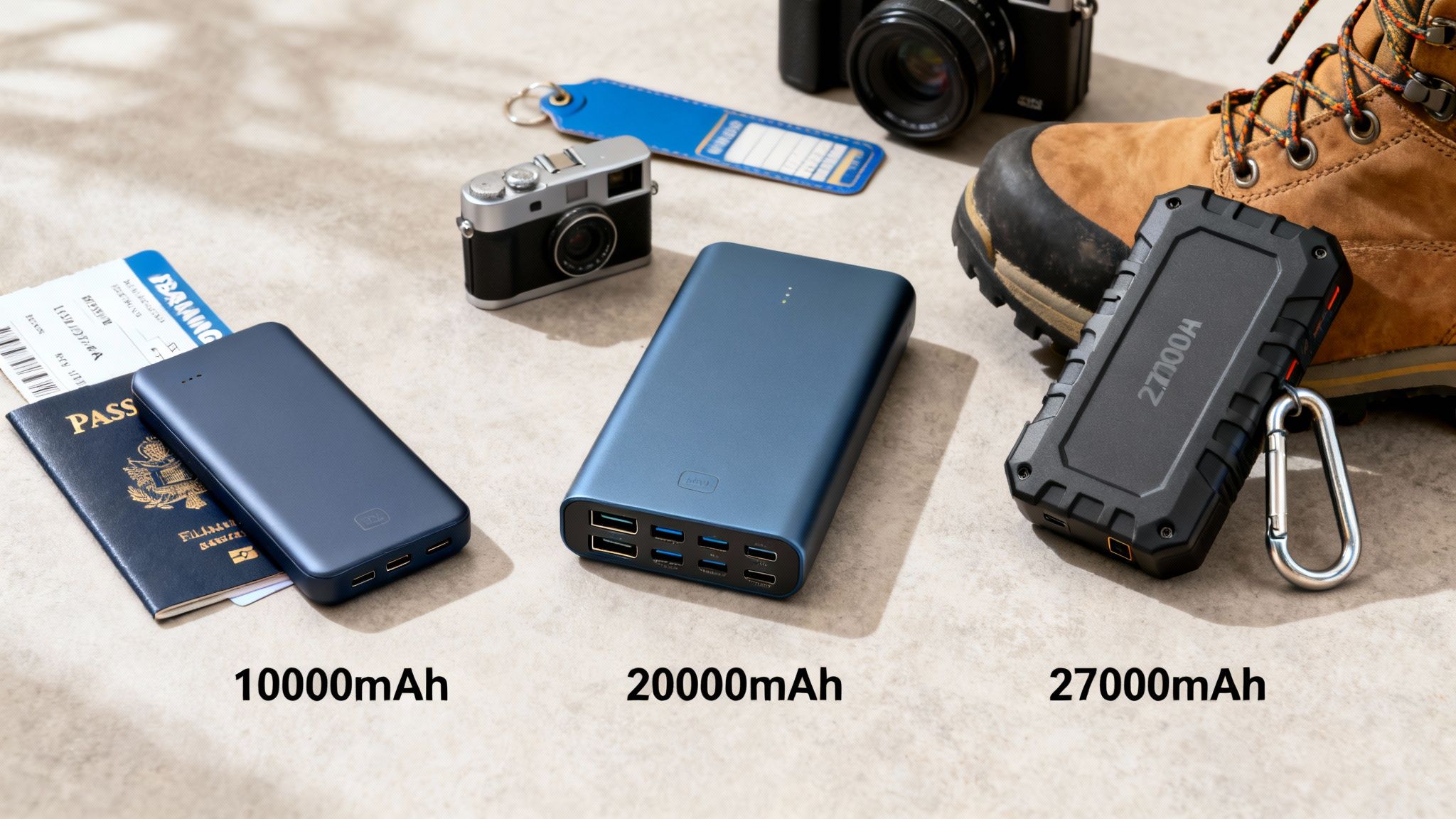
Matching the features to your itinerary means you won't get stuck carrying a heavy brick you barely touch or, even worse, a tiny charger that dies when you need it most.
The Weekend City Hopper
For quick getaways, you want to pack light and stay nimble. The last thing you need is a clunky charger weighing down your daypack while you’re trying to navigate a new city’s streets. Spontaneity is the name of the game.
- Your Ideal Charger: A slim, lightweight 10,000mAh power bank.
- Why It Works: This gives you about two full phone charges, which is more than enough to get you through a long day of using Google Maps, snapping photos, and calling Ubers. The best part? It can slide into your pocket or a small bag, and you'll forget it's even there.
- Key Feature: Portability is everything. Focus on finding the thinnest and lightest models you can.
The Long-Haul Explorer
You're the one juggling a whole ecosystem of tech—a phone, a tablet for movies, noise-canceling headphones for the flight, and maybe a camera. Your travel days are marathons, filled with long flights and big stretches of time away from a wall outlet. You need a serious workhorse.
A classic mistake for long-haul travelers is underpacking on power. One phone charge just won't cut it when your headphones need juice for a 10-hour flight and your tablet is your only source of entertainment once you land.
- Your Ideal Charger: A 20,000-27,000mAh powerhouse with multiple fast-charging ports.
- Why It Works: This much capacity can recharge a smartphone four to six times over, or top up both a phone and a tablet at the same time with plenty left in the tank. Look for multiple USB-C PD ports—they're a must for charging all your gear efficiently.
- Key Feature: High capacity and multiple outputs. Don’t compromise on these.
It's also interesting how location can play a role. The Asia-Pacific region is a hotbed for power bank innovation, expected to generate around 30% of global revenue, meaning travelers there often see the newest tech first. Meanwhile, the North American and European markets tend to prioritize safety certifications, which is a critical detail for any battery you're taking on a plane. You can discover more insights about the portable charger market.
The Off-Grid Adventurer
When you're hiking a remote trail or setting up camp far from civilization, a portable charger stops being a convenience and becomes a lifeline. It needs to be tough enough to handle the elements and provide power you can count on. Here, reliability and durability crush sleek design every single time.
To round out your tech kit for the wilderness, our wireless earbuds comparison can help you find a pair with enough battery life to last the whole trip.
- Your Ideal Charger: A rugged, high-capacity charger, sometimes with a solar panel built-in.
- Why It Works: These are built differently, often with water-resistant shells and reinforced corners to survive drops and downpours. You'll want at least 20,000mAh to make sure you have enough power to last several days off the grid.
- Key Feature: Durability is paramount. Bonus features like a built-in flashlight and weather-sealed ports are incredibly useful out there.
A Few Final Questions About Travel Chargers
Alright, even after breaking down all the technical specs, a few practical questions almost always come up. Let's run through them so you can pack your power bank with complete confidence. This is your final pre-flight checklist.
Getting these details straight is the difference between knowing the rules and knowing how to make them work for you. It’s what turns a good traveler into a great one.
Can I Bring a 20,000mAh Power Bank on a Plane?
Yes, you absolutely can. A 20,000mAh power bank is a traveler's best friend and is perfectly fine for flying. It converts to about 74Wh (Watt-hours), which is well under the 100Wh limit set by the TSA and nearly every airline worldwide.
The one non-negotiable rule? It must be in your carry-on bag. No exceptions. This is a fire safety precaution for the lithium-ion batteries inside. Just toss it in your backpack or purse, and you're good to go. Security might ask to see it, so keeping it handy is always a smart move.
How Many Charges Can I Get from a 10,000mAh Charger?
For most modern smartphones, like a recent iPhone or Samsung Galaxy, you can expect to get 1.5 to 2 full charges from a 10,000mAh unit. It's never a perfect one-to-one conversion because a little energy is always lost as heat during the transfer, but that's a solid real-world estimate.
I like to think of a 10,000mAh charger as the perfect weekend warrior. It’s got enough juice to get you through a long travel day of navigation and photo-taking, or to keep you powered up for a quick two-day trip without having to hunt for an outlet. It really is the sweet spot between power and portability.
Key Takeaway: A 10,000mAh charger isn't just for a single emergency boost. It's designed to be a reliable companion that can keep you connected for a full day or two of travel, so you never have to see that dreaded 1% battery warning.
Do I Really Need Fast Charging for Travel?
Need it? Maybe not. Will you be incredibly glad you have it? Absolutely. Fast charging technologies like USB-C Power Delivery (PD) are a game-changer on the road. They can juice up your phone from 0 to 50% in roughly 30 minutes. That's a lifesaver during a short layover or a quick coffee stop.
It’s all about spending less time chained to a wall and more time exploring. For the small price difference between a standard and a fast-charging power bank these days, the convenience is a no-brainer. It turns charging from a long, drawn-out chore into a quick pit stop.
What Is the Difference Between mAh and Wh?
This is where a lot of people get tripped up, but it's actually pretty simple when you think of it this way:
- mAh (milliamp-hours) is the size of the "gas tank" in your power bank. It's a measure of its storage capacity.
- Wh (Watt-hours) is the total energy stored in that tank. This is the number that airlines actually care about for safety.
Wh is the universal measurement because it accounts for both the capacity (mAh) and the voltage, giving a true picture of the total energy. It's the official language of flight regulations. While you're thinking about managing your devices on the go, it's also a great time to ensure your accounts are secure—learning how to use two-factor authentication is a critical step. But for your charger, all you really need to remember is the magic number for flights: 100Wh.
At Simply Tech Today, our goal is to provide clear, practical advice to help you make sense of technology. For more guides and tips designed for everyday users, explore our other articles at https://www.simplytechtoday.com.
Member discussion