Fitness Tracker vs Smartwatch What to Choose for Your Goals
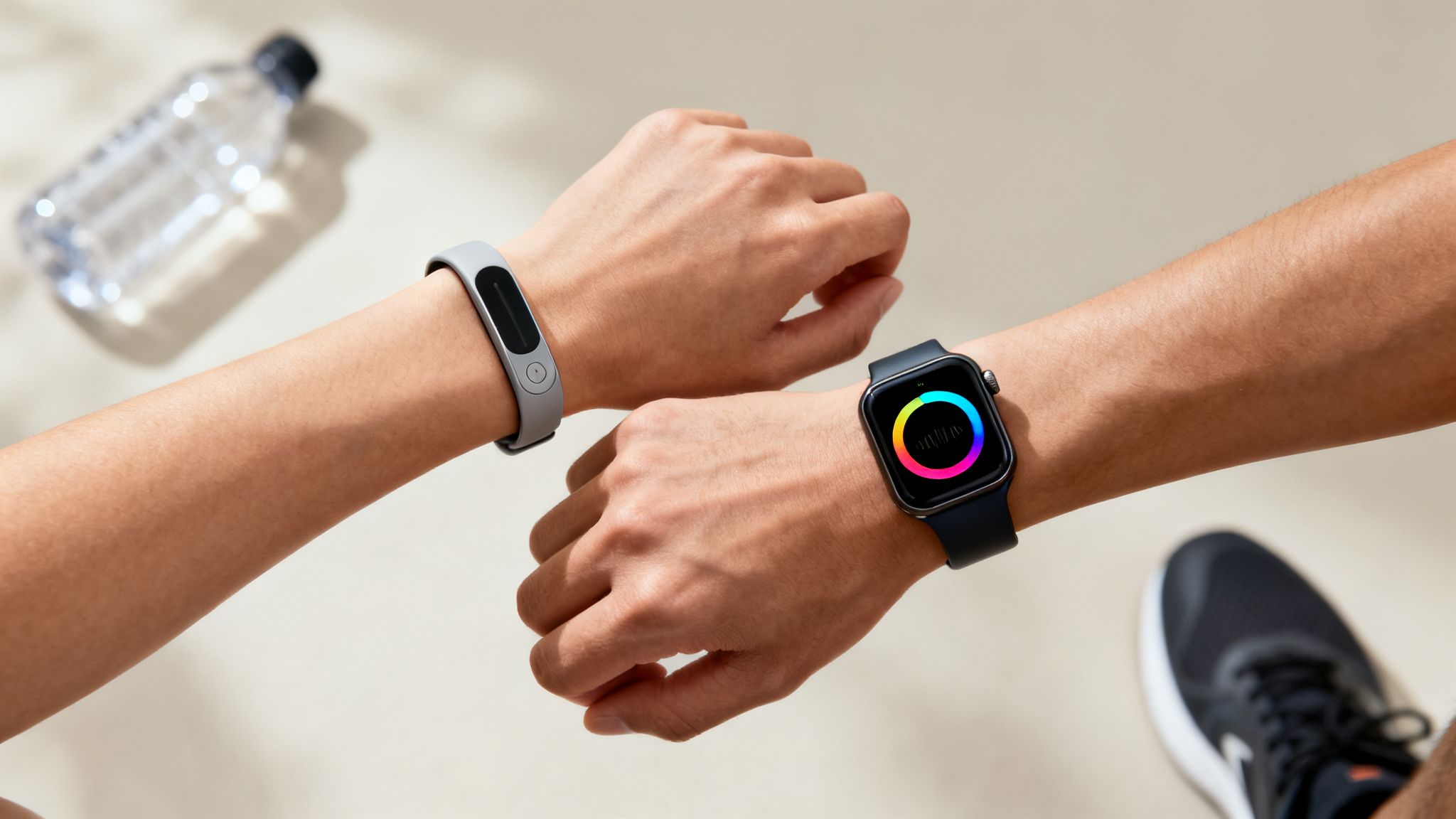
The core difference really boils down to this: a fitness tracker is a purpose-built device laser-focused on monitoring your health, while a smartwatch is essentially a mini-computer for your wrist that also has fitness features. Your decision hangs on whether you want deep, focused health data with killer battery life, or an all-in-one gadget that keeps you connected.
Your Quick Guide to Choosing the Right Wearable
Trying to pick between a fitness tracker and a smartwatch can feel overwhelming, but it really comes down to one simple question: what’s your main goal?
If you're looking to track your steps, monitor sleep patterns, and get a better handle on your overall wellness with a no-fuss, long-lasting device, a fitness tracker is probably your best bet. These gadgets are designed to do one thing and do it exceptionally well, delivering clear, straightforward health data without a lot of distractions.
But if you’re looking for a powerful extension of your smartphone that keeps you in the loop, a smartwatch is the way to go. It manages notifications, calls, music, and even contactless payments, all while packing a suite of health-tracking sensors that can easily go toe-to-toe with dedicated trackers. The compromise? You'll pay more and be charging it almost every night.
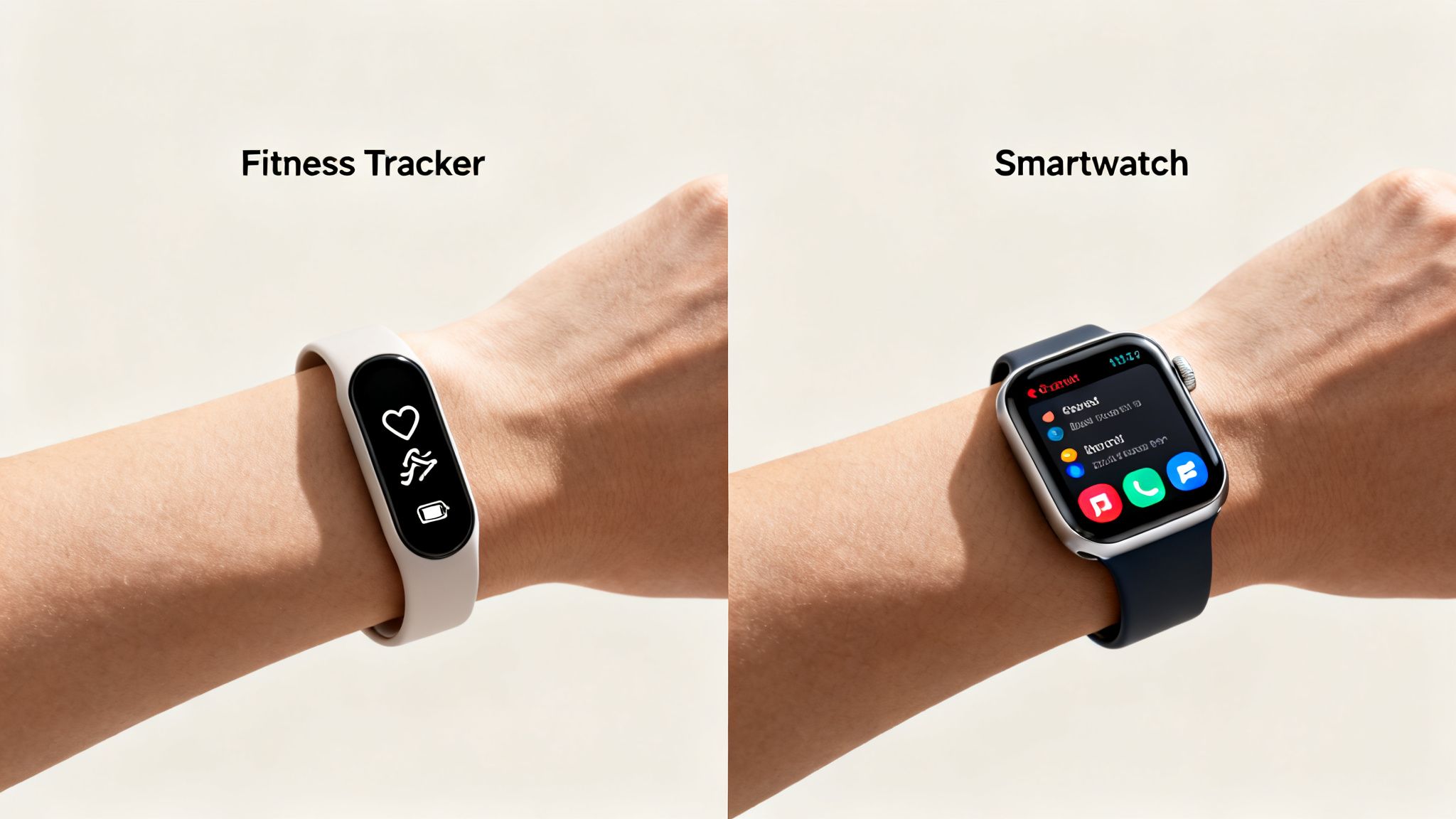
Fitness Tracker vs Smartwatch At a Glance
To cut through the noise, here's a quick side-by-side look at how these two types of wearables stack up. Think of this table as a starting point to see which category aligns best with what you need.
| Characteristic | Fitness Tracker | Smartwatch |
|---|---|---|
| Primary Purpose | Specialized health and activity monitoring | All-in-one connectivity and communication |
| Battery Life | 5 to 14+ days on a single charge | 1 to 3 days on a single charge |
| App Ecosystem | Limited to the manufacturer's health app | Access to extensive third-party app stores |
| Smart Features | Basic notifications (calls, texts) | Advanced features (payments, voice assistant) |
| Price Range | Generally more affordable ($50 - $250) | Higher price point ($200 - $800+) |
This table makes the trade-offs pretty clear. You’re essentially choosing between specialized simplicity and versatile complexity.
The best way to choose is to align the device's core strength with your daily needs. A fitness tracker excels at passive data collection, while a smartwatch excels at active interaction and connectivity.
Ultimately, the fitness tracker vs. smartwatch debate isn't about which one is superior overall—it's about which one is superior for you. Think of a fitness tracker as your dedicated health coach and a smartwatch as your do-it-all personal assistant.
A Deep Dive on Health and Fitness Tracking
When you get down to it, both fitness trackers and smartwatches log your daily activity. The real difference in the "fitness tracker vs smartwatch" debate, though, is how deep they go with the data, how accurate it is, and how they show it to you. At their core, these devices are packed with sensors, but it's what they do with that technology that truly sets them apart.
Fitness trackers are the specialists of the wearable world. They're built to master the fundamentals: steps, distance, calories burned, and sleep patterns. Inside, you'll find accelerometers that detect movement and optical heart rate sensors to keep tabs on your pulse. Their real strength is their no-fuss consistency, presenting everything in a simple, health-focused app.
Smartwatches, on the other hand, often come loaded with a more sophisticated suite of sensors. Many high-end models don't just stop at heart rate; they add sensors for Blood Oxygen (SpO2), Heart Rate Variability (HRV), and even electrocardiogram (ECG) functions to spot potential irregularities like atrial fibrillation.
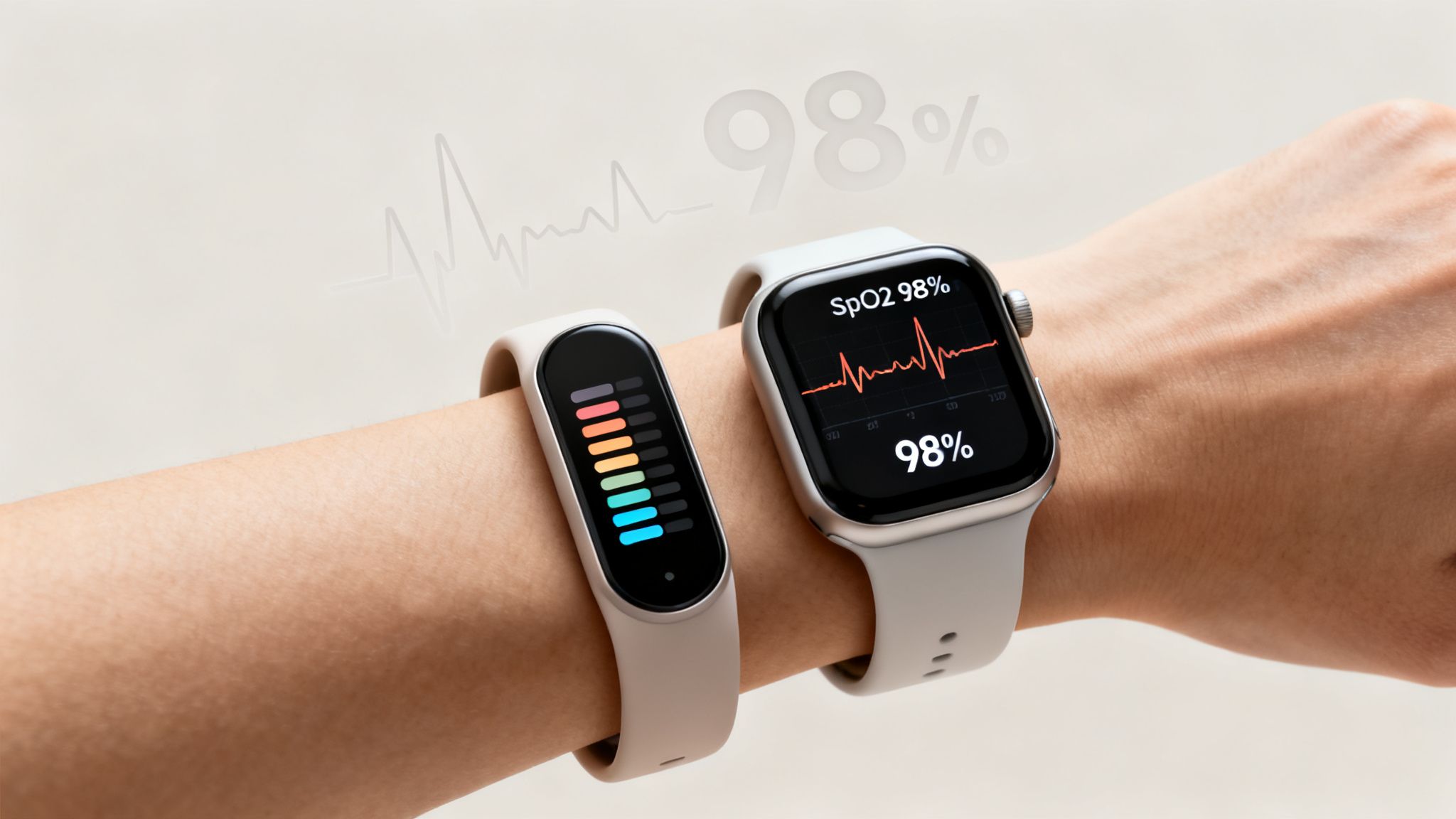
Data Presentation and Actionable Insights
This is where you'll feel the biggest difference in day-to-day use. A fitness tracker gives you clean, straightforward data, usually focused on hitting your daily goals and watching trends over time. It's designed to keep you motivated with simple, clear feedback.
A smartwatch tries to do more than just show you numbers; it wants to give you context. It weaves your health data into a bigger picture, offering more detailed analysis and genuinely useful alerts. For instance, a smartwatch might use your HRV and activity levels to create a "readiness" score, helping you decide if today is a day to push hard at the gym or take it easy and recover.
A fitness tracker tells you what your body is doing; a smartwatch helps you understand why and ties that data into the rest of your digital life.
This difference in philosophy is a big deal. For example, the running community, which lives and dies by precise tracking, is projected to command a 42.41% market share by 2026. It's a clear signal that serious health monitoring is a major reason people buy these devices.
A Tale of Two Scenarios
To really see this in action, let's look at how each device handles a couple of common situations.
Scenario 1: Tracking Your Sleep
- Fitness Tracker: A device like a Fitbit Charge will give you a solid breakdown of your sleep stages (light, deep, REM). You'll get a simple sleep score and some general tips for improvement, all neatly contained within its app. The focus is squarely on the raw data of your night's rest.
- Smartwatch: An Apple Watch or Samsung Galaxy Watch also tracks sleep stages, but it connects that information to your other health metrics. It might notice a poor night's sleep lines up with a high resting heart rate or low SpO2 levels, prompting you to think about things like stress or that late-night drink.
Scenario 2: Logging a Run
- Fitness Tracker: Most trackers will use your phone’s GPS (or their own built-in GPS) to map your route and clock your pace and distance. The post-run summary will give you the key stats: calories burned, heart rate zones, and the like. It's simple and effective.
- Smartwatch: A modern smartwatch often has more advanced GPS and heart rate sensors, which means better accuracy. It can also provide advanced running metrics like cadence, stride length, and vertical oscillation. Afterward, it seamlessly syncs this rich data to apps like Strava and might even offer personalized coaching tips based on your performance.
Medical Features vs. Wellness Monitoring
A critical distinction has emerged lately: the line between general wellness tracking and medical-grade monitoring. Since both devices collect very personal information, it's smart to know how that data is used. You can learn more in our guide on how to protect your privacy online.
Fitness trackers are firmly in the wellness camp. They offer fantastic insights into your general health trends but are not built or approved to diagnose medical conditions.
In contrast, many premium smartwatches have earned regulatory clearance (like FDA approval in the U.S.) for specific features, such as their ECG and irregular heart rhythm notifications. This elevates them to more powerful health tools, capable of generating data you can actually share with your doctor. For anyone with specific health concerns, this is a game-changer.
Understanding Battery Life and Daily Usability
When you're trying to decide between a fitness tracker and a smartwatch, battery life is often the one thing that tips the scales. It's a huge deal. It's the difference between a wearable that seamlessly fits into your life and one that feels like just another gadget you have to babysit.
The fundamental trade-off is simple: one is built for endurance, the other for power.
Fitness trackers are the marathon runners of the wearable world. Their simpler screens and laser-focused feature sets mean they are incredibly power-efficient. You can often go 5, 10, or even 14+ days on a single charge. For a lot of people, this "set it and forget it" freedom is the main reason they choose a tracker.
Smartwatches, on the other hand, are the sprinters. Those brilliant, high-resolution screens, powerful processors juggling apps, and constant Bluetooth connection to your phone are thirsty for energy. Because of this, you'll find most smartwatches need to be charged every 1 to 3 days. Many just become part of a nightly charging routine, right alongside your phone.
How Features Impact Your Charge
What you do with your device has a massive impact on its battery. The advertised battery life is just a baseline—your real-world mileage will absolutely vary based on your habits.
Here are the biggest battery killers to watch out for:
- GPS Tracking: Firing up the built-in GPS for a run or bike ride is one of the most demanding tasks for any wearable. A single one-hour GPS-tracked workout can chew through a huge chunk of a smartwatch's daily battery.
- Always-On Display: It’s great to be able to glance at your watch face anytime, but keeping that screen lit 24/7 constantly sips power. This feature alone can easily cut a smartwatch’s battery life in half.
- Cellular Connectivity: Having a cellular-enabled smartwatch is liberating for phone-free workouts, but maintaining that independent connection is a major power drain.
- Frequent Notifications: Every little buzz, ding, and screen wake-up uses a tiny bit of energy. Over the course of a day, those hundreds of notifications really add up.
This is where you see the practical difference in real-time. A basic tracker logging steps and sleep might last two weeks, but a one-hour run using your phone's GPS might still knock a noticeable amount off its charge. A full-featured smartwatch, however, could easily lose 15-20% of its battery from that exact same run. If you're a power user who's often on the move, you might want to look into the best portable chargers for travel to keep your gear topped up.
Choosing between a fitness tracker and a smartwatch is often a choice between convenience (less charging) and capability (more features).
A Real-World Comparison
Let's paint a picture of two different users at the end of a typical day.
Our first user is wearing a fitness tracker. They've been getting text alerts, tracking their steps all day, and wore it to sleep last night to monitor their rest. After several days, they glance down and see their device is still sitting comfortably above 80% battery.
Our second user has a smartwatch. They've replied to messages from their wrist, used GPS for a morning walk, streamed a playlist to their earbuds, and paid for coffee with a tap. By the evening, their watch is flashing a low-battery warning—it's probably under 20% and definitely needs to be charged overnight.
Ultimately, it comes down to what you're willing to put up with. If you can't be bothered with a daily charging routine and just want something that works with minimal fuss, a fitness tracker’s incredible stamina is tough to beat. But if you want all the bells and whistles and don't mind plugging it in each night, a smartwatch delivers a much more powerful experience.
Comparing Smart Features and App Ecosystems
Beyond counting steps and tracking sleep, the real dividing line in the fitness tracker vs smartwatch debate is how each device plugs into your digital life. This is where smartwatches sprint ahead, evolving from a simple health monitor into a full-blown command center on your wrist.
Think of it this way: a fitness tracker keeps you in the loop with your body, but a smartwatch keeps you connected to your world.
A modern smartwatch is built to be a miniature version of your phone. You can glance at and respond to messages, answer calls right from your wrist, and summon a voice assistant like Siri or Google Assistant for quick questions. Many also come standard with contactless payments through Apple Pay or Google Pay, which is a lifesaver when you're out for a run and want to grab a coffee without your wallet.
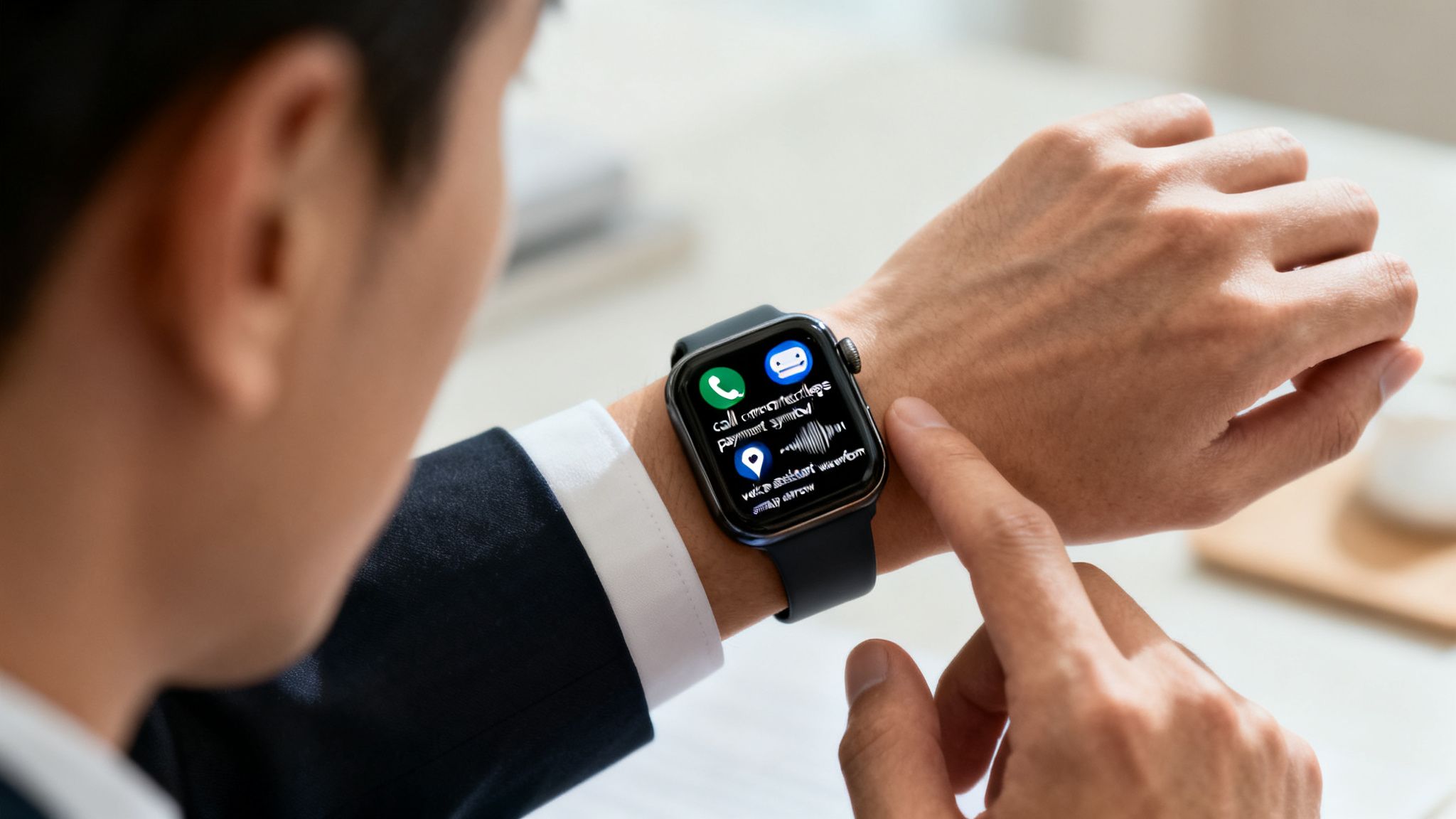
Fitness trackers, on the other hand, take a more streamlined approach. Their job is to deliver essential alerts without becoming a distraction. You’ll usually get notifications for incoming calls, texts, and calendar reminders, but the interaction stops there. You can see who’s calling, but you’ll have to pull out your phone to answer.
The Power of Third-Party Apps
The single biggest game-changer is the app ecosystem. Smartwatches from the big players—Apple, Google (with Wear OS), and Samsung—have dedicated app stores, and that opens up a universe of functionality.
This means you can download and install apps directly onto the watch. Here's what that looks like in the real world:
- Navigation: Getting turn-by-turn walking directions from Google Maps on your wrist in a new city.
- Music: Streaming a Spotify playlist directly to your wireless earbuds, leaving your phone at home during a workout.
- Productivity: Checking off items on your Todoist list or seeing your next meeting at a glance.
- Smart Home: Toggling your smart lights or adjusting the thermostat with a tap.
This is all made possible by powerful onboard processors and storage. It's a concept explored in our guide on what is edge computing, which explains how these tiny devices can process so much data locally. Fitness trackers don't have app stores, so you're limited to whatever features the manufacturer built into their software.
A smartwatch is a platform, inviting developers to build new experiences. A fitness tracker is a closed system—polished and reliable, but ultimately limited to what comes in the box.
This app advantage is a huge reason people stick with a particular brand. Among fitness buffs, 45% already use smartwatches for tracking their activity, and Apple’s tight ecosystem has helped it achieve a 33% adoption rate among all smartphone users. The seamless dance between your phone, watch, and apps creates an experience that a dedicated tracker just can't match.
Smart Feature Showdown
To really see the difference, let’s put the smart capabilities of these devices head-to-head. This table cuts through the noise and shows the gap in functionality, making it clear why the "fitness tracker vs smartwatch" decision so often boils down to how connected you need to be.
| Smart Feature | Fitness Tracker | Smartwatch |
|---|---|---|
| Notifications | View calls, texts, app alerts | View, manage, and reply to all notifications |
| App Store | No third-party apps | Full access to an app store (e.g., App Store, Google Play) |
| Voice Assistant | Not available | Integrated (Siri, Google Assistant, Bixby) |
| Contactless Payments | Rare, on high-end models | Standard feature (Apple Pay, Google Pay) |
| Music Control | Basic (play/pause phone music) | Onboard music storage and streaming |
| Answering Calls | Not available | Answer and make calls from the wrist |
| Cellular Option | Not available | Available on select models for phone-free use |
Ultimately, a fitness tracker gives you a passive window into your digital world, while a smartwatch offers an interactive doorway. If all you need is a buzz to let you know a call is coming in while you’re at the gym, a tracker is a perfect fit. But if you want to manage your inbox, control your music, and pay for a post-run smoothie without reaching for your phone, only a smartwatch will get the job done.
Price, Value, and the Long-Term Cost
The price tag is usually the first stop when you’re deciding between a fitness tracker and a smartwatch, but it’s really just the tip of the iceberg. What you’re actually paying for is a combination of hardware, software, and sometimes, ongoing services. To make a smart choice, you need to look past the initial cost and think about the device's real value over time.
Fitness trackers are definitely the more budget-friendly option, with most models falling somewhere between $50 and $250. On the lower end, you get solid, no-nonsense devices that nail the essentials—think step counting, basic sleep analysis, and heart rate monitoring. As you creep toward the $250 mark, you'll find trackers that start to blur the lines, adding features like on-board GPS and SpO2 sensors for blood oxygen.
Smartwatches pick up where high-end trackers leave off. Their pricing typically starts around $200 and can soar past $800 for premium models. Even an entry-level smartwatch gives you a full-color display, app notifications, and all the core fitness features. The more you spend, the more you get: advanced health sensors like ECG, a richer app ecosystem, and premium build materials. Big price jumps are often tied to cellular connectivity, which lets you leave your phone behind entirely.
What Are You Really Getting for Your Money?
True value isn't just about the upfront cost; it's about how long the device will last and how well it will serve you down the road. This comes down to durability, software support, and any sneaky costs hiding in the fine print.
A well-made device can easily last for years, which makes that initial investment feel a lot more palatable. Most trackers are built to be tough, using durable plastics and silicone that can handle a beating. High-end smartwatches often use more premium materials like stainless steel or sapphire glass, which adds to the cost but also gives them an edge in scratch resistance.
Don't forget about software updates. Consistent updates from the manufacturer are what keep your device feeling fresh and secure. They add new features, fix bugs, and patch security holes, effectively extending the lifespan of your wearable. Big names like Apple, Samsung, and Garmin are known for supporting their devices with updates for years, which is a huge factor in long-term value.
The best value isn't always the cheapest option. It's the device you'll actually want to wear every day—the one that helps you hit your goals.
The Hidden Cost: Subscription Fees
There's a growing trend you need to watch out for: the subscription model. Some brands sell you the hardware, then ask you to pay a monthly fee to unlock the device's best features.
This is a massive point of difference between many fitness trackers and smartwatches. Companies like Fitbit and Oura have built entire ecosystems around premium subscriptions that provide deep-dive analytics, personalized coaching, and guided workout programs. A $10 per month fee might not sound like much, but that’s an extra $120 a year on top of what you already paid for the device. For some, the extra insights are well worth it, but it's an ongoing cost you have to budget for.
On the other hand, major smartwatch platforms from Apple and Google (Wear OS) typically bake all their core health and fitness tracking features into the initial price. You might pay for some third-party apps, but you won't be charged a recurring fee just to see your own health data. This makes the total cost of ownership for a smartwatch much more predictable. Before you click "buy," always double-check if the features you're most excited about are tucked away behind a paywall.
Finding the Right Device for Your Lifestyle
Deciding between a fitness tracker and a smartwatch isn't about which one is "better." It's about finding the right companion for your life. The best way to settle the debate is to honestly look at your daily routines and what you really need a wearable to do for you.
To help with that, I've broken down a few common user types. See which one sounds most like you. By matching your real-world needs to a device's strengths, you can look past the marketing hype and choose something that genuinely fits.
The Health-Conscious Beginner
You're just dipping your toes into the world of wellness. The goal isn't to break records; it's to get more active, sleep a little better, and build some healthy habits that stick. You don't need a supercomputer on your wrist—just a simple, encouraging nudge in the right direction.
- What you really need: Step counting, basic sleep analysis, continuous heart rate monitoring, and maybe a few reminders to get up and move.
- A typical day: You're walking more, trying some light exercise, and you're curious about your health trends without wanting to get lost in a sea of data.
- The deal-breaker: Battery life. You need something you can wear for days without thinking about it, so you can focus on your new habits, not on finding a charger.
For this person, a fitness tracker is the clear winner. Something like a Fitbit Inspire or Garmin Vivosmart gives you all the core data you need in a super simple format. With a battery that lasts a week or more, it just fades into the background of your life, offering gentle encouragement without any fuss.
The Dedicated Athlete
Training isn't just a hobby; it's a huge part of your life. Whether you're a marathoner, cyclist, or triathlete, you live for the data. You need precise metrics, deep analytics, and a device that can withstand grueling, long-haul workouts.
- What you really need: Incredibly accurate GPS, advanced running or cycling dynamics (like cadence and stride length), heart rate zone tracking, and smart recovery advice.
- A typical day: Involves structured training, outdoor sessions, and pouring over post-workout data to see where you can improve.
- The deal-breaker: Durability and seamless integration with third-party apps like Strava are absolutely essential.
In this corner, a high-end, sport-focused smartwatch like a Garmin Forerunner or an Apple Watch Ultra is the only real option. These watches pack far more accurate sensors and specialized workout modes than any fitness band. The performance insights they offer are what you need to find that competitive edge.
The Busy Professional
Your calendar is a Tetris game of meetings, deadlines, and emails. You want to stay healthy, but you need a device that helps you stay productive and connected without being glued to your phone. For you, efficiency is everything.
- What you really need: Flawless notification handling, calendar alerts you won't miss, contactless payments, and the option to take a quick call from your wrist.
- A typical day: You're bouncing from the office to meetings and hopefully to the gym. A versatile tool that works in every setting is key. Music on the go is also a must; for that, our guide on the best wireless earbuds can help you find the perfect pair.
- The deal-breaker: The device has to feel like an extension of your digital life—a personal assistant that also tracks your steps.
For this user, a smartwatch isn't just a health device—it's a productivity tool. The ability to triage notifications and manage tasks from the wrist is a game-changer for a packed schedule.
For the Busy Professional, a full-featured smartwatch like a Samsung Galaxy Watch or an Apple Watch is the obvious choice. It's an indispensable gadget for managing a chaotic day, with the ability to handle communications, payments, and apps. The fact that it also has powerful fitness tracking is the perfect bonus, helping you fit wellness into a life that's already full.
Common Questions About Fitness Trackers and Smartwatches
Making the final call between a fitness tracker and a smartwatch usually boils down to a few specific questions. Let's tackle the most common ones to clear up any lingering confusion and help you choose with confidence.
Sometimes, a quick visual can make all the difference. This decision tree cuts through the noise and shows you which path makes the most sense based on what you truly value.
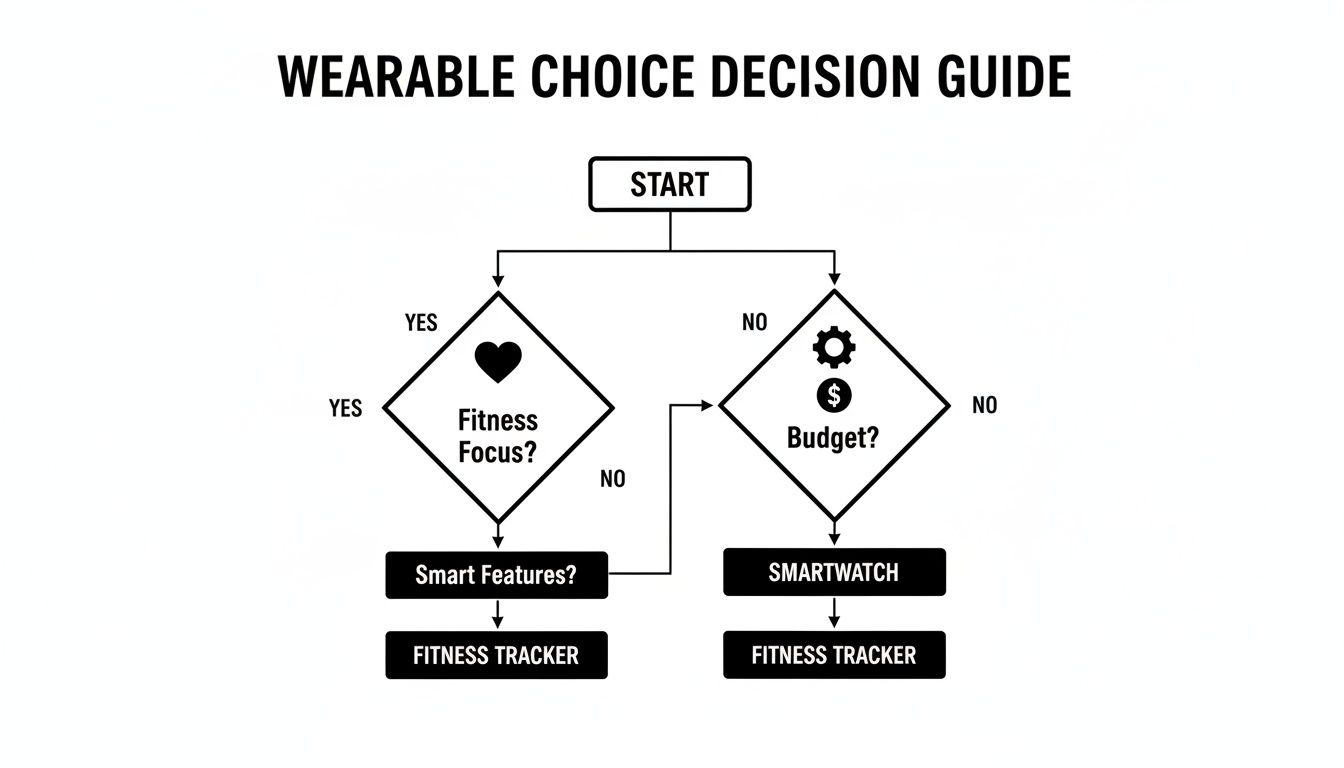
As you can see, if your world revolves around fitness metrics and you're keeping an eye on your budget, a fitness tracker is a no-brainer. But if you need a true extension of your phone on your wrist, you’re headed straight for a smartwatch.
Which One Is More Accurate?
This is a classic question, but the answer isn't about device type—it's about quality and cost. A premium smartwatch from a tech giant like Apple or Garmin is almost always packed with more sophisticated heart rate and GPS sensors than a cheap fitness band.
That said, a high-end tracker from a specialized brand like Fitbit can easily hold its own, delivering just as much accuracy for core stats like step counts and sleep stages. For everyday wellness, both are perfectly capable. When you get into medical-grade territory like ECG monitoring, however, only specific smartwatches with regulatory approval offer that level of validated data.
The biggest factor in accuracy isn’t the device category but the quality of its sensors. A $300 tracker will likely outperform a $150 smartwatch in health tracking precision.
Can I Use a Smartwatch Without a Smartphone?
Yes, but it's a very limited experience. Most smartwatches lean heavily on a paired smartphone for the initial setup and for most of their features to actually work. A GPS-only model can track your run just fine without your phone, but you won't get any notifications, use apps, or stream music until you're reconnected.
The exception is a cellular-enabled smartwatch. These models give you the freedom to make calls, send texts, and use data-dependent apps completely untethered from your phone. Just be prepared for a higher upfront cost and a noticeable hit to your daily battery life.
What if I Have an iPhone but Don't Want an Apple Watch?
You definitely have options, but the experience just won't be as slick. Well-respected brands like Garmin and Fitbit make excellent smartwatches that are fully compatible with iPhones, and their companion apps are solid.
What you'll miss is that deep, almost magical integration that Apple creates within its ecosystem. Things like replying to iMessages directly from your wrist or having your Mac unlock automatically as you approach are exclusive to the Apple Watch. On a related note, if you're switching things up and need to unpair an old device, our guide on how to remove an Apple Watch from your iPhone has some helpful pointers.
Member discussion