
A Tech-Powered Guide on How to Focus While Studying
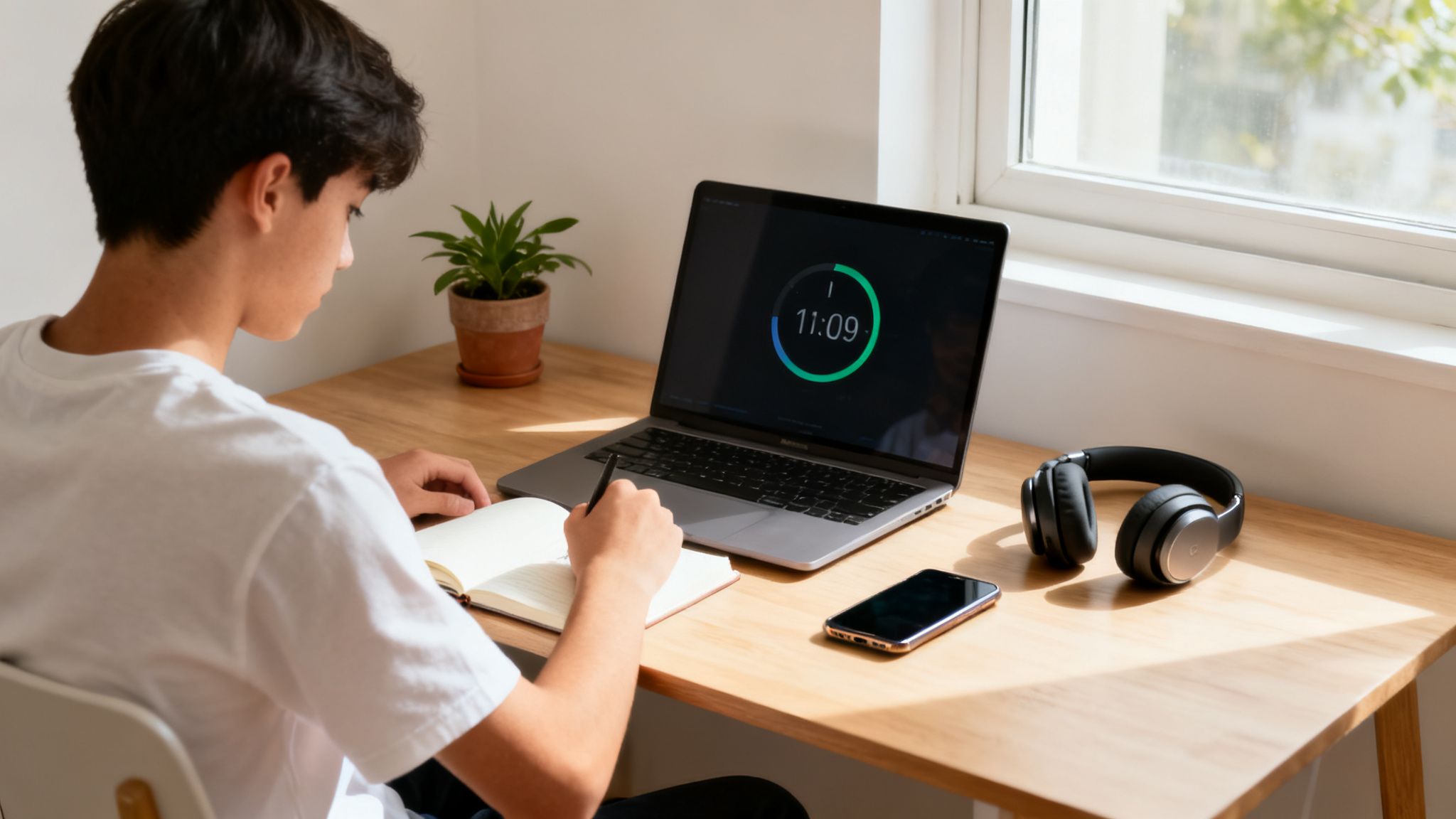
If you really want to focus while studying, you need a solid game plan. It’s not just about willpower; it’s about creating a system that sets you up for success. The magic formula combines a distraction-free space with smart time management and a little help from technology. This isn't about massive life changes, but small, intentional shifts that turn chaotic cramming into productive, focused work.
Your Blueprint for Unbreakable Study Focus
Let's be honest, in a world buzzing with notifications and endless online rabbit holes, deep concentration can feel like a superpower. The good news? It's a skill you can build. Forget the idea that you need to overhaul your entire life. Instead, we'll focus on a simple, three-part system you can put into action immediately.

The Three Pillars of Study Focus
Think of your concentration like a stool with three legs. If one is wobbly, the whole thing tips over. But when all three are strong, you've got a rock-solid foundation for getting things done.
- Shape Your Environment: Your brain is constantly taking cues from what's around you. A messy desk piled high with stuff? That signals chaos and overload. A clean, organized space—both physical and digital—tells your brain, "Okay, it's time to work." It instantly cuts down on mental clutter.
- Command Your Time: Trying to stare at a textbook for three hours straight is a surefire way to burn out. Instead, break it down. Techniques like the Pomodoro method, where you work in focused 25-minute sprints, help manage your energy and make intimidating tasks feel much more doable.
- Wield Technology Wisely: Your phone and laptop can be your worst enemies or your best friends. Using an app to block distracting websites or putting your phone on "Do Not Disturb" isn't a crutch; it’s a strategic move to guard your most valuable resource—your attention.
By putting these three elements together, you stop hoping for focus and start creating it. A tidy desk, a silent phone, and a timer create a powerful force field against distraction.
This framework shifts studying from a frustrating battle against interruption into a controlled, productive flow. Building these habits won't just help you ace your next exam; they lay the groundwork for a more effective morning routine for productivity that you can apply to any goal you set.
To get started right away, here's a quick cheat sheet that pulls these core ideas together.
Immediate Focus-Boosting Framework
| Strategy Area | Actionable Step | Tech Tool Example |
|---|---|---|
| Environment | Clear your physical desk of everything but the essentials. | Use a minimalist desktop background to reduce digital clutter. |
| Technique | Start with one 25-minute Pomodoro session. | A simple kitchen timer or a browser-based one like TomatoTimer. |
| Technology | Put your phone in another room or turn on "Focus Mode." | Use a site-blocking app like Freedom or Cold Turkey. |
Think of this table as your emergency "get focused now" kit. When you feel your attention slipping, just run through these three simple checks to get back on track.
Engineer Your Distraction-Free Study Zone
Think about it: your brain is constantly taking cues from your surroundings. A messy desk piled high with last week's laundry and random gadgets basically screams "do anything but study." But a clean, organized space? That tells your brain it's time to get down to business. Setting up your study zone isn't about becoming a minimalist decorator; it's about deliberately removing anything that gets between you and the work.

The first step is tackling the physical stuff that trips you up. You'd be surprised how much of a difference a few small tweaks can make.
For example, bad lighting is a classic energy vampire. It strains your eyes and makes you feel tired before you've even started. If you can, set up your desk near a window to get some natural light. For late-night sessions, a good desk lamp is a must-have to keep your space feeling bright and focused.
Control Your Sensory Inputs
Noise is another huge focus-killer. If you live in a loud dorm or have a bustling family, managing what you hear is absolutely essential. Noise-canceling headphones are a game-changer, but you don't need to break the bank to get some peace and quiet.
- White Noise Apps: I'm a big fan of apps like Noisli or myNoise. They can play background sounds like rain or a coffee shop buzz that effectively drown out distracting chatter.
- Instrumental Playlists: Music can be a great study buddy, but lyrics can easily pull you out of the zone. Try listening to classical, lo-fi beats, or ambient electronic tracks to help you concentrate.
- Strategic Silence: Sometimes, the best soundtrack is none at all. A simple pair of high-quality earplugs can be just as powerful as fancy tech. If you are in the market for headphones, our guide on wireless earbuds comparison can help you find pairs with solid noise isolation.
The goal here is to make your sensory environment predictable and calm. When your brain isn't jumping at every little sound or straining to see in the dark, it frees up a ton of mental energy for actual learning.
Build a Digital Fortress
Let's be real—your digital world is probably just as cluttered as your physical one. Notifications are literally designed to steal your attention, and a desktop covered in game icons is a minefield of temptation. The solution is to build a digital fortress around your study time.
A great place to start is by creating a dedicated "study mode" on your phone. iOS Focus and Android's Digital Wellbeing are perfect for this. You can program them to block notifications from everything except your most essential apps during your study blocks. It's a simple way to remove the temptation before it even starts.
Here’s a pro tip that has saved me countless hours: create separate user profiles on your computer. Set up a "Study" profile with a totally clean desktop, bookmarks only for research sites, and no distracting apps. Then, have a "Leisure" profile for everything else. The act of switching profiles creates a powerful mental shift, making it much harder to just mindlessly click over to YouTube when you should be writing that essay.
Master Time with Proven Focus Techniques
Staring at a massive textbook or a semester's worth of notes can feel completely paralyzing. The problem isn't usually the amount of work, though—it's how we approach it. Ditching the all-night study marathons for a more structured approach is the key to working smarter, not just cramming harder.
These methods are all about creating a sustainable rhythm. By breaking your work into deliberate, focused intervals, you give your brain the structure it needs to stay sharp, sidestep burnout, and actually remember what you've studied.
The Power of the Pomodoro Technique
One of the best-known and most effective strategies is the Pomodoro Technique. It couldn't be simpler: you work in a hyper-focused 25-minute sprint, then take a quick 5-minute break. After four of these "Pomodoros," you reward yourself with a longer break, maybe 15-30 minutes.
The magic here is in its forced single-tasking. For 25 minutes, you give one task your undivided attention—no email, no phone, no distractions. The short breaks are just enough time for a mental reset, which keeps the fatigue that tanks your concentration at bay. It's a fantastic way to train your attention span and make huge projects feel much more approachable.
The real genius of the Pomodoro Technique is that it respects your brain's natural limits. It treats focus as a finite resource and builds in recovery time to keep you performing at your best.
Schedule Your Success with Time-Blocking
While Pomodoro is great for managing your sprints, time-blocking is how you manage your day. This is where you schedule study sessions into your calendar as if they were appointments you absolutely can't miss.
Instead of a vague to-do list item like "Study for chemistry," you’d block out "7:00 PM - 8:30 PM: Review Chapter 4 Chemistry Notes & Flashcards" in your Google Calendar or Notion. This simple act creates a powerful sense of commitment. It cuts out the mental gymnastics of deciding what to work on next and walls off your study time from other demands.
This isn't just a hunch; it's a globally validated approach. The 2023 TIMSS results, which track academic achievement across 64 countries, showed a direct link between focused study habits and better performance. The data revealed that students with consistent, focused habits—like daily 30-minute review sessions—had scores that were 15-20% higher. You can dig into the full TIMSS 2023 results to see how structured time management makes a real difference.
Pair Your Techniques with Technology
To get the most out of these methods, you have to pair them with the right tools. Think of apps like Forest or Focus Booster as your digital enforcers for Pomodoro sprints. Forest, for example, gamifies the whole process by growing a virtual tree while you focus—if you exit the app to get distracted, your tree dies. It's surprisingly effective.
This blend of a proven technique and modern technology creates a powerful system for deep concentration. And if you're really serious about reclaiming your time, you might also want to check out our guide on how to automate repetitive tasks. By structuring your time and using smart tools to hold yourself accountable, you finally take back control of your focus.
Choosing the Right Apps to Block Distractions
Your phone and laptop can be your worst enemy or your best ally in the battle for focus. Let's be honest, they're designed to grab your attention. But with the right strategy, you can turn these distraction machines into powerful tools that actually protect your concentration.
Think of these apps as your personal focus-enforcement squad. They aren't just about blocking notifications; they're about helping you build the habit of deep work until it becomes second nature.
Aggressive Blockers for Deep Focus
There are times when you just can't afford a single distraction. Think finals week, or the night before a huge paper is due. This is when you need to call in the heavy artillery.
Apps like Freedom and Cold Turkey are the digital equivalent of a deadbolt on your door. You tell them which websites and apps are your personal kryptonite—social media, news sites, you name it—and they block them completely. No loopholes. You can even schedule recurring blocks to align with your study calendar, like automatically locking down social media every weekday from 9 AM to 5 PM.
Gamified Timers for Motivation
Sometimes, the problem isn't just temptation; it's a lack of motivation. If you find yourself struggling to even start, turning focus into a game can make all the difference.
Forest is the classic example here. You plant a virtual seed when you start a study session. As long as you stay in the app and off your phone, your seed grows into a tree. The moment you switch to Instagram or get lost in a YouTube rabbit hole, your little tree withers away. It's a simple psychological trick, but that small desire not to kill your tree is surprisingly effective at keeping you on task.
This approach is more relevant than ever. A 2023 global survey by Chegg.org revealed that while 40% of students use AI for their studies, 47% worry about inaccurate information, which can break their concentration. To combat this, many are turning to apps like Forest, boosting their focus session times by an average of 25-30%. You can explore more of these findings in the global student survey.
The infographic below shows how techniques like these work together to build a rock-solid study routine.
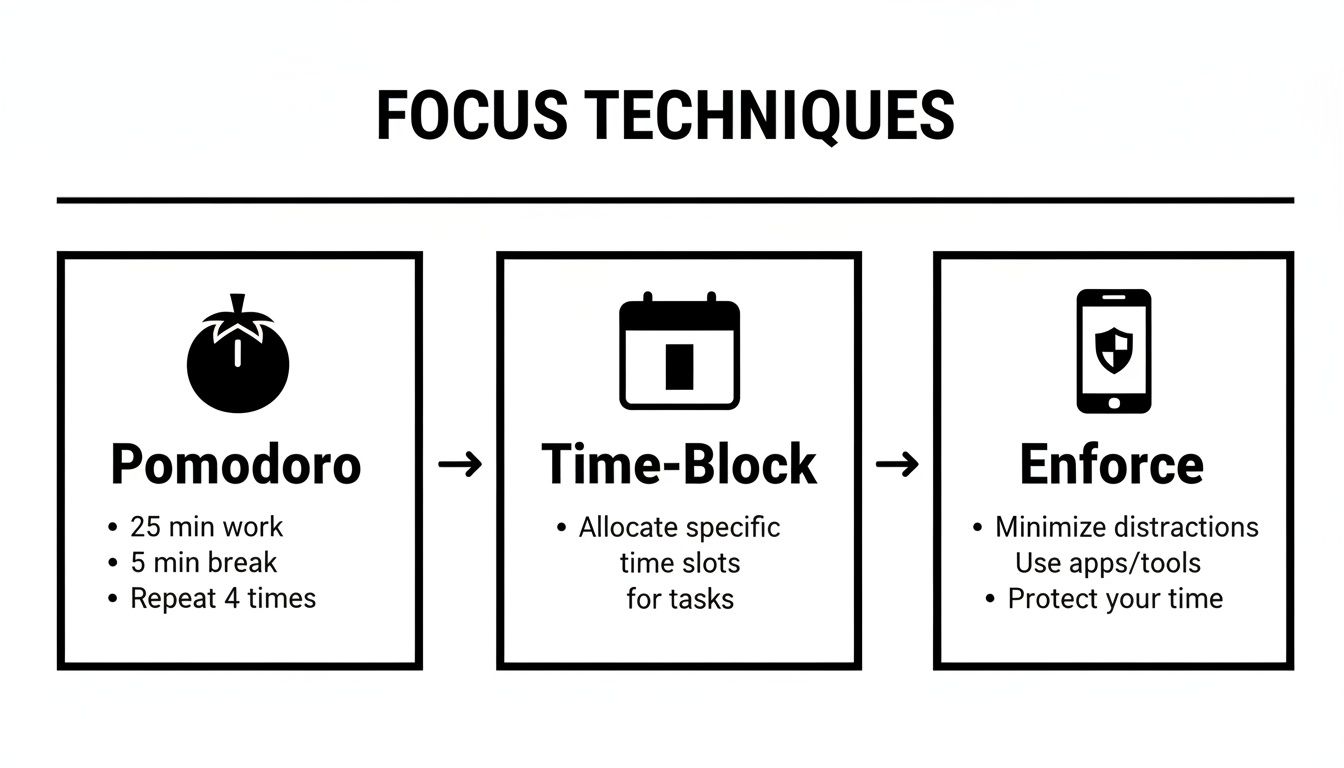
As you can see, structured methods like the Pomodoro Technique are a perfect match for enforcement tools like the apps we're discussing.
Ambient Sound Generators for Noisy Environments
What if the biggest distraction isn't coming from your screen, but from the world around you? A noisy dorm, a chatty roommate, or the constant clatter of a coffee shop can make it impossible to concentrate. This is where ambient sound generators save the day.
Ambient sound apps create a consistent, non-intrusive audio blanket that masks distracting noises and helps your brain settle into a state of flow.
Tools like Brain.fm and myNoise offer libraries of soundscapes scientifically designed for focus, from gentle rain to engineered audio patterns. Unlike your favorite playlist, these sounds are specifically made to fade into the background. They fill the silence without demanding your attention, effectively drowning out the unpredictable noises that shatter concentration.
Top Focus Apps Compared
Choosing the right tool depends entirely on your specific challenges. Are you fighting temptation, battling a noisy environment, or just need a motivational boost? This table breaks down some of the top options to help you decide.
| App Name | Primary Function | Best For | Platform |
|---|---|---|---|
| Freedom | Website & App Blocker | Hardcore distraction elimination during critical study periods. | Windows, Mac, iOS, Android |
| Forest | Gamified Pomodoro Timer | Building consistent study habits through positive reinforcement. | iOS, Android, Chrome Extension |
| Cold Turkey | Aggressive Website Blocker | Students who need an unbreakable block they can't easily bypass. | Windows, Mac |
| Brain.fm | AI-Generated Focus Music | Drowning out noisy environments and getting into a flow state. | Web, iOS, Android |
Ultimately, the best app is the one that fits seamlessly into your study routine and solves your biggest focus problem. For a more comprehensive look, check out our guide on the best productivity apps for students to find the perfect match for your workflow.
Train Your Brain for Deep Work and Retention
Blocking distractions is one thing, but building a truly focused mind is the long game. Think of your concentration like a muscle. The more you work it out with the right exercises, the stronger and more resilient it gets. This is how you achieve a state of deep work—that sweet spot of intense, uninterrupted focus where you produce your best, most creative work.
This isn't about brute force or just "trying harder." It's about fundamentally changing how you engage with your study material to make every minute count.

From Passive Reading to Active Recall
It's easy to fall into the trap of passive studying. Rereading your notes or highlighting half a textbook feels productive, but it’s a surprisingly ineffective way to build lasting memories. The real secret to making information stick is active recall.
Put simply, active recall means pulling information out of your brain instead of just pouring it in. After you read a chapter, close the book. Can you summarize the key points out loud? After studying a diagram of the Krebs cycle, can you sketch it from memory on a blank sheet of paper?
This act of retrieving information is what forges strong neural pathways, making that knowledge easier to access when you’re staring at an exam paper. In fact, a major meta-analysis found that students using active study routines could see their grades jump by up to 30%. You can dig into the findings on study habits and performance to see the data for yourself.
Supercharge Memory with Spaced Repetition
Once you've got active recall down, you can make it even more powerful by timing your review sessions with spaced repetition. The idea is simple: you remember things far better when you review them at increasing intervals over time. Cramming everything the night before is a recipe for forgetting.
Spaced repetition works with your brain’s natural forgetting curve. By reviewing information just as you're about to forget it, you interrupt that process and lock the memory in for the long haul.
You don’t have to track this with a complicated calendar, either. There's some great tech that handles it for you.
- Anki: This is the gold standard for spaced repetition. It’s a free, no-frills flashcard app that uses a smart algorithm to show you cards at the perfect moment to maximize retention. It has a bit of a learning curve, but it’s incredibly powerful once you get the hang of it.
- Quizlet: A more user-friendly option, Quizlet’s "Learn" and "Test" modes use the core principles of active recall and spaced repetition. It's a fantastic tool for just about any subject.
Reset Your Attention with Mindfulness
Sometimes, your mind feels like a browser with 50 tabs open before you even sit down to study. A quick mindfulness exercise can be a mental reset button, helping you quiet the noise and sharpen your focus.
Give this a try before your next study block:
- Find a comfortable seat and gently close your eyes.
- Take three slow, deep breaths—in through your nose, out through your mouth.
- For just two minutes, bring all your attention to the sensation of your breath.
- Your mind will wander. That’s totally normal. When it does, just gently notice it and guide your focus back to your breath without any judgment.
This simple practice trains your brain to recognize when it’s distracted and consciously redirect its attention—a crucial skill for deep focus. If digital clutter is your main problem, check out our guide on ways to reduce screen time for more strategies.
Got Questions About Staying Focused? We've Got Answers
Even with a solid plan, you're bound to hit a few snags. That's totally normal. Here are some of the most common focus-related questions I hear from students, along with some practical advice to get you back on track.
How Long Can I Realistically Study Before My Brain Checks Out?
There’s no magic number here, but shorter, intense bursts are almost always better than long, draining slogs. This is why techniques like the Pomodoro Method are so popular—and for good reason.
Working in focused sprints of 25-30 minutes, followed by a quick 5-minute break, keeps your mind sharp without leading to burnout. If you're deep into a complex project, like drafting an essay, you might be able to stretch that to a solid 50-60 minutes before taking a 10-minute breather.
The real secret? Stop before you feel fried. Pushing yourself for two or three hours straight is a recipe for disaster. Most people see their attention and ability to remember things plummet after about 90 minutes of continuous work.
What Do I Do When My Own Thoughts Are the Biggest Distraction?
Ah, the classic internal distraction. Sometimes, your own brain is a bigger problem than your phone. The best way I've found to deal with this is to create a "distraction pad."
Keep a simple notebook or a blank text file open on your desk. The moment a random thought, worry, or to-do list item pops into your head, just jot it down. By "parking" the thought, you're essentially telling your brain, "I see you, and I'll deal with you later."
This simple habit of offloading mental clutter is one of the most effective ways to reclaim your focus from internal noise without losing your train of thought.
It's a simple trick, but it's incredibly effective at clearing up precious mental space so you can get back to what you were doing.
Are Those Focus Apps Just a Gimmick, or Do They Actually Work?
They can be surprisingly effective, but they aren't magic. Their power comes from how you use them, as they're built on some pretty solid behavioral science. They create real-world friction or motivation that backs up your goal to stay focused.
Here’s how they help:
- Blocker Apps: Tools like Freedom or Cold Turkey are like bouncers for your brain. They create a real, physical barrier between you and the websites that suck you in. It’s not a placebo—it literally stops you from getting sidetracked.
- Gamified Timers: Apps like Forest tap into psychological triggers. The simple desire to keep your little virtual tree alive can be an incredibly powerful nudge to put your phone down and leave it alone.
Think of these apps as a support system. When you pair them with other good habits—like a dedicated study space and clear goals for your session—they make it much, much easier to stick to your plan and build genuine concentration skills over time.
At Simply Tech Today, we believe the right tools and knowledge can make a huge difference in your productivity. Explore more practical tech tips and guides at https://www.simplytechtoday.com.


Member discussion