
Machine Learning for Beginners: A Quick, Clear Intro

Let's pull back the curtain on machine learning, without all the intimidating jargon.
At its heart, machine learning is a way for computers to learn from data, patterns, and past examples—all without being explicitly programmed for every single task. Think about how you’d teach a toddler to recognize a dog. You wouldn't write a long list of rules. You'd just show them lots of pictures of dogs, and eventually, they'd get it. That’s the basic idea.
What Is Machine Learning, Really?
Forget the sci-fi image of robots taking over the world. The reality of machine learning is far more practical and, honestly, more interesting. It’s a specific field within artificial intelligence that’s all about building systems that learn from data, spot patterns, and make decisions on their own.
You don’t sit down and write code that says, "If an email has the word 'lottery' in it, it's spam." That’s old-school programming. Instead, you feed the system thousands of emails that you’ve already marked as spam, and it starts to figure out the common threads by itself.
This “learning from examples” approach is what makes machine learning so powerful. A machine learning model is basically a sophisticated pattern-finding engine. The more data you give it, the sharper it gets at its one job, whether that's recommending your next binge-watch on Netflix or keeping junk out of your inbox. It’s a huge leap from traditional programming, where a developer had to painstakingly write rules for every possible outcome.
The Power of Learning from Data
The magic here is that these systems get better over time, all by themselves, just by being exposed to more information. This built-in adaptability is why machine learning is now the backbone of so much of the tech we use every day.
- Pattern Recognition: It's brilliant at finding subtle connections in massive datasets that no human could ever hope to spot.
- Automation: It handles complex, repetitive decisions, like flagging a potentially fraudulent credit card transaction in real-time.
- Personalization: It’s the engine behind the custom-tailored experiences you get online, from Amazon's product suggestions to your Spotify Discover Weekly playlist.
Machine learning isn't about creating a conscious, thinking brain. It's about building a highly specialized tool that gets incredibly good at one specific task by learning from experience.
This approach is fueling massive growth and innovation. In fact, the global machine learning market is expected to be worth somewhere between $105 billion and $192 billion by 2025, which shows just how deeply it's being woven into how businesses operate.
To get the full picture, it helps to understand how artificial intelligence works more broadly. Machine learning is one of the most important methods we have for actually making AI useful in the real world, allowing computers to do things that once seemed to require human-level intelligence.
Understanding the Building Blocks of Machine Learning
Every machine learning system, whether it's a simple spam filter or a sophisticated self-driving car, is built from the same basic parts. Once you get a handle on these core ideas, you’ll have a solid mental map of how these systems actually learn and get smarter over time.
Think of it like learning to cook a new dish. You need your ingredients, a recipe to follow, and some time in the kitchen to actually practice. Machine learning isn't all that different—it just uses its own versions of these three essential elements.
Data: The Ingredients for Intelligence
First up, and most importantly, is data. Data is the raw material that a machine learning system learns from. Without good, clean data, a model can't learn anything useful. It’s like trying to cook a gourmet meal with an empty pantry—it’s just not going to happen.
This data can be almost anything: thousands of customer reviews, millions of cat photos, or decades of stock market figures. The more relevant and varied the data you feed the system, the better it gets at spotting patterns and making accurate predictions.
The image below shows how this all connects—data fuels a learning process, which in turn creates a real-world tool like a spam filter.
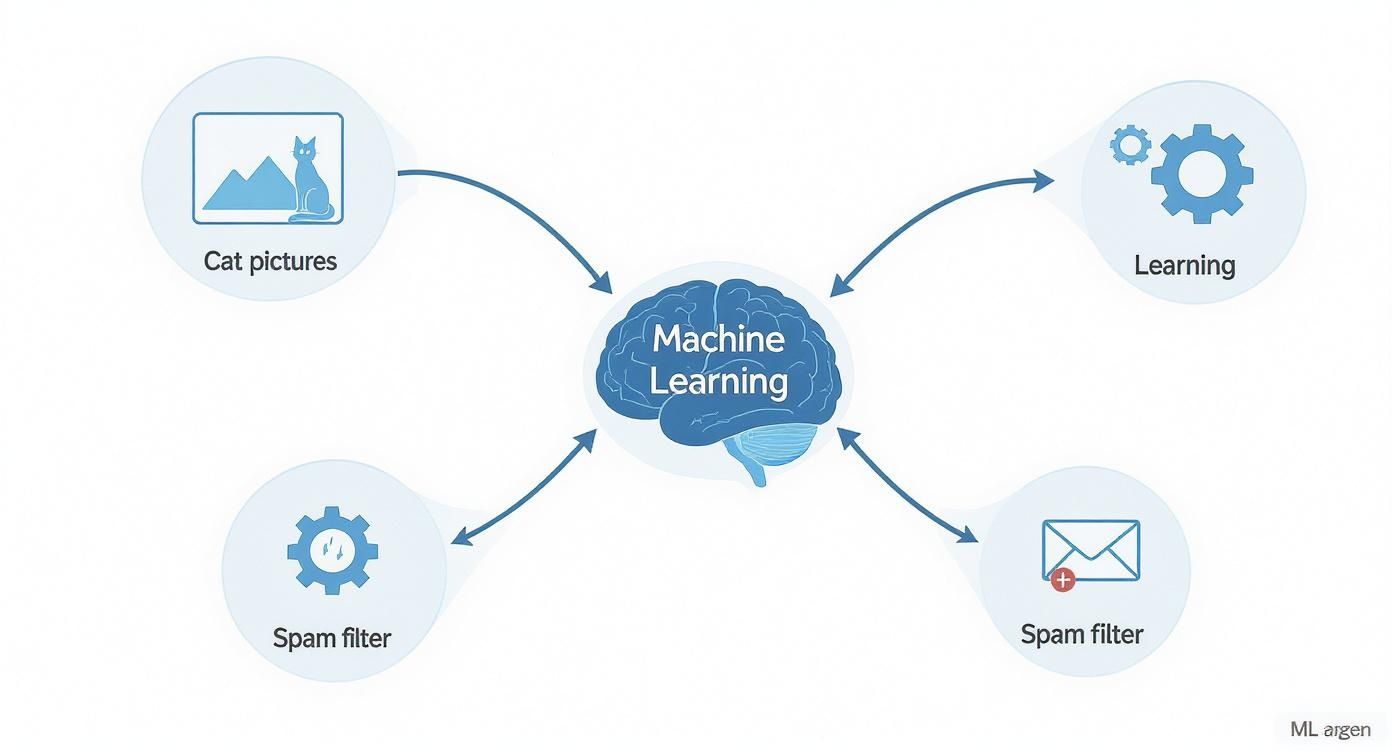
As you can see, it all starts with data. That’s the fuel for the entire machine learning engine.
Models: The Recipe for Making Predictions
Next, we have the model. In our cooking analogy, the machine learning model is the recipe you choose. It's a specific set of rules and mathematical structures that takes your data (the ingredients) and tries to produce the outcome you want.
Just like you wouldn't use a cake recipe to make soup, you have to pick the right model for the job.
- A model designed to classify emails as spam or not spam looks very different from one built to predict house prices.
- The model isn't the final answer itself; it’s the framework that learns from the data to find the answer.
At the very beginning, a model is essentially a blank slate. It's an empty recipe card waiting for the training process to fill it in with instructions.
Training: The Learning and Cooking Process
Finally, we get to training. This is the "cooking" phase where all the action happens. During training, we feed the model massive amounts of our data, and it constantly adjusts its internal logic to make its predictions better and better.
For an email spam filter, this means showing it thousands of emails we’ve already labeled as "spam" or "not spam." For each one, the model takes a guess. If it gets it wrong, it tweaks its internal settings to try and get it right the next time. This constant cycle of guessing, checking, and correcting is what "learning" really means for a machine.
Training is all about repetition and refinement. It's not a one-shot deal but a continuous cycle of practice that turns a generic algorithm into a specialized expert at one specific task.
This goes on and on until the model's performance is good enough, meaning it can reliably classify new emails it has never seen before. There are a few different ways to approach this training process, and they fall into three main categories.
Three Main Types of Machine Learning Explained
Machine learning isn't a monolith; it's a field with different strategies for different problems. The way a model learns is determined by the type of data it's given and the goal it's trying to achieve. Here's a quick breakdown of the three main approaches.
| Type of Learning | How It Works | Common Example |
|---|---|---|
| Supervised Learning | The model learns from data that has already been labeled with the correct answers. It's like studying with a set of flashcards that have the questions on one side and the answers on the other. | An email spam filter learns from thousands of emails that have been pre-labeled as "spam" or "not spam." |
| Unsupervised Learning | The model is given a bunch of data without any labels or correct answers. Its job is to find hidden patterns, structures, or groups all on its own, without any human guidance. | A streaming service groups users with similar viewing habits together to create personalized recommendations, without being told what the groups should be. |
| Reinforcement Learning | The model learns by trial and error in an interactive environment. It gets rewards for good actions and penalties for bad ones, figuring out the best strategy over time to maximize its total reward. | A computer learning to play a video game. It gets points (rewards) for clearing a level and loses a life (penalty) for making a mistake. |
Each of these methods—Supervised, Unsupervised, and Reinforcement Learning—provides a different toolkit for solving problems, and the one you choose depends entirely on the task at hand and the kind of data you have available.
How Machine Learning Powers Your Everyday Life
You might think of machine learning as something from a sci-fi movie, but the truth is, it’s already woven into the fabric of your daily life. It’s the invisible assistant working behind the scenes, from the moment you wake up and check your phone to when you relax with a movie at night.
These systems are constantly learning from your actions and the data you generate to figure out what you might want or need next. It’s not magic—it's just a practical use of the concepts we've been talking about. Let's pull back the curtain on a few examples you've probably already used today.

The spread of this technology has been incredible. By 2025, it's estimated that 378 million people around the world will be using AI and machine learning tools. This isn't just a niche for tech experts anymore; the number of daily AI users jumped from 116 million in 2020 to 314 million in 2024. If you're curious, you can dig into these AI adoption statistics to see just how fast things are moving.
Your Personalized Soundtrack with Recommendation Engines
Have you ever been amazed by how Spotify’s "Discover Weekly" playlist just gets you? That uncanny ability to find your next favorite song is a recommendation engine in action—a perfect example of machine learning for beginners to grasp.
- What it learns from (the data): The system pays attention to everything: the songs you play on repeat, the ones you skip after five seconds, the artists you follow, and the playlists you build. It also peeks at what people with similar musical tastes are enjoying.
- What it does (the prediction): Its entire job is to predict how likely you are to enjoy a song you haven't heard yet.
- How it gets better (the learning): Every time you hit 'play' on a suggestion or skip to the next track, you’re giving it feedback. That new data helps it tweak its understanding of your taste, making future recommendations even more spot-on.
Keeping Your Inbox Clean with Spam Filters
Without a smart gatekeeper, your email inbox would be an absolute disaster. Modern spam filters are a fantastic, real-world example of a machine learning model performing a classification task.
A spam filter doesn't just check for a list of "bad" words. It learns the subtle DNA of junk mail by analyzing millions of examples, which is why it's so good at catching brand-new spamming tricks.
It’s trained to spot patterns and red flags—things like suspicious links, odd grammar, or sketchy email headers. Based on these signals, it classifies a message as either "inbox" or "junk." And as spammers evolve their tactics, the model learns from every email you mark as spam, constantly updating its defenses.
Finding Faces in Photos with Image Recognition
When you upload a batch of vacation photos and your phone or social media app automatically suggests tagging your friends, that’s image recognition at work. It's a feature so common now that we barely even notice it.
The model behind this was trained on a colossal dataset of images where human faces were already labeled. It learned to recognize the specific patterns of pixels that form eyes, noses, and mouths. After seeing millions of examples, it becomes incredibly skilled at finding faces from different angles, in low light, or even when they're partially obscured. Every time you confirm a tag, you're essentially giving the system a small lesson, helping it get even more accurate for the next photo album.
Your First Steps into Machine Learning
Moving from theory to practice is where the real fun begins, but I get it—it can feel like a huge leap. The good news? You don't need a PhD in advanced math or a decade of coding experience to get your start in machine learning. The secret is to focus on hands-on, conceptual learning first.
This roadmap is all about building your confidence through small, achievable wins. Forget about getting stuck in dense academic papers. We're going to get you creating and experimenting right away, which is a far more engaging and effective way to learn.

Step 1: Solidify Your Conceptual Foundation
Before you even think about code, it’s vital to get a solid handle on the core concepts. What exactly is a model? What does "training" actually involve? The best way to build this mental framework is with a beginner-friendly course that focuses on the ideas, not the equations.
Platforms like Coursera, edX, and Google's own Machine Learning Crash Course are fantastic for this. They're designed to build your intuition with analogies and real-world examples, giving you the "why" behind the "how." The goal here is understanding, not memorization.
Step 2: Experiment with No-Code Tools
Once the basic ideas click, it's time to get your hands dirty—without writing a single line of code. There are some brilliant, user-friendly tools that let you experience the entire machine learning workflow for yourself.
A perfect place to start is Google's Teachable Machine. It's a web-based tool that lets you train a simple model in minutes, right in your browser. You can teach it to recognize images, sounds, or even your posture. It’s an incredibly powerful experience that peels back the curtain and shows you that you can actually build something that works.
Key Takeaway: The point of no-code tools isn’t to build a massive, production-ready app. It's to build your gut feeling for how data, training, and evaluation all connect in a live environment.
Step 3: Tackle a Small, Fun Project
Alright, now you're ready to mix your conceptual knowledge with a little bit of code. The trick is to pick a small, clearly defined project that you're genuinely curious about. This is the key to staying motivated and not getting overwhelmed.
Here are a few classic project ideas that are perfect for beginners:
- Movie Genre Classifier: Can you predict a movie's genre just from its plot summary?
- Spam Detector: Build a simple spam filter using a dataset of labeled emails.
- Handwritten Digit Recognizer: Use the famous MNIST dataset to teach a model to identify handwritten numbers.
For projects like these, you'll need a way to store your datasets. As you advance, it's worth learning how to use cloud storage, as it's essential for handling the much larger datasets you'll encounter down the road. By following these steps, you’re creating a path for yourself that builds momentum, making your entry into the world of machine learning feel both manageable and incredibly rewarding.
Myths, Misconceptions, and a Few Big Questions
https://www.youtube.com/embed/aGwYtUzMQUk
As you dip your toes into machine learning, you’ll quickly realize there’s a ton of hype and a good bit of misunderstanding. Let’s cut through some of that noise and tackle the myths that often trip up beginners.
First, let's get this out of the way: you do not need to be a math Ph.D. to get started. Far from it. While the theory behind the algorithms is built on some serious math, getting started is more about logic and understanding the concepts. Modern tools and libraries do all the heavy lifting, letting you focus on what you're trying to accomplish.
Then there's the whole "robot overlord" scenario. It makes for great science fiction, but the reality of machine learning is much more grounded. These systems are highly specialized; think of them as power tools, not conscious beings. A model that's brilliant at identifying cat photos has no idea how to recommend a movie. They're just really, really good at finding patterns within the specific data they were trained on.
The Problem of Fairness and Bias
Beyond the myths, there's a serious conversation we need to have from day one: the ethical side of things. Machine learning models learn from data, and if that data is skewed, the model will be too. It’s not a hypothetical problem for the future—it's something people building these systems grapple with right now.
Think about a bank that wants to use an AI model to decide who gets a loan. They train it on their loan application data from the last 30 years. But what if that historical data contains subtle, or not-so-subtle, biases from past lending practices? Maybe people from certain zip codes or backgrounds were unfairly denied loans.
The model will learn these patterns as "the way things are done" and start replicating them automatically.
The Bottom Line: A machine learning model is only as fair as the data it's trained on. Garbage in, garbage out. Biased data will always lead to a biased model, no matter how sophisticated the algorithm is.
This isn't a small thing. It can lead to real-world harm, creating automated systems that reinforce inequality. The model isn’t “evil”; it’s just doing exactly what it was taught to do—find and repeat patterns from the past, flaws and all.
Getting a handle on this is a core part of being a responsible practitioner. It’s not enough to build a model that works; you have to build one that works fairly.
As you build, keep these questions in your back pocket:
- Where did this data really come from? Digging into the source and quality of your data is your best defense against building a biased system.
- Who could be hurt by this model's predictions? Think about the real people who will be affected by its decisions.
- How can I check for fairness? You can, and should, test your models to see if they perform differently for different groups of people.
You don't need to become an ethics professor overnight. It’s about cultivating a mindset of responsibility and remembering that the code you write can have a real impact on people’s lives.
A Few Common Questions Answered
Diving into a new field always brings up a few questions. As you start connecting the dots from what machine learning is to what you can do with it, some common queries inevitably surface. Let's tackle them head-on.
Think of this section as your quick-reference guide for those moments when you're wondering, "Okay, but what about...?"
What’s the Difference Between AI, Machine Learning, and Deep Learning?
It's easy to get these terms tangled up, but they fit together quite logically.
Imagine a set of those nested Russian dolls.
- Artificial Intelligence (AI) is the largest, outermost doll. It's the big, all-encompassing idea of creating machines that can think or act in ways we’d consider "smart."
- Machine Learning (ML) is the next doll inside. It’s a specific way to achieve AI. Instead of programming a machine with explicit rules for every single situation, we let it learn from data.
- Deep Learning is an even smaller, more specialized doll tucked inside ML. It's a powerful technique that uses complex, multi-layered networks to tackle incredibly tough problems, like understanding human speech or translating languages on the fly.
For anyone just starting out, that Machine Learning doll is the perfect one to focus on.
Do I Need to Be a Math and Coding Genius to Start?
Absolutely not. To get started, your curiosity is far more important than a long list of credentials. Many of the best modern tools and libraries are specifically designed to do the heavy lifting for you, handling all the complex math behind the scenes. This lets you focus on the what and why of your project.
As you get more serious, a basic grasp of algebra, statistics, and a programming language like Python will definitely help. But that's not a barrier to entry. You can pick up what you need as you go along.
The biggest myth that stops people from even trying is the belief they need to be a math wizard first. The reality is you learn the necessary math and code as you need it, one small project at a time.
How Long Does It Take to Learn the Basics?
This really depends on your dedication, but it’s probably faster than you think. With a bit of consistent effort, you can wrap your head around the core concepts and build your first simple model in just a few weeks.
Of course, becoming a professional takes years, but the initial hurdle is lower than ever. Focus on small, steady learning sessions. Maybe aim to understand one new concept or try one new tool each week. That kind of steady progress is how you build a solid foundation without getting overwhelmed. You'll be surprised by how much you can do, and how quickly.
At Simply Tech Today, we break down complex topics into clear, practical guides. Subscribe to our newsletter for more insights on AI, new gadgets, and how technology is shaping our world.
Article created using Outrank
Member discussion