Smart Speaker Comparison: Echo, Nest, and HomePod Showdown

When you boil it all down, the choice between smart speakers really comes down to three things. If you want the absolute best smart home compatibility, you go with Amazon Echo. If you're looking for the smartest, most conversational assistant, Google Nest is your winner. And if you're an audiophile who won't compromise on sound, the Apple HomePod is the one.
It all depends on which of those three pillars means the most to you.
Your Quick Guide to Choosing a Smart Speaker
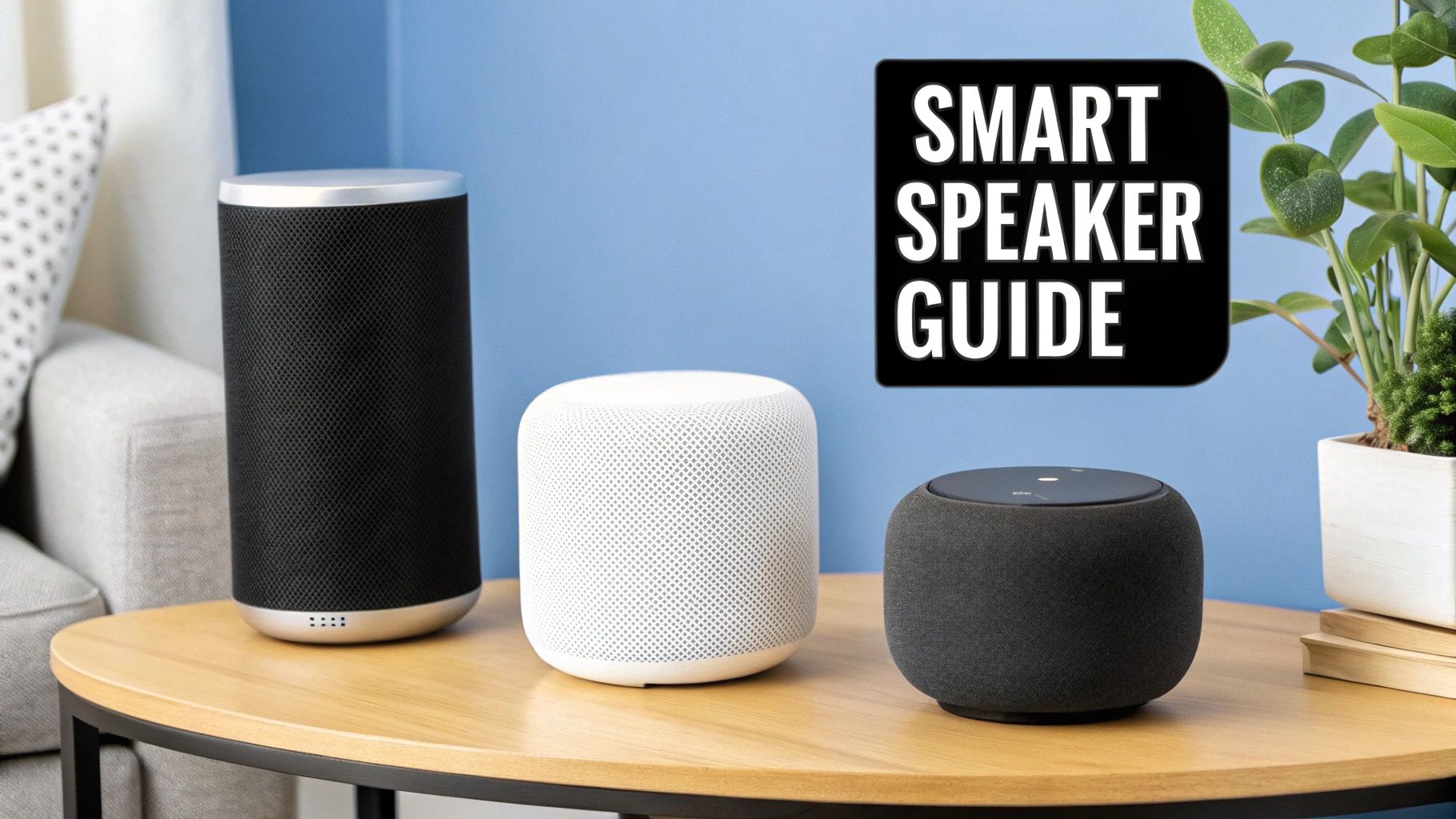
Trying to pick the right smart speaker can feel like a huge task, but it’s actually more straightforward than you might think. This isn't just about comparing tech specs on a sheet of paper; it’s about finding a device that fits naturally into your life. Each of the big three—Amazon, Google, and Apple—has crafted a very distinct personality for its smart speaker family.
The smart speaker market has absolutely exploded, jumping from around $4.36 billion in 2017 to a figure that's now many times larger. With North America making up roughly 36.9% of that market, it’s obvious these gadgets have become a staple in modern homes.
The real goal here is to figure out which ecosystem clicks with the tech you already own and where you see yourself going. This one decision will shape everything from how you listen to music to the way you turn on your lights.
Identifying Your Top Priority
Before you get lost in the weeds of features, just ask yourself one simple question: What’s the main thing I want this speaker to do for me? Your answer will immediately cut through the noise and point you in the right direction.
- For the Smart Home Builder: If your dream is to connect and command an ever-growing army of gadgets—from smart plugs to thermostats—Amazon's Alexa is the undisputed champion. Its massive library of third-party "skills" means it works with almost anything you can buy.
- For the Information Seeker: Need an assistant that can actually understand what you're asking and give you smart, on-point answers? Google Assistant is your go-to. It has the full power of Google's search engine behind it, making it incredibly knowledgeable.
- For the Audio Enthusiast: If amazing sound quality and a perfect connection with your Apple gear are your top priorities, the Apple HomePod was made for you. It's built from the ground up to deliver high-fidelity audio that leaves most competitors in the dust.
A smart speaker is so much more than a device for playing music; it's the command center for your entire connected home. Getting a handle on what is the Internet of Things is a great first step to understanding how these devices tie everything together.
To make it even clearer, I've put together a quick comparison table. It's a simple way to see how the big three stack up based on what matters most to you.
Smart Speaker Strengths At a Glance
| Priority | Best For Amazon Echo (Alexa) | Best For Google Nest (Google Assistant) | Best For Apple HomePod (Siri) |
|---|---|---|---|
| Smart Home Control | Unmatched compatibility with thousands of devices and a massive skills library. | Strong integration with popular brands and intuitive routine creation. | Secure and reliable with HomeKit, but has more limited device support. |
| AI Assistant Smarts | Good for commands and shopping, but less conversational. | Best-in-class for answering questions and understanding natural language. | Effective for basic tasks and controlling Apple services, but less flexible. |
| Audio Quality | Good all-around sound, with high-end models offering immersive audio. | Clear and balanced audio, great for podcasts and background music. | Superior, room-filling sound with a focus on high-fidelity music playback. |
| Ecosystem | Works well with Amazon services (Prime Music, Audible) and third-party apps. | Integrates seamlessly with Google services (Calendar, Maps, YouTube Music). | Flawless integration for users heavily invested in the Apple ecosystem (iPhone, Mac). |
Think of this table as your cheat sheet. Find your main priority in the first column, and the answer for which speaker to get becomes pretty obvious.
The AI Assistants: Comparing the Brains Behind the Voice
When you ask a smart speaker to play a song or check the weather, you’re not really talking to a piece of plastic. You're talking to a powerful artificial intelligence living in the cloud. This AI assistant is the soul of the machine, and its personality will define your entire experience.
Deciding between Alexa, Google Assistant, and Siri is easily the most important choice you'll make. This isn't just about a list of features. It’s about how they perform in the messy reality of your home. Does it understand you when the TV is blaring? Can it handle a complicated, multi-part question without getting flustered? These little moments are what make an assistant genuinely helpful instead of just another frustrating gadget.
The technology is incredibly complex, but the goal is dead simple: to understand what you want. If you're curious about what's going on under the hood, our guide explaining how artificial intelligence works provides a great breakdown. Knowing the basics helps you see why each AI has its own unique quirks.
Google Assistant: The Resident Know-It-All
Google Assistant's superpower is its direct line to the world’s biggest search engine. When it comes to answering questions—any questions, really—it’s in a class by itself. It has an almost spooky ability to understand context, which lets you ask follow-up questions just like you would with a person.
For instance, you can ask, "Who directed Inception?" and then immediately follow up with, "What other movies has he made?" Google Assistant just knows you're still talking about Christopher Nolan. This contextual awareness makes your conversations feel far less robotic and way more natural.
This intelligence shines in everyday planning, too. A question like, "How's the traffic to the airport, and what time should I leave to get there by 3 PM?" is the kind of complex query that Google often nails, combining live traffic data with a quick calculation to give you one simple, useful answer.
Amazon Alexa: The Master Connector
If Google Assistant is the brainiac, Alexa is the ultimate social butterfly. Its real strength lies in its "Skills," which are basically apps for your voice. With a library of over 100,000 Skills, Alexa can connect to an absolutely staggering number of third-party apps, services, and smart home gadgets.
This makes Alexa the undisputed king of home automation. You can build all sorts of custom routines, like saying "Good morning" to have Alexa turn on the lights, fire up your smart coffee maker, and read you the day's headlines from your favorite news source. The ecosystem is massive and mature.
The trade-off? Alexa isn't quite the conversationalist that Google Assistant is. It can get tripped up by complex questions or follow-ups that don't fit a specific command structure. It’s much better at executing direct orders than having a free-flowing chat.
Recent market analyses from 2023-2025 show Amazon as the clear leader in the smart speaker space. While figures vary, Amazon's revenue share often sits around 23%, with Google and Apple following behind. This widespread adoption has fueled the growth of its massive Skills library. You can review more insights on smart speaker statistics at ElectroIQ.
Because of its market dominance, more companies develop integrations for Alexa first, giving it a huge head start in device compatibility.
Apple Siri: Guardian of the Ecosystem
Siri's power comes from its deep, seamless integration within the Apple universe. If you live and breathe Apple—with an iPhone, Mac, and Apple Watch—Siri offers an experience that its rivals can't touch. It’s brilliant at on-device tasks like setting reminders that sync everywhere, sending iMessages, or queuing up a playlist on Apple Music.
Apple's hardcore focus on privacy is another major selling point. Many Siri requests are processed right on your device instead of being sent to a server, which adds a significant layer of security. You can really feel this with HomeKit smart home devices, which are known for their rock-solid, secure connections.
The flip side is that Siri is the most sheltered of the three. It's not as sharp with general knowledge questions and has far fewer third-party integrations. While its conversational skills are getting better, they still trail Google's. Siri is a superstar inside its walled garden, but it struggles a bit when asked to reach beyond it.
Head-to-Head: How the Assistants Stack Up
To put it plainly, each assistant is built for a different kind of person. The right choice for you boils down to what you value most.
| Assistant Capability | Google Assistant | Amazon Alexa | Apple Siri |
|---|---|---|---|
| Answering Questions | Excellent. Taps into Google Search for spot-on, contextual answers. | Good. Solid for general knowledge but can be less conversational. | Fair. Best with questions about Apple services and basic facts. |
| Conversational Flow | Excellent. The best at understanding context and follow-up questions. | Fair. More of a command-taker than a conversationalist. | Good. Handles simple follow-ups but isn't as flexible. |
| Smart Home Control | Very Good. Works with thousands of devices from major brands. | Excellent. The undisputed champ, with unrivaled device support via Skills. | Good. Super secure with HomeKit, but the device list is shorter. |
| Third-Party Skills | Good. "Actions" are available, but the library is smaller than Alexa's. | Excellent. The biggest and most diverse collection of integrations. | Limited. Integrations are mostly tied to apps on your Apple devices. |
Honestly, picking your assistant is the biggest decision you'll make. Before you buy any speaker, try playing around with the assistants on your smartphone. It’s the best way to get a feel for their personalities and figure out which one is the right fit for you.
A Deep Dive Into Audio and Sound Performance
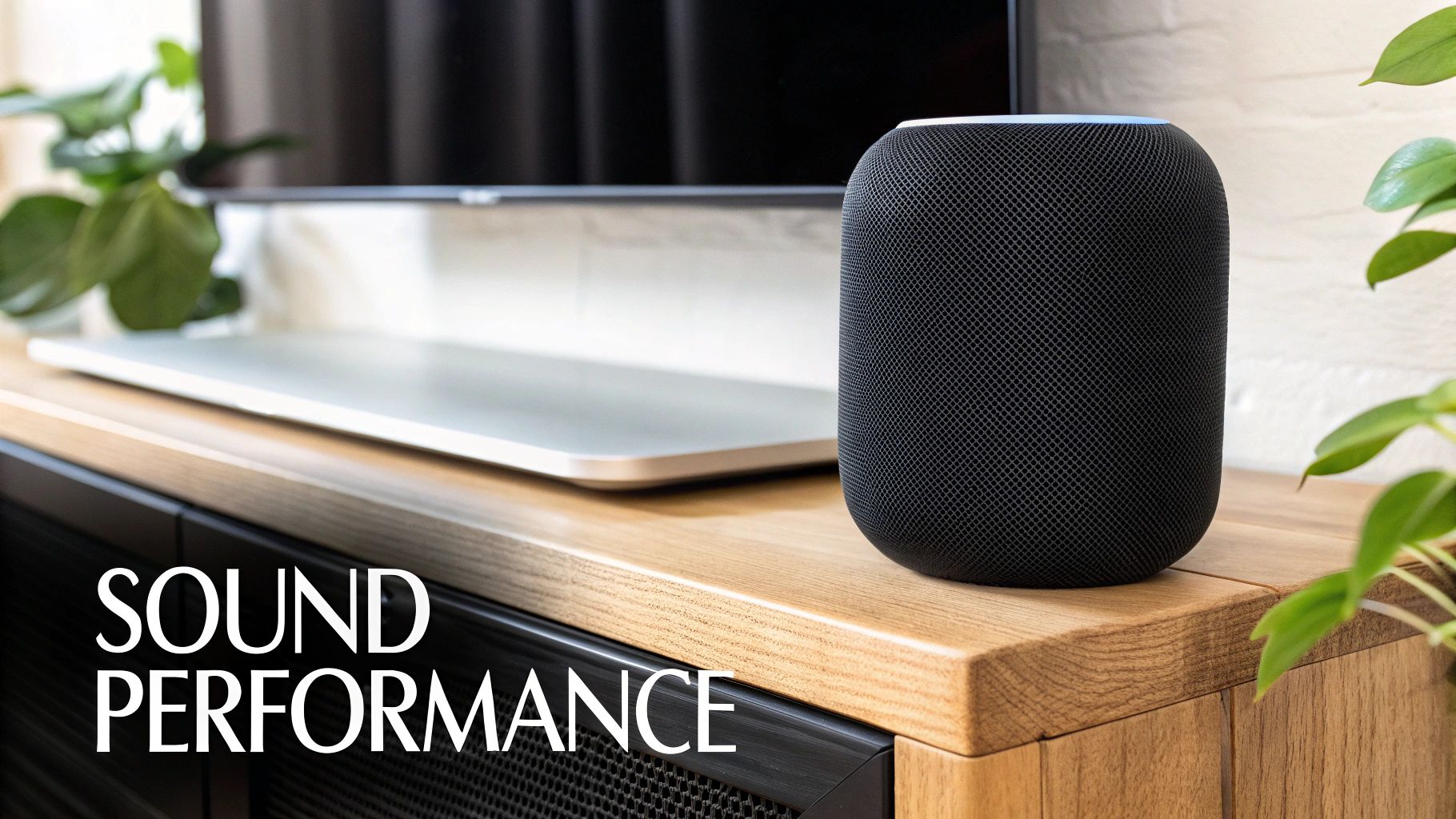
Sure, the "smart" part of a smart speaker gets all the attention, but let's be honest—it's the "speaker" part you'll be living with every day. The way it handles your favorite playlist, makes a podcast feel like a conversation, or ramps up the tension on movie night is what really makes it part of your home.
This is where the flagship models from Apple, Amazon, and Google really start to show their differences. Choosing the right one comes down to what you listen to and how you listen. An audiophile chasing high-fidelity sound has very different needs than someone who just wants to hear the morning news clearly while making coffee. Let's break down how these top contenders actually sound in the real world.
Apple HomePod: The Undisputed Audiophile Choice
Right out of the box, you can tell the Apple HomePod was built by people who love music. When it comes to pure, unadulterated sound quality, it’s in a class of its own. Its most impressive trick is delivering powerful, deep bass that stays incredibly tight and controlled, never bleeding into the mids and highs or turning your music into a muddy mess.
This makes it absolutely phenomenal for genres like hip-hop, electronic, and pop, where a solid low-end is non-negotiable. The HomePod doesn't just play bass; it produces a physical, room-filling rumble you can actually feel. But it's not a one-trick pony. The speaker has a remarkably balanced and detailed sound profile across the board, making it a fantastic all-rounder for anyone who listens critically.
Apple’s computational audio is what really puts it over the top, featuring:
- Spatial Audio with Dolby Atmos: This isn't just stereo. It creates a genuine three-dimensional soundstage, making music and movies feel like they’re happening all around you.
- Room Sensing: The HomePod uses its mics to listen to the room's acoustics and automatically tunes its output for the best possible sound, no matter if it's in a corner or the middle of a shelf.
For anyone deep in the Apple ecosystem who refuses to compromise on audio quality, the HomePod is the only real choice. The immersive listening experience it creates from a single speaker is genuinely special.
Amazon Echo Studio: The Home Theater Powerhouse
Amazon designed the Echo Studio for one thing: big, cinematic sound. While it's a perfectly capable music speaker, its true talent shines when you want an expansive, immersive audio experience for movies and TV shows, especially when you pair it up with a Fire TV device.
The Studio was one of the first smart speakers to fully embrace 3D audio formats like Dolby Atmos and Sony 360 Reality Audio. That gives it a massive advantage for home entertainment, allowing it to create a sense of height and space that smaller speakers just can't touch. The upward-firing driver is the key, bouncing sound off your ceiling to create convincing overhead effects.
Its sound signature is powerful and dynamic, with a punchy mid-bass that makes action sequences feel explosive. It might not be as musically delicate as the HomePod, but the Echo Studio delivers a thrilling audio experience that can easily command a large living room. If you want to know which services deliver the best sound, our streaming service comparison guide breaks down which platforms offer the highest-quality audio.
Google Nest Audio: The Vocal Specialist
The Google Nest Audio plays a different game. Instead of chasing booming bass or cinematic surround sound, Google focused entirely on clarity and balance. This speaker’s main strength is reproducing vocals and dialogue, making it the perfect sidekick for podcast addicts, audiobook fans, and anyone who loves acoustic or singer-songwriter tracks.
The sound is crisp, clear, and forward, so voices are always front and center, never getting lost in the mix. It won't shake your walls, but its sound is surprisingly full for its size and stays pleasant and easy to listen to for hours on end. That makes it an ideal choice for background music in an office or as a kitchen companion for following recipes without missing a step.
In the end, it’s all about what you value most. For pure musical fidelity, the HomePod is king. For a powerful home theater experience, the Echo Studio is the one to beat. And for crystal-clear voices and podcasts, the Nest Audio nails it.
Evaluating Smart Home and Ecosystem Integration
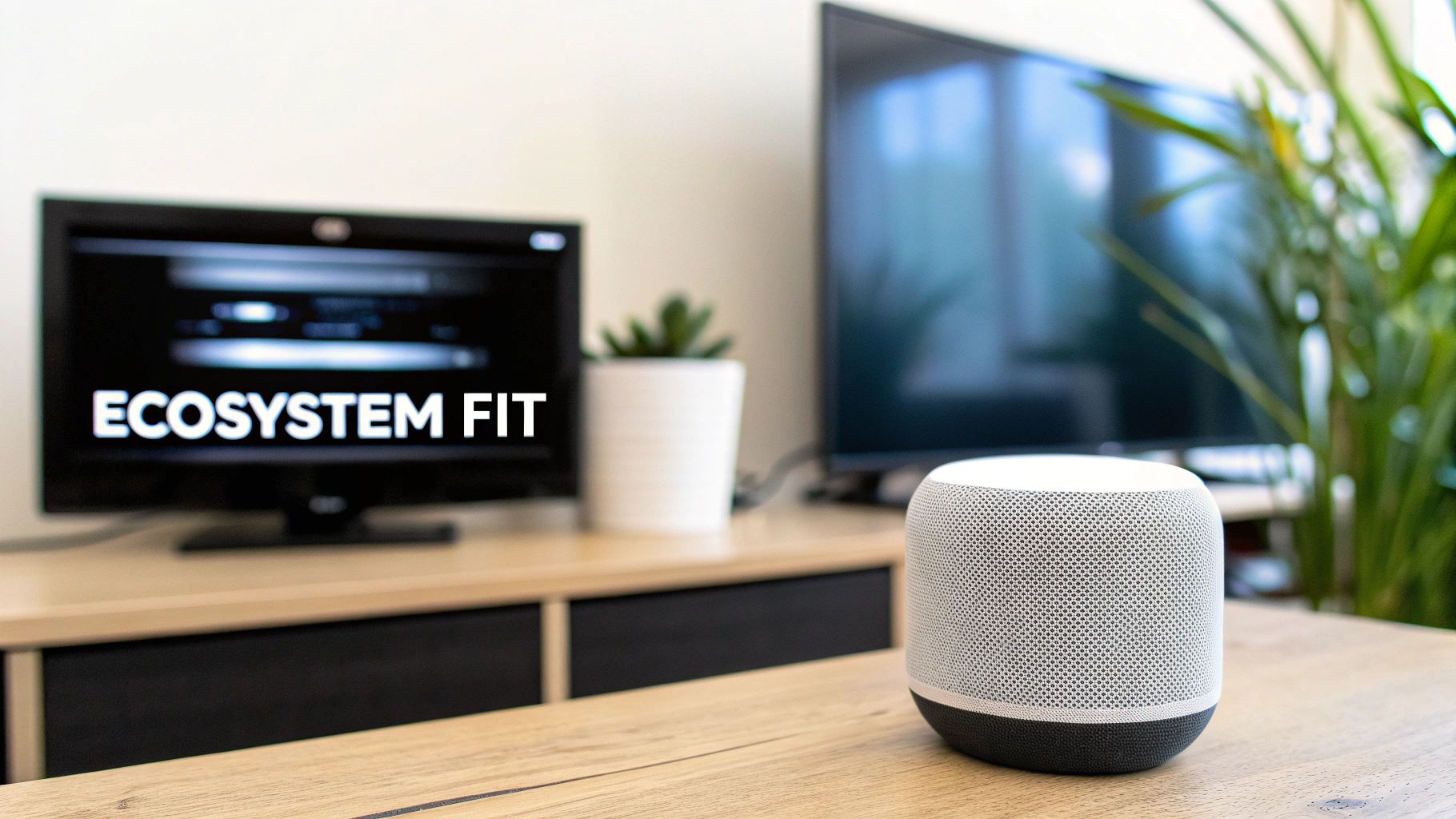
A smart speaker is more than just a speaker—it’s the command center for your entire digital life. Its real value comes from how well it connects with all the other devices, apps, and services you use every day. This network is its ecosystem, and picking one is a long-term decision that will define your smart home experience for years to come.
Each platform has its own personality. One is an open playground for tinkerers, another is all about seamless simplicity, and the third is a locked-down fortress of security. Let’s look past the compatibility checklists and explore what it’s actually like to live inside each of these digital worlds.
Amazon Alexa: The Boundless Tinkerer
When it comes to sheer device compatibility, Alexa is in a league of its own. Amazon’s head start in the market has created the largest and most mature smart home ecosystem by a wide margin. The magic behind this is "Skills"—think of them as voice apps that let thousands of third-party products talk to Alexa.
With over 100,000 Skills, the list of gadgets you can connect is practically endless. If a smart device exists, you can bet it works with Alexa. This makes it a dream for anyone who loves to experiment. You can build complex routines, like a single "movie night" command that dims your Philips Hue lights, lowers your Lutron blinds, and fires up your TV.
But this incredible flexibility has a downside. The quality of those Skills can be all over the place. Setup sometimes feels clunky, bouncing you between different apps to link accounts. You get ultimate control, but you'll need a little patience to get everything humming along perfectly.
Google Assistant: The Streamlined Integrator
Google Assistant takes a more polished, walled-garden approach. Instead of an open marketplace like Alexa's, Google works directly with its partners to ensure everything feels deeply integrated. The result is a smaller list of compatible devices, but the ones that make the cut usually work flawlessly right out of the box.
Setup is a breeze. Adding a new smart plug or lightbulb often just takes a few taps inside the Google Home app. It’s a clean, straightforward process designed for people who want a reliable system that just works, no fiddling required.
Google's real superpower is its seamless connection to its own universe of services. It taps into your Google Calendar, knows your commute from Google Maps, and can pull up memories from Google Photos. This turns it into a genuinely useful assistant that already understands your life.
This tight integration makes Google Nest speakers a fantastic hub, especially for families and anyone already living in Google’s world. The trade-off for that simplicity, of course, is having fewer device options compared to Amazon's sprawling empire.
Apple HomeKit: The Secure Sanctuary
Apple's HomeKit is built from the ground up on two core principles: privacy and security. It has the most rigorous certification process for device makers, which naturally means it supports the fewest products. But for those who choose this path, the benefits are huge.
HomeKit devices are known for being rock-solid and secure. All communication is end-to-end encrypted, and a lot of the command processing happens locally on a device like a HomePod or Apple TV, not in the cloud. This intense focus on privacy offers real peace of mind.
For anyone already invested in Apple products, the experience is buttery smooth. If you want to build a smart home that's as simple as it is secure, HomeKit is the obvious choice. If you're just starting out, our guide on how to set up a smart home can help you get the basics down, no matter which ecosystem you land on.
Smart Home Ecosystem Compatibility Guide
To give you a clearer picture of where each platform shines, we’ve put together a quick comparison of how they handle the most popular smart home devices and services. This table shows who has the edge in different areas.
| Category | Amazon Alexa | Google Assistant | Apple HomeKit |
|---|---|---|---|
| Smart Lighting | Excellent. The widest compatibility, supporting nearly every brand. | Very Good. Supports all major brands with an easy setup process. | Good. Fewer options available, but their performance is rock-solid. |
| Thermostats | Excellent. Works with almost every smart thermostat on the market. | Excellent. Seamless integration, especially with Nest products. | Good. Limited to certified models like Ecobee. |
| Streaming Services | Excellent. Supports Spotify, Apple Music, Pandora, and many more. | Excellent. Native support for YouTube Music, Spotify, and others. | Good. Works best with Apple Music; Spotify support feels less integrated. |
| Security Cameras | Very Good. Integrates well with Ring, Arlo, Wyze, and more. | Very Good. Works best with Nest Cams but supports other brands. | Excellent. HomeKit Secure Video offers unparalleled privacy features. |
Ultimately, choosing an ecosystem comes down to what you value most.
- Want the widest possible choice and love to tinker? Go with Alexa.
- Prefer simplicity and deep integration with services you already use? Google Assistant is for you.
- Are you an Apple user who prioritizes privacy and security above all else? HomeKit is the clear winner.
Understanding Your Privacy and Data Controls
Bringing a smart speaker into your home means you're also bringing in an always-on microphone. It’s completely normal to wonder what it’s hearing, what gets recorded, and where that data goes. When you’re comparing smart speakers, privacy isn't just a feature—it's a fundamental consideration. Each company has a different philosophy on handling your data, creating a real trade-off between personalized smarts and tighter security.
At the heart of the matter is your voice. When you say the wake word—like "Alexa" or "Hey Siri"—the device records what you say next and sends it to the cloud to figure out what you want. This is how the AI gets smarter over time, but it also means your voice clips end up stored on a server somewhere.
The good news is that Amazon, Google, and Apple all give you a way to see and manage this data. Each one has a privacy dashboard in your account where you can listen to—and delete—your past recordings. For anyone who's mindful of their digital footprint, checking this out is a must.
How Each Platform Manages Your Data
You can really see the philosophical divide between these companies when you look at how they handle your voice recordings by default.
Amazon and Google are pretty similar in their approach. Most of what you say gets processed in the cloud, which is what helps their assistants learn so quickly. While they give you plenty of privacy tools, their default setting is to use anonymized data to make their services better. With both, you can:
- Review and delete your voice history: You can do this command by command or tell them to automatically delete anything older than three or 18 months.
- Opt out of human review: You can stop employees from listening to your recordings to improve the AI.
- Mute the microphone: Every speaker has a physical button that electronically cuts power to the mic. It’s a hardware-level off switch for peace of mind.
Apple, true to form, does things differently. Their big focus is on-device processing.
Apple’s privacy-first stance means many Siri and HomeKit commands are handled right on the HomePod, without ever sending audio to the cloud. This design choice is a huge differentiator for security-focused users, as it drastically reduces the amount of data leaving your home.
This local-first approach is a big reason why HomeKit is often seen as the more secure smart home platform, though it can sometimes hold Siri back on more complicated, web-based questions.
What This Means for You in the Real World
Ultimately, the choice comes down to your personal comfort level. Amazon and Google have incredibly powerful and versatile assistants precisely because they learn from a massive pool of cloud-based user data. Their whole ecosystem is built on that model, which is why they work with so many different smart home gadgets.
Apple’s walled garden offers a more private experience right out of the box, but you do make some trade-offs in Siri's overall capabilities and the number of third-party devices it works with. To really feel confident in your choice, it helps to understand the bigger picture of digital security. Taking a few proactive steps, which we cover in our guide on how to protect your privacy online, can empower you to use any of these devices comfortably. In the end, the best smart speaker is the one whose privacy policies you can live with.
Final Recommendations for Every Type of User
I get it—sifting through all the specs can make your head spin. But at the end of the day, picking the right smart speaker isn't about which one has the longest feature list. It's about figuring out which one will actually fit into your life. So, let's cut through the noise and match you with the right device based on how you'll really use it.
Think of it less like buying a gadget and more like hiring a personal assistant. Who gets the job?
For the Ultimate Smart Home Tinkerer
If you're the kind of person who loves to automate everything and has smart gadgets from a dozen different companies, there's really only one choice: the Amazon Echo. Its biggest strength is the sheer size of its ecosystem. The Alexa platform has a massive library of third-party "Skills," giving it the widest compatibility you'll find anywhere.
Seriously, from obscure smart lighting brands to niche kitchen appliances, if you can plug it in, Alexa can probably control it. This is the perfect playground for anyone who enjoys tinkering with routines and building a truly connected home from the ground up.
For the Busy Family Needing a Central Hub
For a bustling household that juggles schedules, reminders, and endless questions from the kids, the Google Nest Hub is the clear winner. Google Assistant is just better at natural conversation and it ties in perfectly with the tools your family already uses, like Google Calendar and Google Photos. It’s a fantastic digital command center.
Having that screen makes a world of difference. You can pull up a recipe while your hands are messy, see the weekly forecast at a glance, or make video calls to the grandparents. It’s a level of practical, daily usefulness that audio-only speakers just can't touch.
This decision tree visualizes the key trade-offs between control, convenience, and security when choosing a smart speaker's privacy settings.
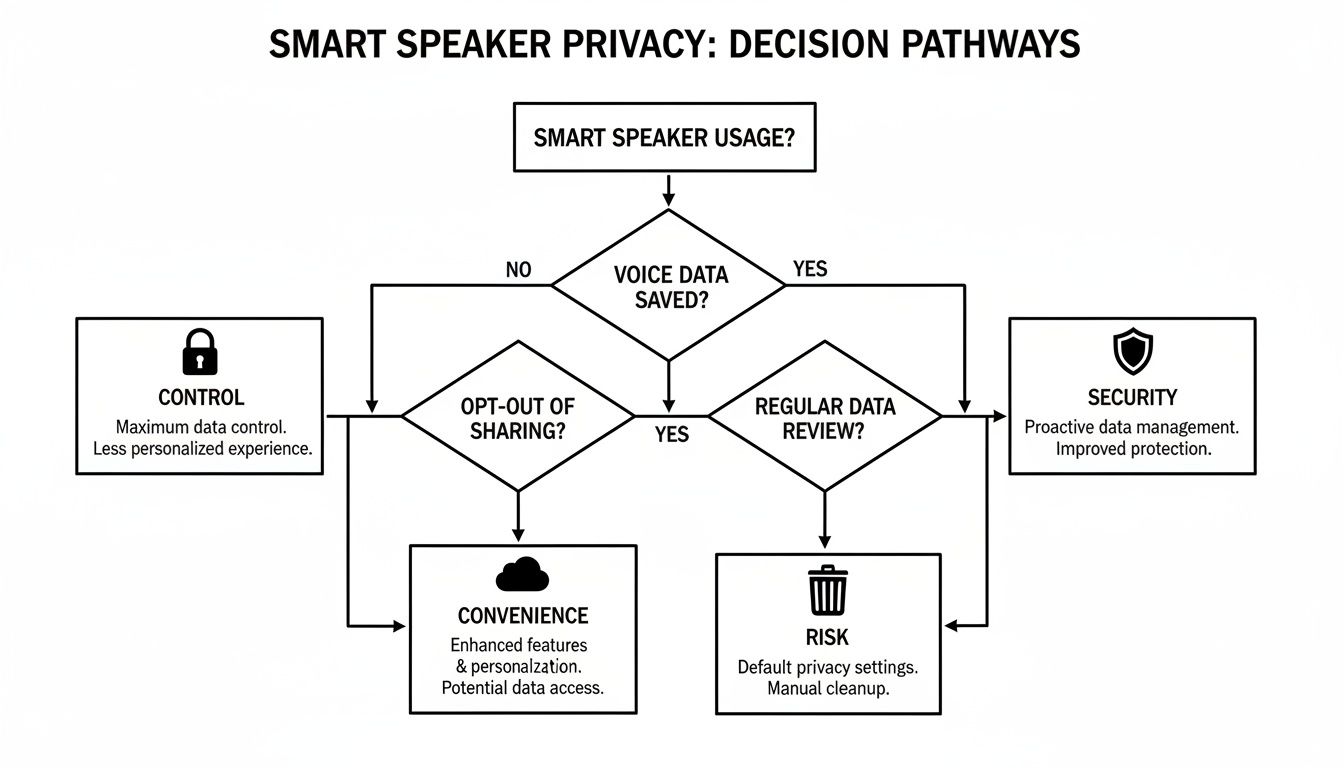
The visualization highlights that platforms with greater convenience often rely more on cloud processing, whereas those prioritizing security may offer more on-device controls.
For the Apple Loyalist and Audiophile
Are you already living entirely in Apple's world? If you have an iPhone, Mac, and Apple TV and you simply refuse to compromise on sound quality, the Apple HomePod is built for you. It's engineered first and foremost for a premium, high-fidelity audio experience that music lovers will appreciate immediately.
Beyond its audio prowess, the HomePod offers flawless integration with your other Apple devices, along with the robust security and privacy features baked into HomeKit. For dedicated Apple users, its effortless operation and exceptional sound make it the only logical choice.
A Few More Things You Might Be Wondering
Even after breaking down all the top smart speakers, there are always a few lingering questions that pop up. These are the nitty-gritty details that can make or break your decision, so let's tackle the ones we hear most often.
Can I Mix and Match Different Smart Speaker Brands?
You can, but it’s not the seamless experience you might be hoping for. It's totally fine to have an Amazon Echo in the living room and a Google Nest speaker in the bedroom, but they’ll operate on two different teams. They won't talk to each other, so you can't sync music between them.
If you dream of having music flow from room to room, you need to commit to one ecosystem. Grouping several Echo speakers for whole-home audio is a breeze, and the same goes for Nest speakers. But trying to group an Echo and a Nest together just won’t work.
Think of it like trying to use an Android charger for an iPhone—they both charge phones, but they don't speak the same language. For a true multi-room audio setup, stick with one family of devices.
How Much Data Do These Things Actually Use?
For most commands, surprisingly little. Asking for the weather or setting a timer uses a negligible amount of data—less than loading a simple webpage. The real data usage comes from streaming.
When you're playing music, you can expect to use between 40MB and 150MB per hour, depending on the streaming quality. For the average person, this is nothing to worry about and won't make a dent in your monthly data allowance. You'd have to be streaming high-res audio around the clock for it to become an issue.
Do Smart Speakers Still Work if My Internet Goes Down?
A smart speaker without an internet connection is, well, not very smart. All the magic—answering questions, playing songs from Spotify, and controlling your lights—happens in the cloud. So, a stable Wi-Fi connection is an absolute must.
Without internet, it can't process a single voice command. It basically becomes a paperweight. The one exception is if your speaker has Bluetooth. You can still connect your phone and use it as a basic Bluetooth speaker to play music you've already downloaded, but all the voice-activated "smart" features will be completely offline.
At Simply Tech Today, our mission is to cut through the jargon and give you advice that actually makes sense. For more straightforward guides on the gear you use every day, come say hello at https://www.simplytechtoday.com.

Member discussion