
Pandora vs Spotify A Head-to-Head Music Streaming Showdown
At the end of the day, the choice boils down to how you like to listen to music. Spotify is built for people who want a massive, on-demand library and love building their own playlists. Pandora, meanwhile, shines with its "lean-back" radio experience, powered by its impressive Music Genome Project.
It all comes down to a simple question: Do you prefer actively curating your music, or do you enjoy the serendipity of passive discovery?
Pandora vs. Spotify: A High-Level Comparison
Picking between Pandora and Spotify is less about which one is "better" and more about which one fits your listening style. Think of them as two completely different philosophies for enjoying music and podcasts.
Spotify has established itself as a true audio hub. It puts you in the driver's seat with direct access to a staggering catalog of over 100 million songs and a vast universe of podcasts. It's designed for listeners who want to meticulously craft the perfect playlist for a road trip, a workout, or a quiet night in.
Pandora, on the other hand, started as a pure music discovery engine, and that DNA is still at its core. It uses a fascinating system to analyze the musical attributes of every track, creating personalized radio stations that consistently introduce you to artists you'll probably love. If you'd rather have the service do the heavy lifting of finding your next favorite song, Pandora is fantastic.
While both services have free and paid plans, their foundational approaches are what truly set them apart. If you're also weighing other options, our guide on choosing between Spotify and Apple Music can provide more context.
The Bottom Line: If you're a hands-on music librarian who loves to organize and collect, Spotify is your playground. If you're a radio lover who enjoys curated surprises and effortless discovery, Pandora is the way to go.
Pandora vs Spotify: Key Differences at a Glance
To quickly see how they stack up, this table breaks down the core distinctions between the two platforms.
| Attribute | Pandora | Spotify |
|---|---|---|
| Best For | Passive, radio-style listening and music discovery | On-demand song selection and active playlist curation |
| Core Technology | Music Genome Project (analyzes song traits) | Algorithmic recommendations and collaborative filtering |
| Podcasts | Yes, but with a smaller library | Extensive library with many exclusive titles |
| Free Tier | Ad-supported radio with limited skips | Ad-supported shuffle play with limited skips |
Ultimately, this high-level view shows that while both are music streaming giants, they cater to very different listening habits.
Radio Curation vs On-Demand Library
At their core, Pandora and Spotify aren't just two competing apps; they represent two completely different ways of thinking about music. It’s a classic showdown between passive discovery and active control.
Pandora’s entire identity is built on the Music Genome Project. This wasn't some AI algorithm run wild; it was a massive effort by actual human musicologists who sat down and tagged songs with hundreds of attributes—things like melody, harmony, rhythm, and instrumentation. The result is an incredibly smart radio engine. You give it a starting point, and it delivers a station that just works.
This "lean-back" experience is where Pandora truly shines. It’s perfect for those times when you want to set a mood and let the music flow without having to constantly skip tracks or manage a queue.
Spotify, on the other hand, was conceived as a gigantic, searchable record collection for the digital age. Its philosophy is all about putting you in the driver's seat. With a library of over 100 million tracks, the platform empowers you to be your own DJ. You can search for literally anything, build meticulous playlists, and organize your music exactly the way you want it.
The Real-World Difference
Let's put this into a practical context. Imagine you're throwing a dinner party and need a steady stream of laid-back jazz. With Pandora, you can start a station based on Miles Davis, and it will effortlessly create a cohesive, vibe-appropriate playlist for the entire evening.
Now, picture planning a road trip. You want a very specific playlist that starts with high-energy rock, transitions into some 90s hip-hop, and then winds down with acoustic folk as the sun sets. For that level of granular control, Spotify is unquestionably the better tool.
The simplest way to put it is this: Pandora is a music discovery service that serves you music. Spotify is a music library service that lets you serve yourself. Grasping that fundamental difference is the key to figuring out which one is right for you.
This philosophical divide also shapes how you discover new music on each platform. Both are great for finding new artists, but they go about it in very different ways. If you're interested in the tech behind how these services learn your taste, our deep dive into how algorithms shape your media experience explains it all. Ultimately, your choice comes down to whether you prefer to stumble upon new favorites or actively seek them out.
Breaking Down the Pricing Tiers and Plans
When you’re trying to decide between Pandora and Spotify, the first thing most people look at is the price tag. Both platforms have free, ad-supported versions, but to really unlock their potential, you'll want to look at the paid plans. This is where you see the massive difference in their business models and user bases.
Spotify is an absolute giant in the music streaming world. It commands a staggering 37% of the global market share, powered by 246 million Premium subscribers out of its 550 million active users. Pandora, on the other hand, plays in a much smaller league with just 6 million paid users from its 46 million listener base. If you're curious, you can dig into more data on music streaming market share to see just how wide that gap is.
This difference in scale really shows in how they structure their paid tiers.
Pandora Pricing Tiers
Pandora’s subscription options are pretty straightforward and stick to its radio-first roots. They're built for people who primarily want to hit play and have music curated for them, but with fewer interruptions and a little more control.
- Pandora Plus ($4.99/month): This is the perfect plan for dedicated radio listeners. For about five bucks, you get an ad-free experience, unlimited skips, and the ability to replay tracks. You can even download a handful of your favorite stations for offline listening, but you can't just search and play any song you want.
- Pandora Premium ($9.99/month): This is Pandora's answer to Spotify. It gives you full on-demand access to their entire catalog. You can search for specific songs, build your own playlists from scratch, and listen in higher-quality audio.
The real magic of Pandora's pricing is the Plus tier. It fills a unique niche for people who want an enhanced, ad-free radio experience without paying for a full-blown on-demand service.
Spotify Pricing Tiers
Spotify’s approach is all about giving different kinds of listeners the same core experience. Whether you're flying solo or sharing with family, every premium plan gets you the good stuff: no ads, unlimited skips, offline downloads, and top-tier audio quality.
- Spotify Premium Individual ($10.99/month): The classic, go-to plan for a single user.
- Premium Duo ($14.99/month): A great deal for a couple or two people living together, giving you two separate Premium accounts.
- Premium Family ($16.99/month): Easily the best value for households, offering up to six individual Premium accounts under one bill.
This handy visual breaks down the core philosophies of each service—Pandora’s lean-back radio style versus Spotify’s hands-on curation.
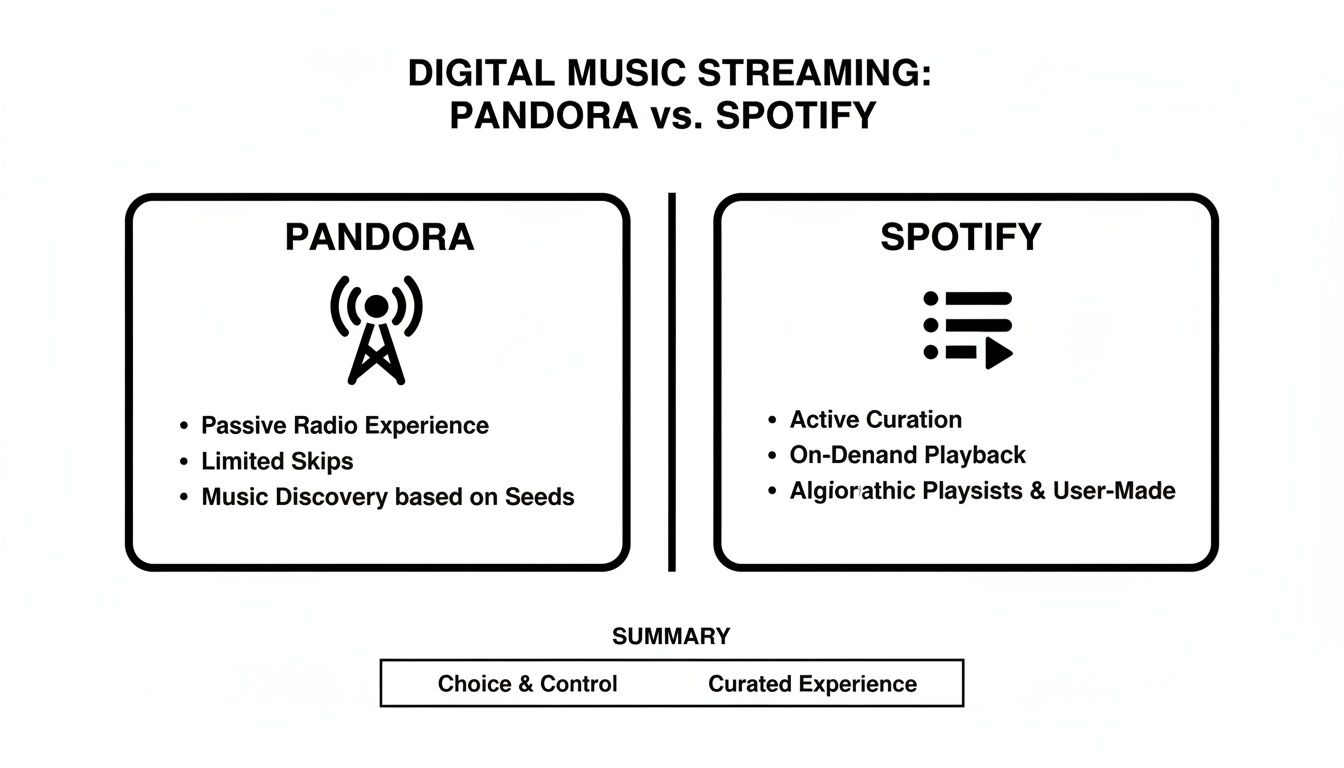
At the end of the day, your choice really boils down to how you like to listen. Do you want a service to serve you music, or do you prefer to serve yourself?
How You Discover New Music
When you stack Pandora up against Spotify, their core difference really boils down to how they help you find your next favorite song. Each one has a completely different philosophy on music discovery, and figuring out which one matches your style is the key to picking the right service.
Pandora’s entire system is built on human analysis. The foundation is its legendary Music Genome Project, a massive undertaking where real, trained musicologists have sat down and tagged millions of songs with hundreds of specific musical traits. We're not talking about simple genre tags here; this is incredibly detailed stuff like vocal harmony styles, rhythmic patterns, and even specific guitar-playing techniques.
This human-first approach means Pandora is a master at finding songs that sound alike. When you kick off a station based on an artist or a track you love, Pandora isn’t just grabbing other songs from that genre. It's digging through its data to find tracks that share the same musical DNA.
Pandora's Human-Curated Radio
What you get from this system is a classic "lean-back" radio experience that just works. The flow is incredibly consistent. If you're trying to create a station that perfectly captures the vibe of your favorite indie band from the 2000s, Pandora is uncannily good at it.
Here’s how it plays out in the real world:
- Your Goal: You need a high-energy workout mix that sounds just like Rage Against the Machine.
- Pandora's Method: Start a "Rage Against the Machine Radio" station. Pandora's algorithm immediately taps into its genome data to find other songs with heavy guitar riffs, aggressive vocals, and a driving beat. Sonic consistency is the name of the game.
This is the perfect setup for anyone whose thought process is, "I love this sound; give me more of exactly this." It’s fantastic for setting a specific mood without any jarring surprises.
Spotify's Algorithmic Playlists
Spotify, on the other hand, comes at discovery from a totally different angle, relying heavily on data and machine learning. Instead of focusing only on musical attributes, it crunches billions of data points to figure out context and user behavior. For a deeper dive into how this works, our guide on machine learning for beginners is a great starting point.
Spotify’s algorithm is a powerful combination of a few key techniques:
- Collaborative Filtering: This is the "people who like this also like that" engine. It sees that you love Artist A, and since tons of other Artist A fans also stream Artist B, it puts Artist B on your radar.
- Natural Language Processing (NLP): Spotify’s bots are constantly scanning the internet—blogs, music sites, social media—to see what people are saying about music. This helps it identify trending artists and understand the cultural conversation around them.
- Your Own Activity: Every skip, save, and repeat is a signal. Spotify is constantly learning from your actions to fine-tune what it shows you next.
This data-first model is what fuels Spotify's famous personalized playlists, like Discover Weekly and Release Radar. They aren't just designed to feed you more of what you already love; their goal is to push your boundaries a bit, introducing you to artists in adjacent genres you're likely to enjoy.
Practically speaking, starting a radio station on Spotify might feel a bit more eclectic. It’s more likely to serve you a wider variety of sounds that other people with your taste profile enjoy, rather than sticking religiously to a single sonic template. This makes Spotify’s discovery feel more like an adventure, perfect for listeners who want a blend of comfort and surprise.
Comparing Content Libraries and Catalogs
When you're picking a streaming service, the library is everything. And in the Pandora vs. Spotify matchup, this is where you'll find one of the starkest differences. It’s not just about how many songs they have, but what kind of audio experience you’re really after.
Spotify has gone all-in on becoming a true audio behemoth. We're talking a catalog of over 100 million songs. It's staggering. From global chart-toppers to obscure indie bands, if a track has a commercial release, it's almost certainly on Spotify.
But they didn't stop at music. Spotify has aggressively expanded into podcasts, locking down exclusive deals with major creators and building a library of millions of shows. If you want your music and podcasts all under one roof, with a seamless experience between them, Spotify's library is tough to argue with.
Curation vs. Comprehensiveness
Pandora, on the other hand, plays a different game. While its Premium subscribers get a solid on-demand library, Pandora’s soul has always been its radio-style curation, all driven by the famous Music Genome Project. The library is big, but it’s more focused and U.S.-centric; it isn't trying to be the exhaustive, global archive that Spotify is.
The strategies couldn't be more different. Spotify wants to be your one-stop shop for everything audio.
Spotify’s mission is to be the definitive library for all things audio—music, podcasts, you name it. Pandora's real strength is its mastery of music-first curation, making its core radio product exceptional, even with on-demand as an option.
The numbers tell the story. Spotify has a massive global audience of 675 million monthly active users. Pandora, focused on the U.S. market, sits at 41.56 million. What's more telling is the trend: Pandora has seen a gradual decline, losing over 10 million users in the last two years, while Spotify’s growth continues to skyrocket. You can see how the numbers have shifted over time and understand these user trends more deeply.
So, what does this mean for you? It really boils down to your priorities. Do you need a service that has nearly every song and podcast ever made? Or would you rather have a platform that excels at delivering a perfectly tuned music stream, even if its overall library isn’t as vast? Your answer to that question will point you straight to the right choice.
Evaluating User Experience and App Integration
How you actually use a music app every day is where the real test lies. Forget the feature lists for a second—this is where the Pandora vs. Spotify debate gets personal. The experience each app offers is built for two completely different kinds of listeners, and it affects everything from your morning commute to your evening wind-down.
Pandora is all about simplicity. It’s built around the idea of a radio; you open it up, hit a station, and the music starts. The interface is clean and doesn't demand much from you, which is a huge plus when you’re driving or in the middle of a workout and just want something good to play without a lot of tapping and searching.
Spotify, on the other hand, is built for the hands-on music lover. Its interface is much more detailed, pushing you to search, build your library, and get lost in crafting the perfect playlist. It's incredibly powerful, but if you're just looking for a simple radio stream, it can feel like you've been handed the keys to a jumbo jet when all you wanted was a bicycle.
Ecosystem and Device Connectivity
Of course, music doesn't just live on your phone. How well an app plays with all your other gadgets—speakers, TVs, cars—is a massive part of the experience. Both services have the basics covered with good support for most major devices. But this is one area where Spotify pulls way ahead.
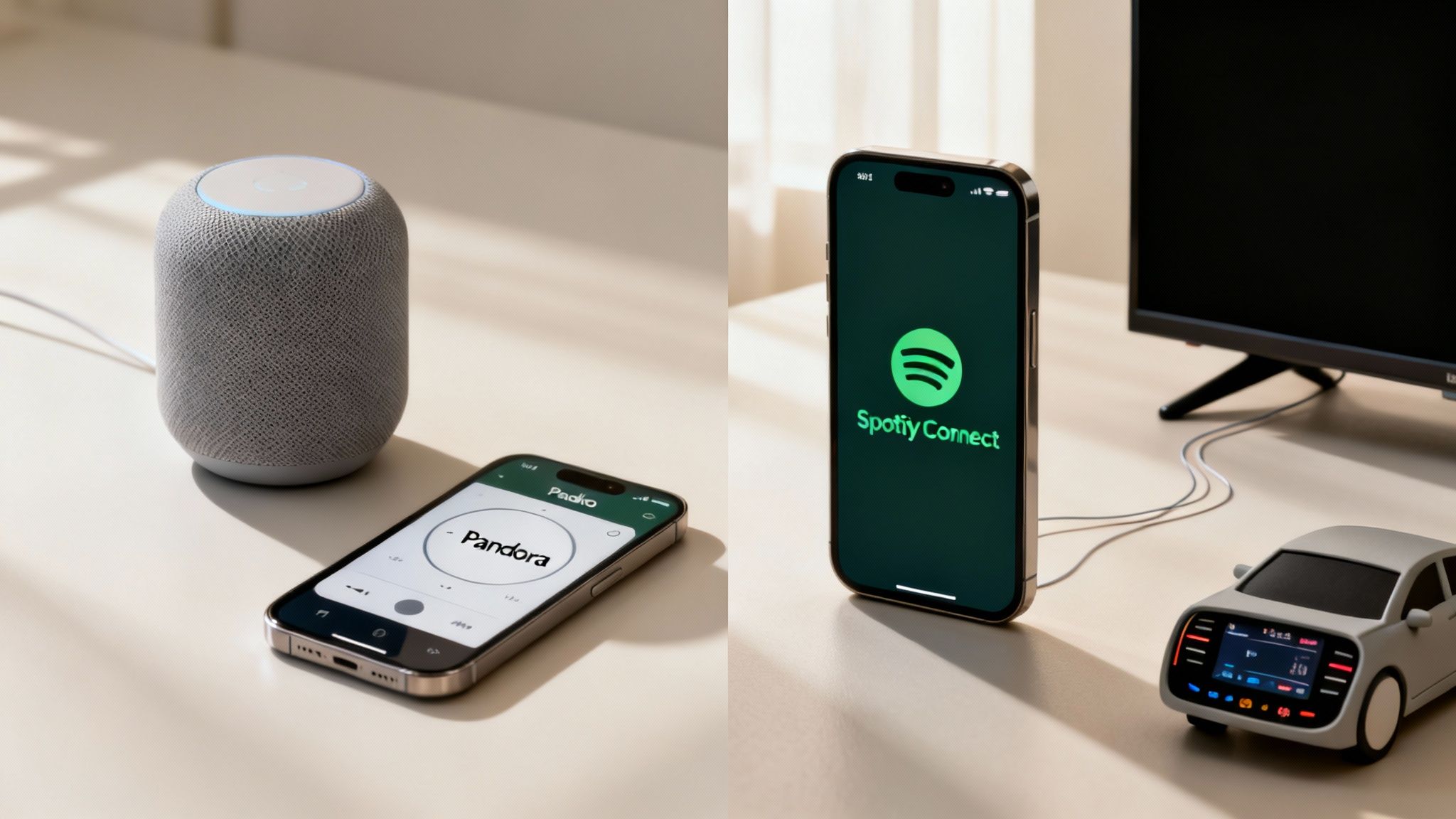
The secret sauce is a feature called Spotify Connect. Think of it as a universal remote for your music. As long as your devices are on the same Wi-Fi network, your phone can control what’s playing on your PlayStation, your smart fridge, or your bedroom speaker. It's incredibly slick.
Spotify Connect creates a seamless audio ecosystem that Pandora just can't quite match. It lets you effortlessly hand off music from one device to another, a feature that quickly becomes essential if you live in a connected smart home.
Picture this: you're listening to a podcast on your phone on the way home. You walk in the door and, with a single tap, the audio seamlessly transfers to your Google Nest Hub, picking up right where you left off. Pandora has its integrations, but it doesn't have that unified, magical control that makes Spotify feel like part of the house itself. If your smart devices struggle to stay connected, you might find our guide to improving Wi-Fi signal strength at home helpful.
Ultimately, it comes down to what you need. If you want an app that just plays great music with zero fuss, Pandora’s straightforward design is its greatest strength. But if you're invested in a smart home and want your music to move with you from room to room, Spotify's mature and deeply integrated ecosystem is in a class of its own.
Pandora vs. Spotify: So, Who Wins?
After digging into the features, pricing, and overall vibe of both services, the choice between Pandora and Spotify really boils down to how you listen to music. There isn't a single "best" option here—just the one that fits your life.
Think about it. Your daily routine—whether you're driving to work, sitting at your desk, or hitting the gym—is the biggest clue to which service you'll love. Let's match you with the right platform.
Choose Pandora If You Want to "Set It and Forget It"
Pandora is, hands down, the king of effortless listening. If you just want to press play and have a stream of great music start—perfectly matched to your mood—then Pandora’s Music Genome Project is exactly what you're looking for.
Pandora is probably for you if:
- You love radio-style listening: You'd rather create a station based on an artist you like and let the algorithm take the wheel.
- You crave sonic consistency: Your main goal is discovering new tracks that sound a lot like the songs you already know and love.
- You listen while doing other things: You need a simple, no-fuss interface for driving, working, or just having background music at a party.
Pandora is the modern-day equivalent of having a personal DJ who intuitively understands your taste. It’s all about creating that perfect, hands-off audio stream.
Choose Spotify If You're a Hands-On Music Lover
Spotify is built from the ground up for the active music curator—the person who sees their music library as a carefully tended collection. If you live for building the perfect playlist for every possible mood and want a single app for all your audio needs, Spotify is the easy choice.
Spotify is your best bet if:
- You're a playlist perfectionist: You spend time crafting specific playlists for your workouts, road trips, and study sessions.
- You want everything in one place: You need access to a massive library of over 100 million songs and millions of podcasts, all in one seamless app.
- Your home is filled with smart devices: You use smart speakers, gaming consoles, or other connected tech and will make heavy use of Spotify Connect for switching between them.
A quick tip: for a flawless multi-device setup, it's worth learning how to improve your WiFi signal strength to keep the music playing without interruption.
In the end, the Pandora vs. Spotify decision is a classic case of control versus curation. Do you want to be the DJ, or would you rather hire one? Your answer points directly to your next download.
At Simply Tech Today, our goal is to make technology simple and accessible for everyone. Explore more of our guides and articles at https://www.simplytechtoday.com.
Member discussion