
Virtual Reality vs Augmented Reality A Definitive Guide
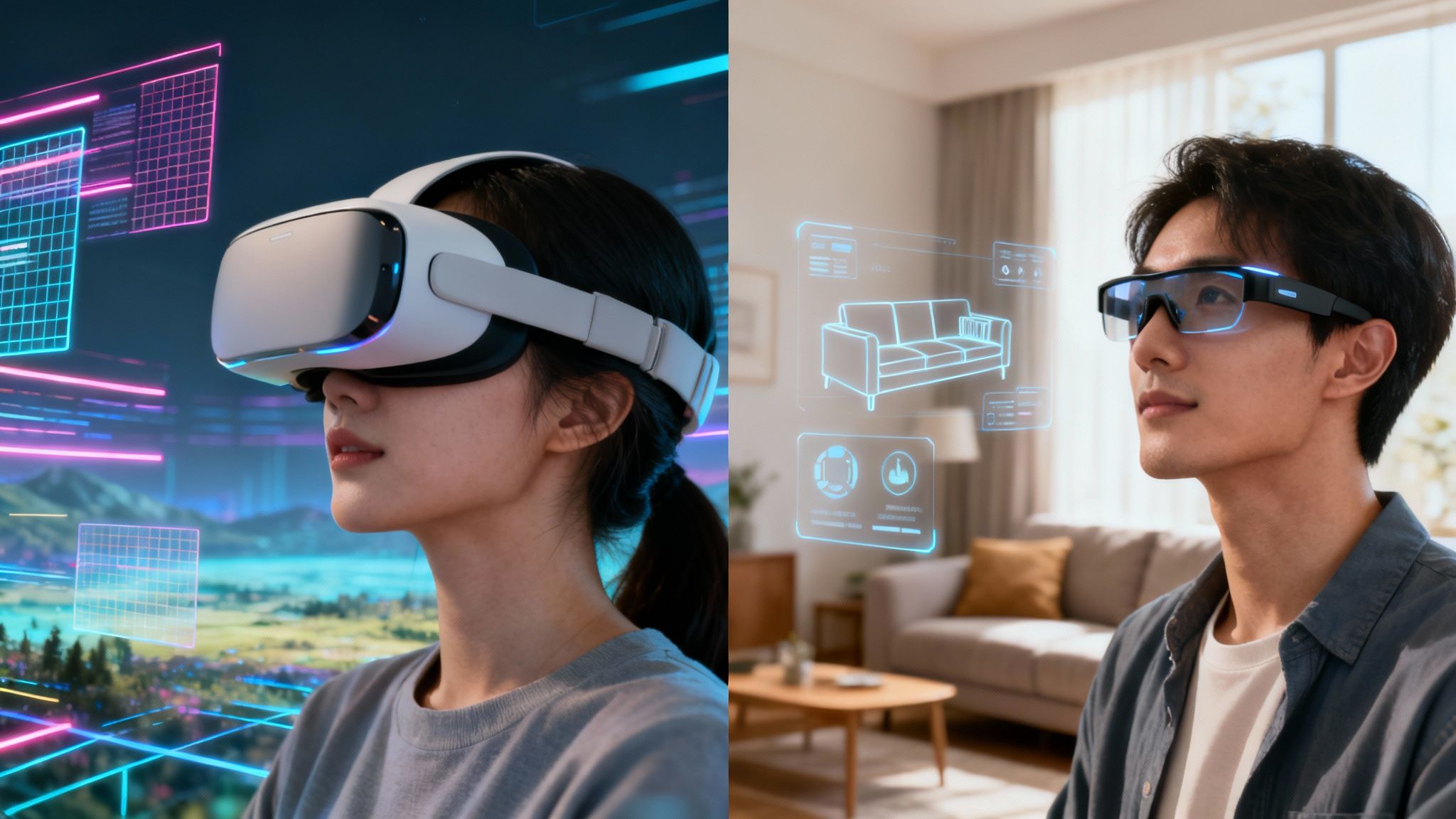
The simplest way to think about virtual reality versus augmented reality is this: VR replaces your world, while AR adds to it.
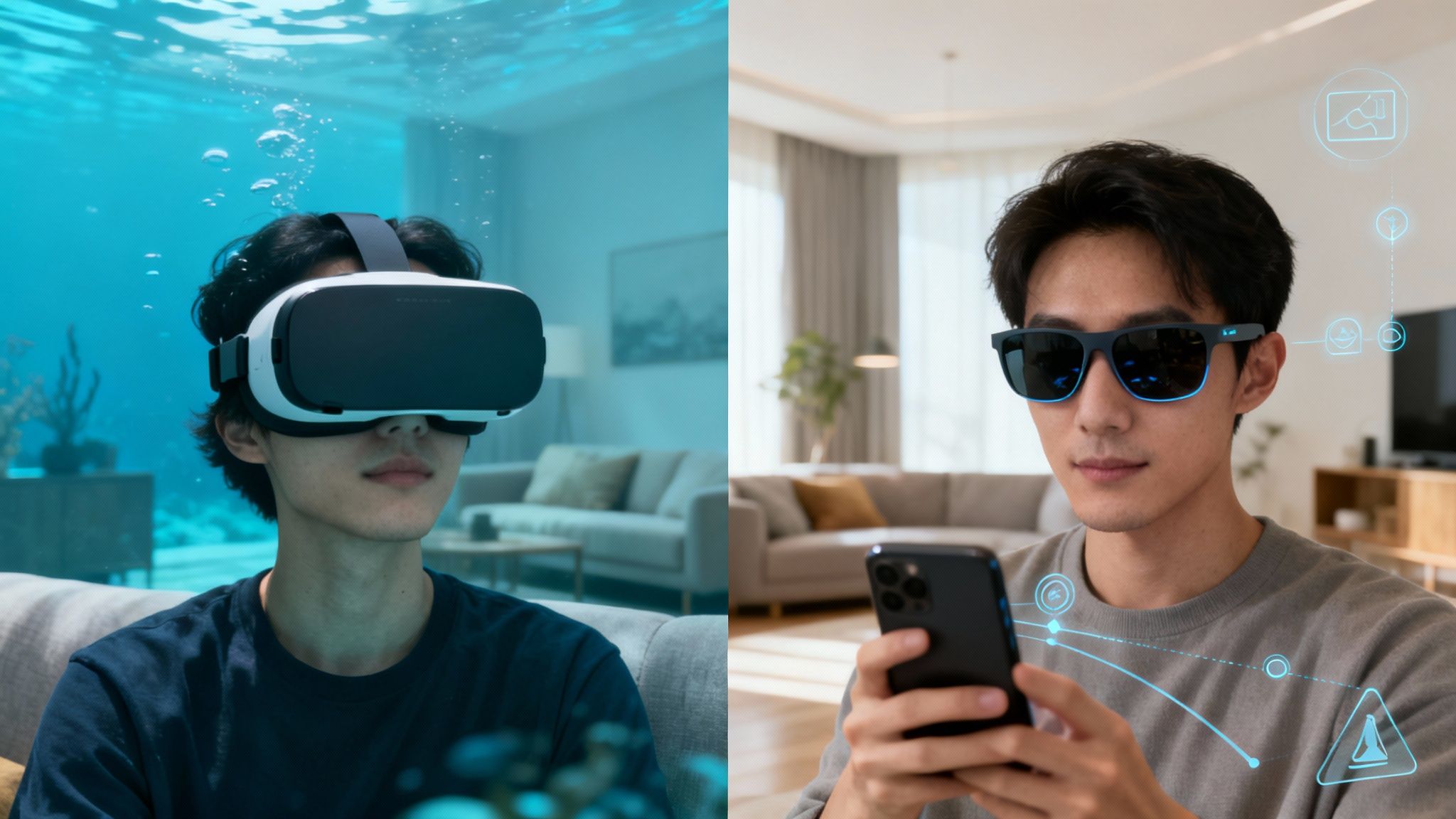
Imagine putting on a scuba mask and diving into an entirely new, all-encompassing digital ocean. That’s virtual reality. Now, picture wearing a pair of sunglasses that project a weather forecast and your text messages into the corner of your vision as you walk down the street. That’s augmented reality.
VR vs AR: What Is the Core Difference?
While both technologies create immersive experiences, they get there from opposite directions. VR's whole purpose is immersion. It uses a headset to completely block out your physical surroundings and drop you into a fabricated, computer-generated space. This total sensory swap makes it perfect for applications where you need to feel like you're truly somewhere else, whether for a game or a high-stakes training simulation.
Augmented reality, on the other hand, is all about enhancement. It takes your real-world environment—viewed through a phone camera or smart glasses—and layers digital information on top of it. You stay firmly planted in your own world, but with an extra digital layer of context and data. This makes it incredibly practical for everyday tasks. To pull this off, the tech often relies on sophisticated environmental mapping, which shares some DNA with artificial intelligence. If you're curious about how machines learn to see and interpret the world, our guide on machine learning for beginners is a great place to start.
This fundamental difference is fueling some serious market growth. The combined AR and VR market is expected to rocket from USD 75.18 billion in 2025 to a staggering USD 693.01 billion by 2035. While VR gets a lot of hype, many experts predict AR will ultimately win the race for mainstream adoption, mainly because it works on the smartphones we already have in our pockets. You can dig into the numbers and explore the full market research for a deeper look.
Core Differences Between VR and AR
To really nail down the virtual reality vs. augmented reality distinction, it helps to see their key attributes laid out side-by-side.
| Attribute | Virtual Reality (VR) | Augmented Reality (AR) |
|---|---|---|
| User Experience | Fully immersive and isolates you from the real world. | Overlays digital information onto the real world; you remain present. |
| Primary Goal | To replace reality with a simulated one. | To enhance reality with contextual data. |
| Hardware | Requires a dedicated headset (e.g., Meta Quest 3, PSVR2). | Works on most modern smartphones, tablets, and smart glasses. |
| Typical Use Case | Immersive gaming, complex training simulations, virtual tourism. | Interactive maps, product visualization, educational overlays. |
As you can see, the choice between them really comes down to the goal. Are you looking to escape your environment or add something useful to it? That’s the central question.
How Each Immersive Technology Functions
While VR and AR both pull you into a digital experience, the way they get you there is completely different. Getting a handle on the "how" behind each one is key to understanding why they feel so distinct and where each technology truly shines.
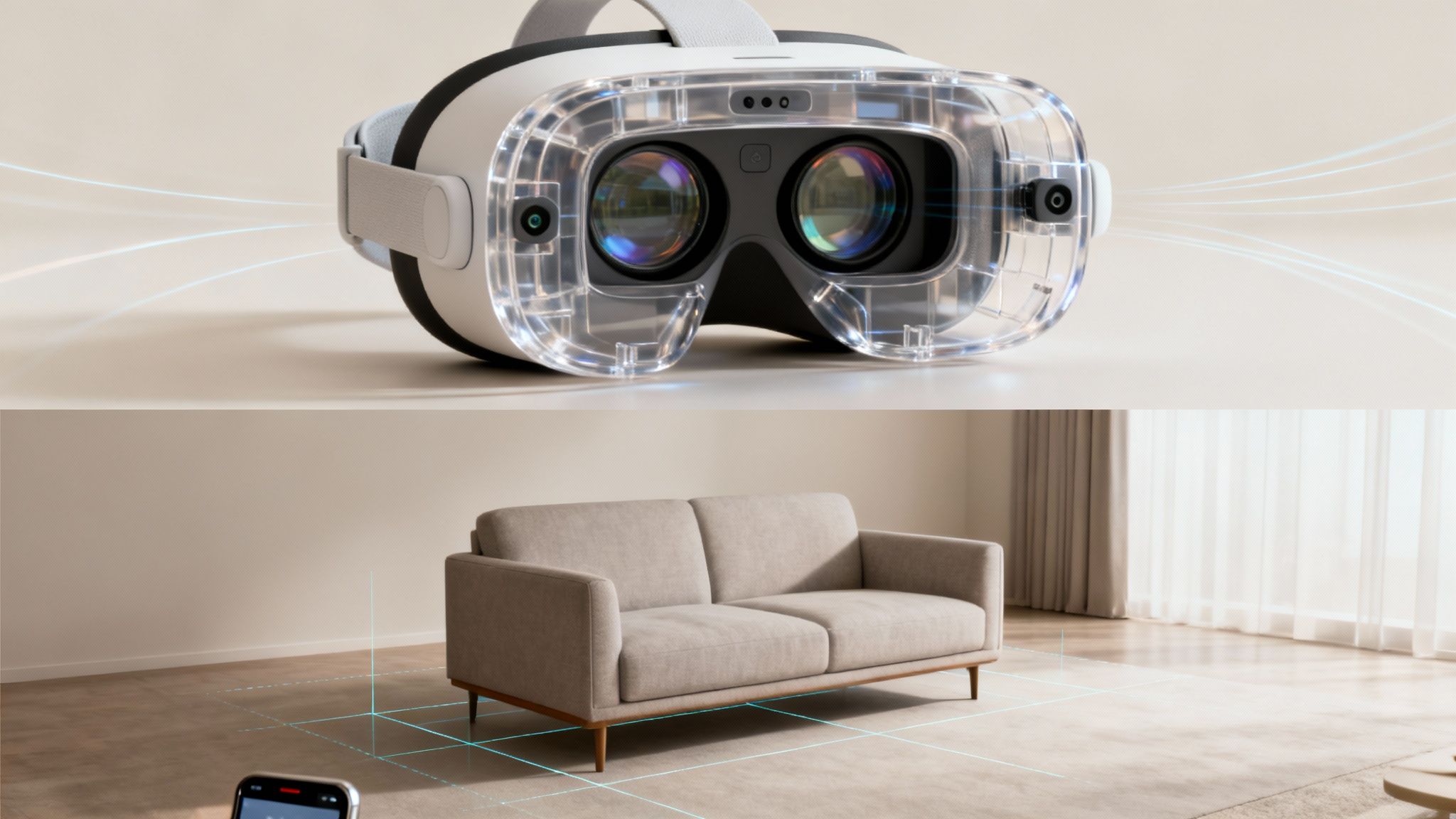
Virtual reality's entire mission is to convince your brain that you're somewhere else. To pull this off, a VR headset puts a high-resolution screen in front of each eye. Special lenses then warp these two slightly different images into a single, stereoscopic 3D view that completely fills your vision and shuts out the real world.
Of course, just seeing a new world isn't enough—you have to be able to move in it. That’s where motion tracking comes in. Sensors in the headset and controllers constantly follow your every move, making the virtual world react to your actions in real time.
Understanding VR Freedom of Movement
The quality of that motion tracking is measured in degrees of freedom (DoF), which is just a fancy way of describing how you can move around inside the digital space.
- 3DoF (Three Degrees of Freedom): This level of tracking only follows rotational movement—looking up and down, turning your head left and right, and tilting side to side. It’s what you'll find in simpler headsets designed for stationary experiences, like watching a 360-degree video.
- 6DoF (Six Degrees of Freedom): This is the whole package. On top of rotational tracking, 6DoF adds translational movement—it knows when you step forward, backward, side-to-side, or even crouch down. It's the standard for modern VR gaming because it lets you physically walk around and interact with your virtual surroundings.
How Augmented Reality Works
Augmented reality, on the other hand, starts with the world you’re already in. It uses a device's camera—usually on your smartphone or tablet—to see and map your physical environment. Using complex software, it identifies surfaces like floors, walls, and tables. Once it understands the layout of your space, it can realistically place digital objects within it.
The goal of AR isn’t to replace your reality but to use it as a canvas. The technology has to understand the real world first before it can add anything to it.
AR apps typically work in one of two ways:
- Marker-Based AR: This type needs a specific trigger image, like a QR code or a product logo. You point your camera at the marker, and the app instantly recognizes it and overlays a specific digital animation or model.
- Markerless AR: This is the more sophisticated AR you see in apps like IKEA Place, where you can drop a virtual sofa right onto your living room floor. It uses advanced environmental mapping to work without any special trigger image. This kind of heavy-duty data processing relies on a fast, reliable connection—something that's becoming more common thanks to the advancements explained in our guide on what 5G technology is.
A Tale of Two Realities: Practical Use Cases and Applications
Knowing the tech specs is one thing, but the real "aha!" moment with virtual and augmented reality comes when you see them at work. The fundamental difference isn't just a technical detail—it's what defines how they solve actual problems. They rarely step on each other's toes because one is built to replace your world, while the other is made to add to it.
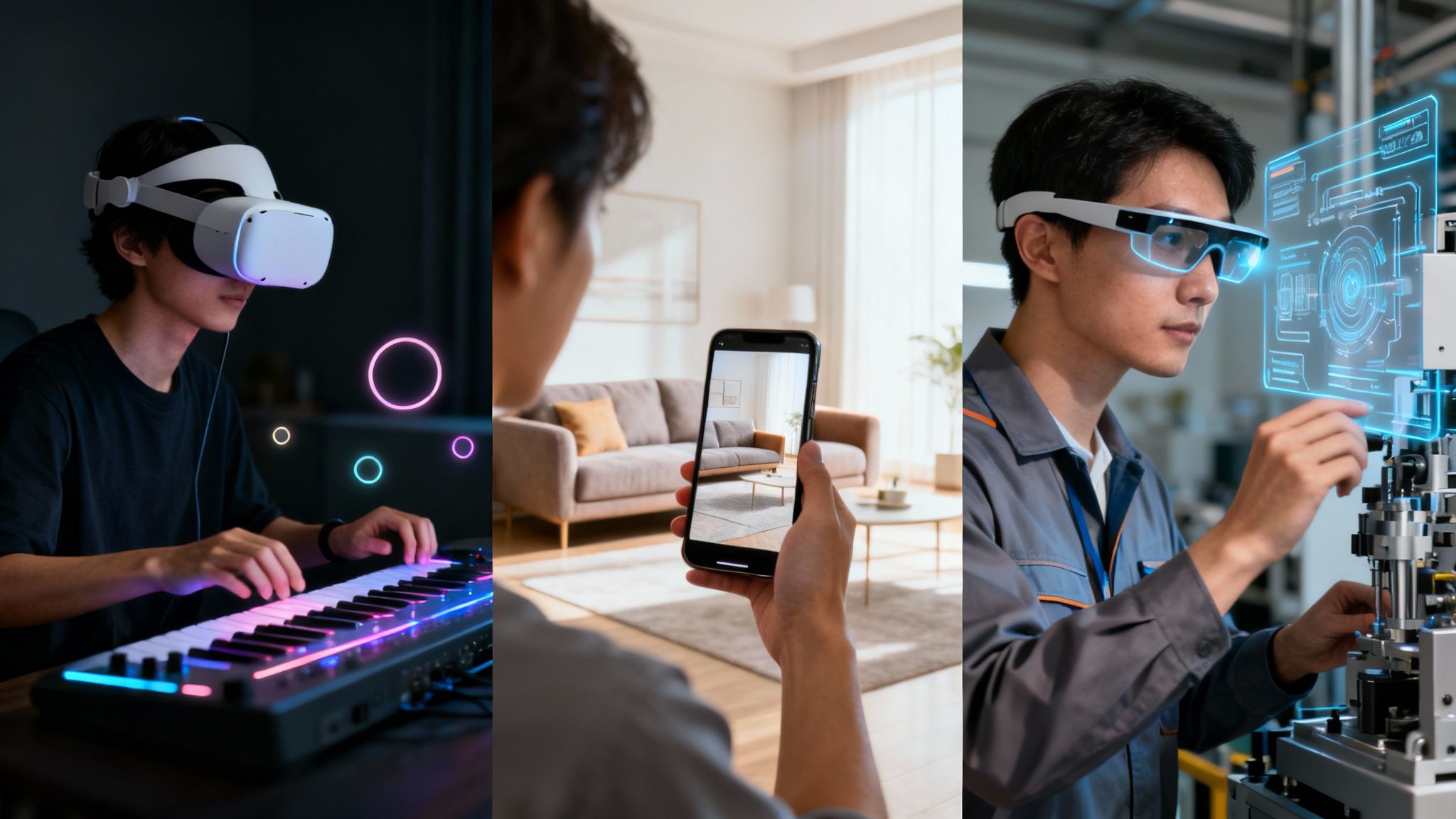
This distinction becomes razor-sharp when you look at how different industries put them to use. Whether it's for play, work, or learning, the choice between VR and AR always comes down to the ultimate goal of the experience.
Gaming and Entertainment
When it comes to gaming, the debate is all about immersion versus interaction. VR's whole purpose is to pull you out of your reality and drop you into another one. It’s pure escapism.
Think about a game like Beat Saber. You’re not just playing a game; you’re in it. Your living room vanishes, and suddenly you're in a pulsing, neon world, physically swinging your arms to slice blocks in time with the music. That complete, all-encompassing experience is what makes VR so powerful for entertainment.
Augmented reality flips that script entirely. Instead of whisking you away, it brings the game to you. The most famous example, of course, is Pokémon GO. It uses your phone’s camera to make a Pikachu appear on your lawn or a Pidgey on your desk. AR doesn't try to hide your world—it just makes it a little more fun.
VR for Gaming: The go-to for total immersion. It's for when you want to forget where you are and explore fully-realized digital worlds.
AR for Gaming: Perfect for interactive fun that weaves digital elements into your physical surroundings.
Retail and Ecommerce
The retail world really puts a spotlight on the practical, business-focused differences between VR and AR. Here, AR has carved out a massive role in helping people feel more confident about what they're buying online.
Apps like IKEA Place are a perfect example. You can use your phone to see exactly how that new POÄNG chair will look in your reading nook—to scale and in the right color—before you ever click "add to cart." This "try before you buy" magic is a game-changer for online shopping.
VR, on the other hand, is more about creating an exclusive, high-touch shopping event. A luxury automaker might build a virtual showroom where you can "sit" in their latest model, play with the leather and trim options, and get a feel for the car from thousands of miles away. It's less about utility and more about crafting a memorable brand experience.
The numbers back this up, especially for AR. Data from ExplodingTopics.com shows that AR experiences make nearly half of consumers more likely to spend more, with the market already hitting $32 billion thanks to over 1.4 billion active devices.
Professional Training and Development
In the professional world, the choice between VR and AR hinges on a simple question: does the job require a completely controlled simulation, or does it need real-time guidance in the real world?
Virtual reality is king for high-stakes training where real-world mistakes are dangerous or incredibly expensive. Medical students use VR to perform complex surgeries on digital bodies, allowing them to practice and fail without any real-world consequences. This is where VR's ability to create a safe, repeatable, and entirely simulated environment is invaluable.
Augmented reality shines by providing on-the-job support. Imagine a technician trying to fix a complex piece of industrial machinery. With AR glasses, they can see digital schematics and instructions layered directly over the engine they’re working on. If they hit a snag, a remote expert can see through their camera and draw arrows in their field of view, pointing to the exact part that needs attention. These and other powerful augmented reality use cases show how AR gives workers digital superpowers, enhancing their skills with live data.
Ultimately, looking at these applications makes the distinction clear. VR builds new worlds from scratch, while AR cleverly enhances the one we already live in.
Understanding the Hardware and Device Requirements
When you get down to brass tacks, the hardware is one of the biggest real-world differences between virtual and augmented reality. The device you choose dictates everything—cost, power, and how you actually interact with the digital world. It's probably the most important factor in figuring out which tech fits your needs.
VR is all about the headset. These devices are built to completely take over your senses of sight and sound, which is what creates that feeling of being somewhere else entirely. They generally come in three main flavors.
Virtual Reality Hardware Options
Standalone VR Headsets: Devices like the Meta Quest 3 are the easiest way to get started. All the computing power, sensors, and storage are built right into the headset, so you don't need to tether it to a powerful PC or console. This all-in-one design makes them portable, simple to set up, and perfect for gaming and social apps.
PC-Tethered VR Headsets: If you're chasing the best possible graphics and the most realistic experience, this is the way to go. Headsets like the Valve Index plug directly into a high-end computer. The PC does all the heavy lifting, rendering incredibly detailed virtual worlds. Of course, this means you need a beefy machine, and if you're building one, you'll want to know how to choose a graphics card that can keep up.
Console-Based VR Headsets: The PlayStation VR2 basically owns this category, offering a fantastic middle ground. It connects to a PlayStation 5, using the console's power to drive high-fidelity VR games. You get a premium experience without the expense or complexity of a dedicated gaming PC.
Augmented Reality Hardware Simplified
AR hardware, on the other hand, is a much simpler story. Most of us are already carrying a powerful AR device in our pockets every single day: a smartphone.
The latest iPhones and Android phones are packed with the cameras, sensors, and processing muscle needed to run thousands of AR apps, whether you're playing a game in your living room or trying on a new pair of shoes virtually.
The biggest advantage for AR is its accessibility. By using the hardware already in billions of pockets, it removes the significant cost and setup barrier that VR often presents.
Beyond phones, we're starting to see more dedicated AR devices pop up. AR glasses, like the Ray-Ban Meta smart glasses, are designed to weave digital information more naturally into your field of view. For serious professional work, you have advanced headsets like the Microsoft HoloLens 2, which can overlay complex 3D models and instructions for surgeons or engineers. These tools give us a glimpse into a future where AR is a constant, helpful layer on top of our reality.
Hardware Guide for VR and AR
To make things clearer, here's a quick breakdown of the hardware landscape, what you can expect to pay, and what each category is really good for.
| Device Category | Examples | Typical Cost Range | Best For |
|---|---|---|---|
| Standalone VR | Meta Quest 3, Pico 4 | $300 - $700 | All-in-one gaming, social VR, and casual use |
| PC-Tethered VR | Valve Index, Varjo Aero | $1,000 - $3,500 | High-end gaming, professional simulation, and development |
| Console-Based VR | PlayStation VR2 | $550 - $600 | High-quality console gaming |
| AR on Smartphones | iPhone 15 Pro, Samsung Galaxy S24 | $800 - $1,200 | Everyday AR apps, casual gaming, and retail try-ons |
| AR Glasses | Ray-Ban Meta, XREAL Air 2 | $300 - $500 | Hands-free notifications, media viewing, and basic overlays |
| Enterprise AR | Microsoft HoloLens 2, Magic Leap 2 | $3,500 - $5,000 | Industrial training, remote assistance, and complex design |
This table shows the vast difference in both cost and application. For most people, the choice comes down to a standalone VR headset for immersive fun or using the smartphone they already have for quick AR experiences. The more specialized gear is fantastic but still aimed at enthusiasts and professionals with specific needs.
Which Technology Is the Right Choice for You?
Deciding between virtual reality and augmented reality really boils down to one simple question: do you want to escape your world or enhance it? Answering that will immediately steer you in the right direction. This isn't about which one is "better" but about picking the right tool for the job.
If what you're after is total immersion—for mind-blowing games, cinematic viewing, or hyper-realistic training simulations—then virtual reality is the clear winner. It's designed to transport you completely, swapping your physical surroundings for a digital environment you can get lost in.
But if you want to bring digital information into your physical space to make life a little easier, like seeing how a new couch looks in your living room or using interactive learning guides, then augmented reality is your best bet. AR keeps you firmly planted in the real world, just with a helpful layer of digital context on top.
Making the Decision Based on Your Goals
To feel confident in your choice, think through these key areas. Each one plays to the unique strengths of either VR or AR, helping you match the tech to your true goal.
- Your Objective: Are you chasing pure escapism and entertainment (VR), or are you looking for practical, real-world information and utility (AR)?
- Desired Interaction: Do you want to manipulate objects and navigate an entirely new, simulated world (VR), or would you rather interact with digital elements placed within your actual room (AR)?
- Hardware and Budget: Are you ready to invest in a dedicated headset for a high-end, immersive experience (VR), or does the convenience of using the smartphone you already have sound more appealing (AR)?
The choice isn't permanent. Lots of people get their feet wet with mobile AR apps and only later decide to buy a VR headset once they find a specific use case they're passionate about, like gaming or virtual fitness.
Global Trends and Accessibility
Where you live might also play a role in what's more readily available. Right now, North America leads the VR market with a 35.60% share, thanks in large part to big players like Meta pushing their Quest headsets. Meanwhile, AR is seeing massive, mobile-first growth in the Asia-Pacific region, which shows just how differently these technologies are catching on around the globe. You can dive deeper into these regional market trends on Fortune Business Insights.
Ultimately, both AR and VR are powerful technologies that are weaving their way into our daily lives. As they get more sophisticated, they’ll need faster, more responsive data processing. This is where other technologies come into the picture; you can learn about the role of edge computing in our detailed guide, which breaks down why processing data closer to the user is so critical for the future of immersive tech. By thinking about your goals, budget, and how you want to interact, you can pick the technology that makes the most sense for you today.
Frequently Asked Questions About VR and AR
Even after breaking down the differences, a few key questions always pop up when people are trying to wrap their heads around virtual and augmented reality. Let's tackle some of the most common ones.
Can VR or AR Cause Motion Sickness?
Yes, it's a possibility, but the problem is getting much better. Motion sickness in VR happens when your brain gets mixed signals—your eyes see movement, but your inner ear, which governs balance, tells you you're standing still. The good news is that modern headsets with high refresh rates (90Hz or higher) and ultra-precise tracking have dramatically reduced this effect.
Still, some people are more sensitive than others, especially in fast-paced games. AR, on the other hand, almost never causes motion sickness because your view is still anchored to the real world, which keeps your brain happy.
If you're new to VR, the trick is to ease into it. Start with short, calm experiences and gradually work your way up. This gives your brain time to adjust to the new sensory input without getting overwhelmed.
Which Technology Has a More Promising Future?
That really depends on how you measure "promising." VR's future is incredibly deep and specialized. It will continue to be a game-changer in areas that demand full immersion—think hyper-realistic gaming, specialized therapy, and high-stakes job training for pilots or surgeons. Its path is about mastering specific, powerful applications.
AR, however, is poised for a much broader impact. Most experts see it becoming an everyday utility, seamlessly integrated into our lives through our phones and, eventually, smart glasses. Imagine getting navigation overlays as you walk down the street or instantly seeing product info in a store. AR's future is about becoming a helpful, almost invisible, layer on top of our daily reality.
Is My Smartphone Powerful Enough for AR?
For the vast majority of people, the answer is yes. Most modern smartphones are already built for augmented reality. Apple's devices use a framework called ARKit, and Android phones use ARCore to run these experiences.
If you bought your phone in the last few years, it almost certainly has the camera, sensors, and processing power to handle today's AR apps without a problem.
This simple decision tree can help you figure out which technology fits your needs at a glance.
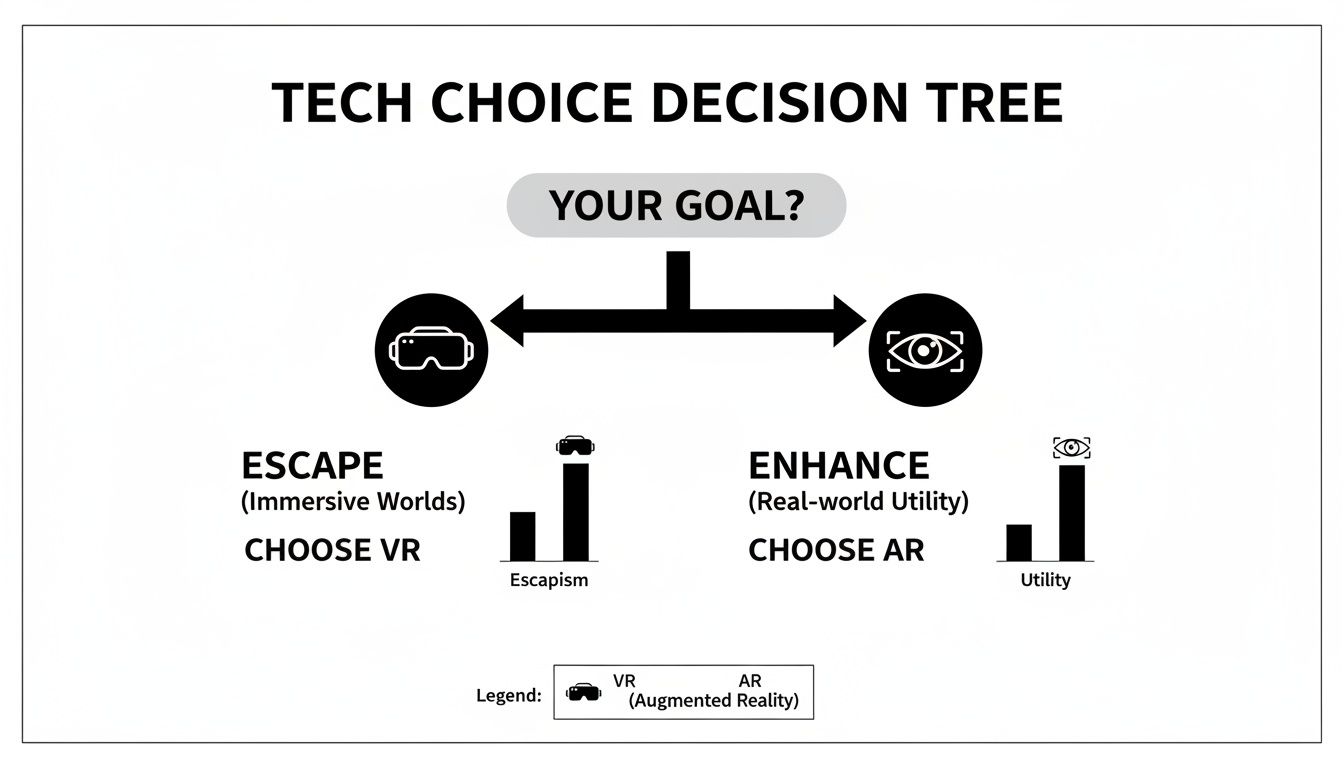
It boils down to a pretty straightforward choice: if you want to escape to new worlds, go with VR. If you want to add useful information to your current world, AR is the way to go.
Member discussion