What Is 5G Technology a Simple Guide to Next-Gen Wireless
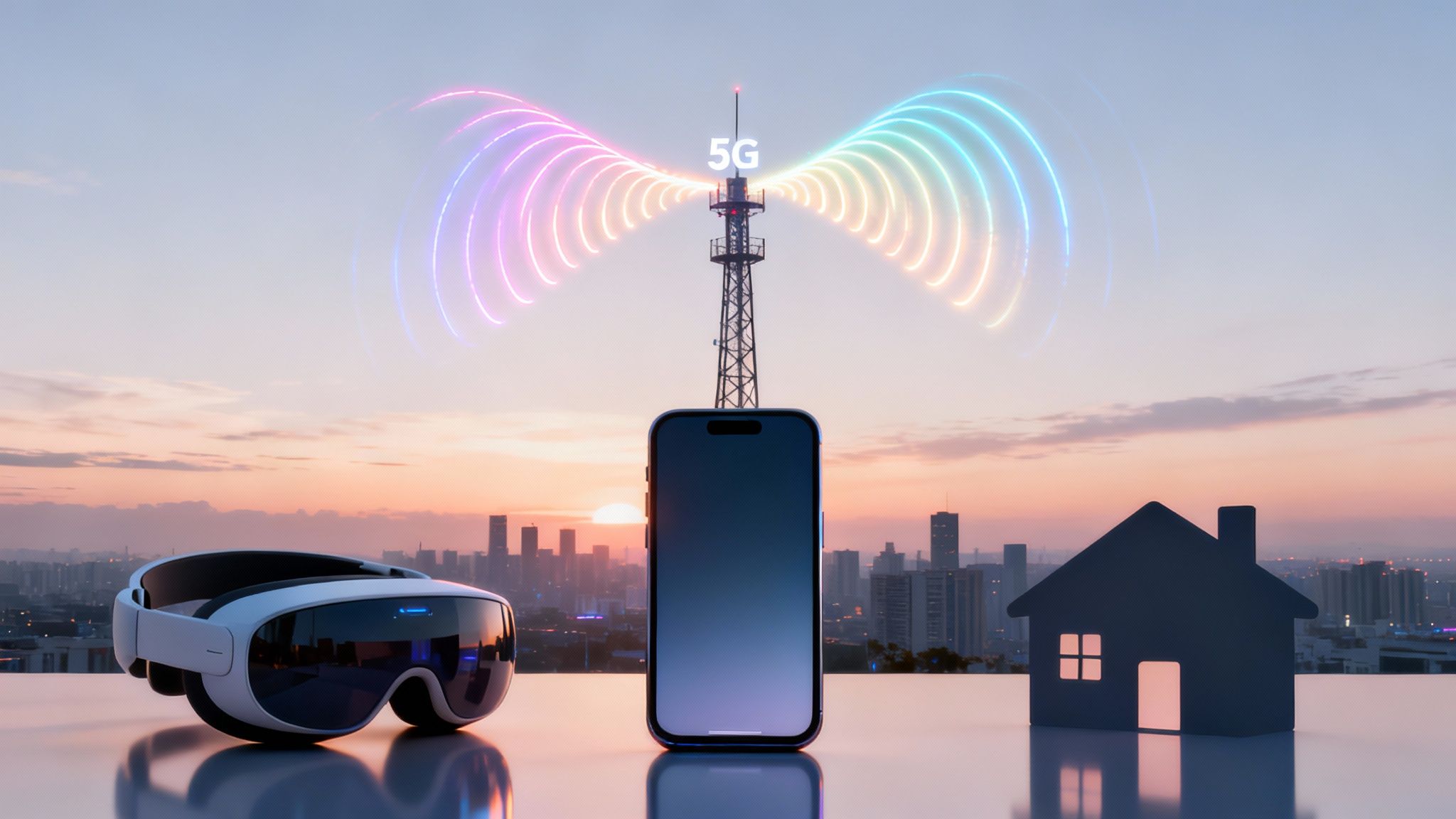
Let's get right to it. 5G is the fifth generation of wireless technology. But it’s not just another "G" to add to the list—it's a completely new kind of network, built from the ground up to be faster, smarter, and way more efficient than the 4G we've used for the last decade.
Think of it this way: if 4G was a two-lane highway, 5G is a massive, multi-lane superhighway. It’s designed to handle a ton more traffic (all our devices) at incredible speeds and with almost zero delay. It’s the foundation for a world where everything is connected, not just our phones.
This isn't just about the future, either. The groundwork is being laid right now. Carriers are already shutting down their old 2G and 3G networks to free up resources for the 5G rollout. While 4G will stick around for a while, all the real innovation is happening on 5G.
5G is more than just a speed boost. It's the connective tissue for the next wave of technology, from self-driving cars to immersive augmented reality experiences that feel instantaneous.
What Does This Mean For You, Really?
The real magic of 5G isn't just faster movie downloads on your phone (though that's a nice perk). Its true power lies in its ability to connect a huge number of devices all at once, with practically no lag. This is what unlocks technologies that felt like science fiction just a few years ago.
For you, this translates into some tangible benefits:
- Blazing-Fast Downloads: Grab a full-length 4K movie in a matter of seconds, not minutes.
- Zero-Lag Everything: Think cloud gaming that feels like it’s running on a local console or video calls so clear and smooth they feel like you’re in the same room.
- A Truly Smart World: This is the network that will finally power the massive web of connected gadgets known as the Internet of Things. You can dive deeper into that in our guide on what is the Internet of Things.
So, what is 5G? It’s the engine for the next decade of innovation. It provides the raw speed, rock-solid reliability, and instant response time needed to make smart homes, connected cities, and even technologies we haven't dreamed of yet a part of our daily lives.
Understanding the Different Flavors of 5G
One of the biggest points of confusion around 5G is that it's not just one single thing. The "5G" icon on your phone doesn't always mean the same experience. It’s better to think of 5G as a toolkit with different radio frequencies—or "flavors"—that carriers use to build their networks. Each one has its own distinct job, and knowing the difference helps set real-world expectations.
A simple analogy helps make this clear. The three main types of 5G spectrum are a bit like different types of sound waves.
Low-Band 5G: The Foundation
Think of low-band 5G as a deep, rumbling bass sound. Those low-frequency waves travel a very long way and are fantastic at getting through obstacles like walls, trees, and buildings. This makes low-band the perfect tool for carriers to blanket huge suburban and rural areas with reliable coverage.
The trade-off for that incredible range, however, is speed. While it's a definite step up from 4G LTE, the improvement is often pretty modest. If you see "5G" on your phone but aren't blown away by the speed, you're almost certainly connected to a low-band tower. Its main purpose is broad coverage, not raw power.
High-Band 5G: The Speed Demon
At the completely opposite end is high-band 5G, which you'll often hear called millimeter wave (mmWave). This is like a super high-frequency whistle—it's incredibly intense up close but fades out very quickly. This is the flavor of 5G that delivers the mind-boggling, multi-gigabit speeds you see in commercials, the kind that lets you download a full 4K movie in just a few seconds.
But here’s the catch: its range is incredibly short, and the signal is fragile. It can be blocked by almost anything—a window, a leafy tree, or even the way you hold your phone. That's why you'll only find high-band 5G in very specific, densely populated spots like sports stadiums, airports, and crowded downtown city blocks where tons of people need ultra-fast connections at once.
Mid-Band 5G: The Sweet Spot
Mid-band 5G hits that perfect balance between the other two, making it the "Goldilocks" of the mobile world. It delivers speeds that are dramatically faster than low-band, while offering far better range and wall penetration than high-band mmWave. It’s the version that provides a truly noticeable performance jump from 4G without the frustrating limitations of mmWave.
For most of us, mid-band is where the real promise of 5G comes to life. It’s the workhorse frequency that gives you that ideal blend of speed and coverage, making everything from 4K streaming to cloud gaming feel snappy and responsive.
This infographic does a great job of breaking down the core pillars that make 5G such a big step forward.
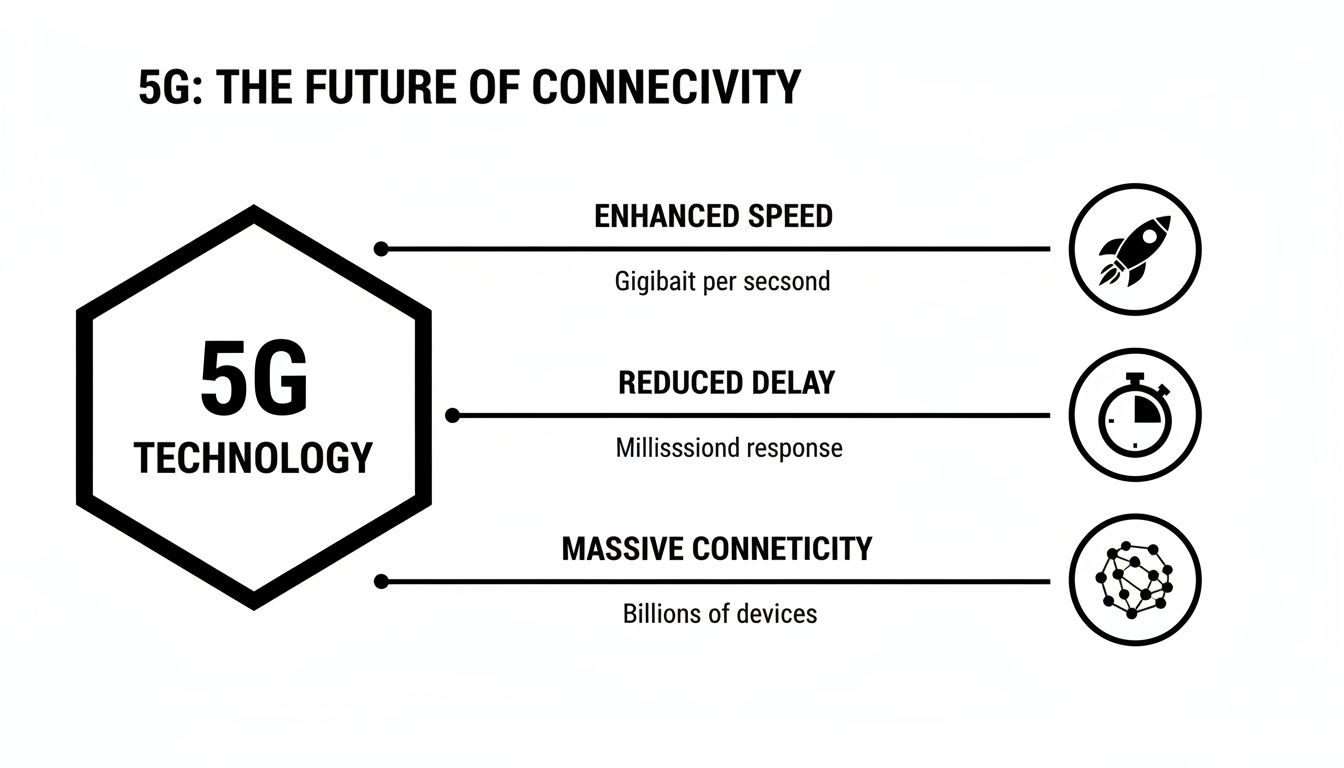
The visual shows how higher speeds, less lag, and the ability to connect more devices all combine to create a much better network. And while 5G is a huge upgrade for when you're out and about, many of us still depend on our home networks. If you're running into trouble there, you can learn how to improve WiFi signal strength in our separate guide.
So, What Is 5G Already Doing for Us?
It’s easy to get lost in the tech specs and coverage maps, but 5G isn’t just a concept for the future—it's already making a real difference in the world around us. This isn't science fiction. The combination of incredible speed, near-zero lag, and the ability to connect a ton of devices at once is unlocking new possibilities you can see and use today.
From the games on your phone to the way cities manage traffic, 5G is the quiet engine powering a smarter, more connected world. As the networks continue to grow, these innovations are becoming part of our everyday lives.
Immersive Entertainment and Gaming
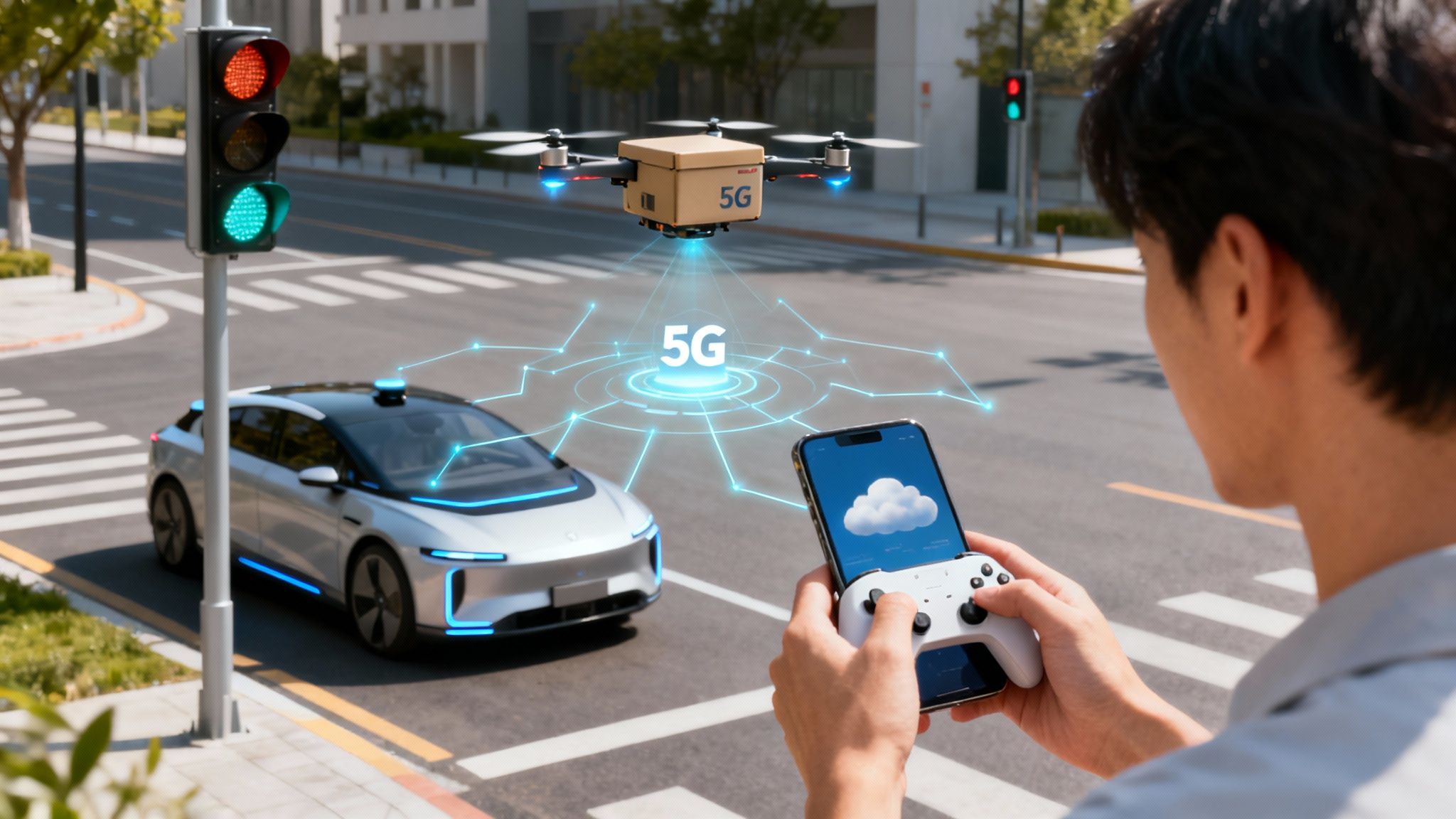
One of the first places you’ll really feel the difference with 5G is in entertainment. That ultra-low latency we talked about—the almost complete lack of delay—has finally made high-quality cloud gaming on the go a reality. Services like Xbox Cloud Gaming or NVIDIA GeForce NOW can stream blockbuster games right to your phone, and it actually works without the stuttering and lag that made it a non-starter on 4G.
The same magic is happening with augmented reality (AR). On 5G, those interactive social media filters feel snappier, and AR shopping apps that let you "place" a new couch in your living room look shockingly realistic. The digital overlay and the real world just mesh perfectly because there’s no delay. For a deeper dive into what’s possible, check out our guide on the most practical augmented reality use cases.
5G isn’t just faster internet—it's the catalyst for experiences that were previously impossible. It closes the gap between the digital and physical worlds, making interactions feel instantaneous and real.
Powering a Smarter World
Beyond just fun and games, 5G's ability to connect millions of devices within a small area is what truly unlocks the Internet of Things (IoT). This is the secret sauce that’s making our homes, cities, and even our cars much smarter and more efficient.
- Responsive Smart Homes: With 5G, your smart speakers, thermostats, and lights talk to each other and the cloud instantly. The result? Home automation that feels fluid and reliable, not clunky and slow.
- Smarter Cities: This is where it gets really interesting. 5G allows traffic lights to adjust to congestion on the fly, helps sensors monitor air quality in real-time, and gives public transit systems the power to provide up-to-the-second tracking.
- Next-Generation Vehicles: We're not at full self-driving just yet, but 5G is a huge step. It allows cars to communicate with each other (V2V) and with city infrastructure, sharing data to prevent accidents and improve traffic flow for everyone.
This massive connectivity is why adoption is skyrocketing. For example, by the end of Q2 2025, global 5G connections hit 2.6 billion, marking a whopping 37% increase from the previous year. This explosive growth means more people are enjoying smoother video calls and lag-free apps than ever before. You can read the full research about these global 5G adoption trends.
Whether it’s lag-free gaming on the bus or smarter infrastructure making your commute a little less painful, 5G is already quietly improving the world around us. It’s the foundation that countless new innovations will be built on for years to come.
Speed and Latency: The One-Two Punch of 5G
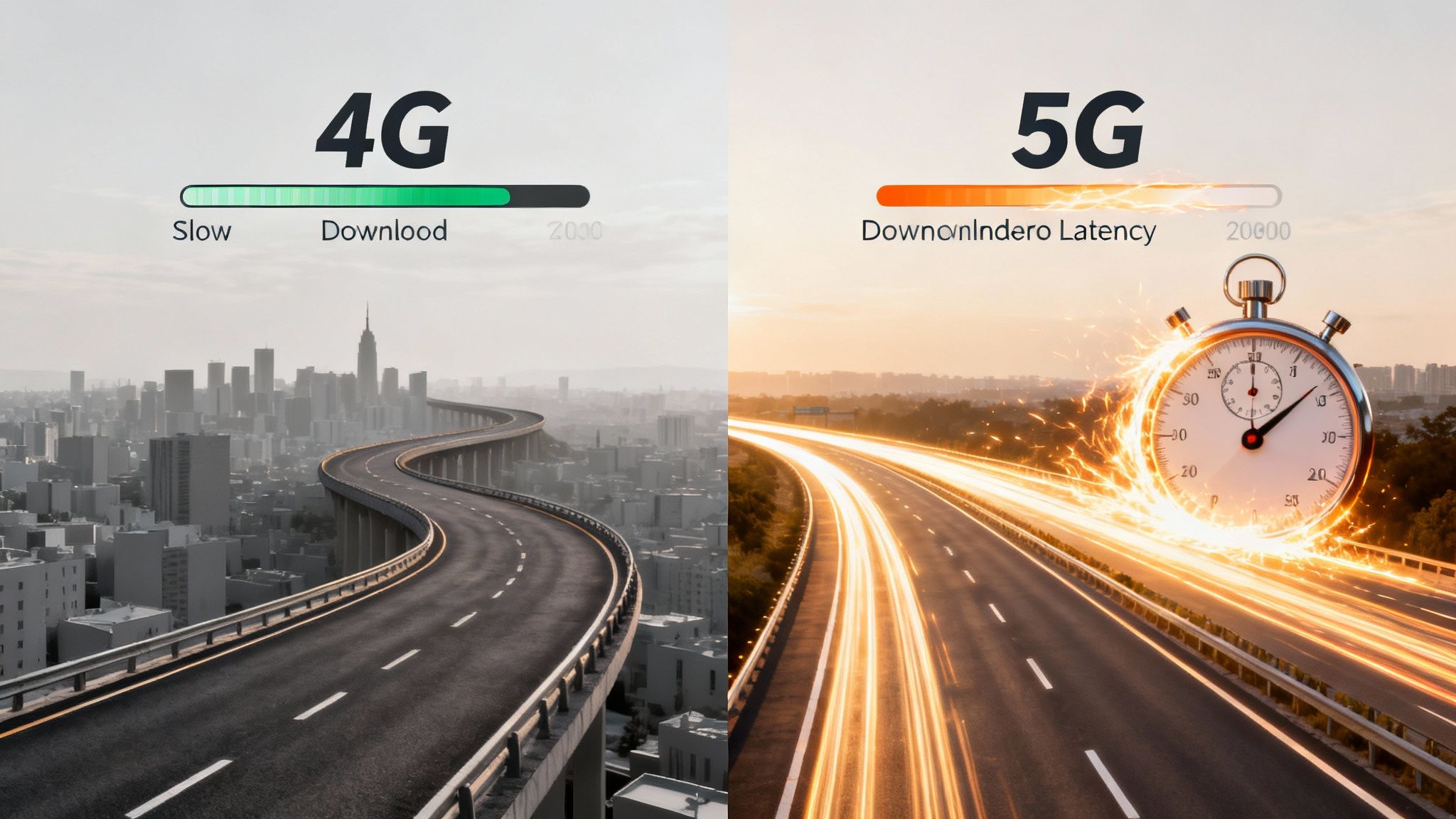
When people talk about 5G, the first thing that usually comes to mind is speed. And for good reason. On a great day, 4G might give you around 100 megabits per second (Mbps). 5G, however, is built to theoretically hit 10 gigabits per second (Gbps). That’s a 100-fold jump.
To put that in perspective, a movie that used to take several minutes to download on 4G can be on your device in just a few seconds with 5G. This isn't just about faster downloads; it means seamlessly streaming 4K video without a hint of buffering, even in a packed arena. But as impressive as raw speed is, it’s only half the story.
Why Low Latency Is the Real Game Changer
The feature that truly sets 5G apart is its incredibly low latency. Think of latency as the network’s reaction time—that tiny but noticeable delay between when you tap a button and when the action actually happens. It’s the lag that frustrates you in an online game.
With 4G, that delay is always there. But 5G slashes it down to just a few milliseconds, making the connection feel practically instantaneous. It’s this real-time responsiveness that opens up a whole new world of possibilities.
Low latency isn’t just about making things faster; it’s about making things possible. It unlocks applications where even the slightest delay could be critical, from remote surgery to autonomous vehicle communication.
This powerful combination of high speed and instant feedback is why 5G is poised to handle a massive surge in data. Projections show 5G could carry 43% of all global mobile traffic by the end of 2025, with worldwide connections expected to cross the 50% mark by 2030. You can get more details from these mobile data traffic forecasts on Ericsson.com.
For the average person, this means lag-free AR and VR experiences, uploading huge 4K videos in a flash, and video calls that feel more present than ever. It's also the backbone for complex systems like self-driving cars and smart city grids, which need to make split-second decisions. This rapid communication often happens closer to you, a concept we dive into in our guide on what is edge computing. At the end of the day, it's the mix of speed and responsiveness that makes 5G a genuine leap forward.
Cutting Through the Noise: Common 5G Myths Debunked
Whenever a new technology arrives on the scene, it’s usually followed by a cloud of questions and, let's be honest, a good bit of misinformation. With 5G, it’s no different. So, let’s clear the air and separate the facts from the fiction.
Is 5G a Health Risk?
This is probably the biggest myth out there. The short answer is no. 5G operates on non-ionizing radio waves—the very same type of energy used by 4G, Wi-Fi, and even your TV remote control.
Decades of research from major health organizations around the globe have looked into these frequencies. The consensus? There is no credible evidence linking them to negative health effects.
The key thing to understand is that 5G’s radio waves don't have enough energy to damage DNA. That puts them in a completely different category from ionizing radiation like X-rays or UV rays.
What About Security and the "Death" of 4G?
Another common worry is that 5G might be easier to hack. In reality, the opposite is true. Security was a top priority when 5G was being designed. It actually has stronger, built-in encryption and better network verification tools than any generation before it, making the whole system more secure from the ground up.
And what about that nagging feeling that your 4G phone is about to become a paperweight? Don't worry, it's not. The idea that 5G will instantly make 4G obsolete is completely off the mark.
- They're Built to Coexist: 4G and 5G networks are designed to work side-by-side for a long time. In fact, carriers use a clever technology called Dynamic Spectrum Sharing (DSS) that lets 4G and 5G signals share the exact same frequency band, like two-way traffic on a road.
- It’s a Slow Transition, Not a Switch: Think of the rollout more like a gradual upgrade to the highway system rather than a sudden demolition. Your 4G phone will work just fine for years to come.
The bottom line is that 4G LTE isn't going anywhere anytime soon. It will remain the backbone of our mobile world for at least the next decade, working in tandem with the growing 5G network. Knowing this means you can decide when to upgrade based on your needs, not on unfounded fears.
Do You Need a 5G Phone and Is It Available Near You?
With all the talk about what is 5G technology, the big question for most of us is simple: is it actually time to upgrade? The answer really boils down to two things. You need a smartphone that can handle 5G, and you need to be in an area that has 5G service.
If you have one without the other, a brand-new 5G phone will just run on the same 4G LTE network you're used to. The new speeds are great, but there's no sense in rushing out to buy a new device if your local carrier hasn't rolled out the network yet.
Checking Your Phone and Local Coverage
First things first, let's see if your current phone is even 5G-ready. A quick Google search of your phone's model or a peek into its network settings will tell you what you need to know. If your phone is more than a few years old, it almost certainly doesn't have the right hardware inside.
Next, you'll want to play detective and investigate the coverage in your area. Every major carrier has interactive coverage maps on its website. Pull them up and look at the places you spend the most time—your home, your office, and any other spots you frequent.
The decision to upgrade is personal. If you're in a strong 5G zone and frequently use data-heavy apps, the upgrade can feel like a major improvement. If coverage is spotty, waiting for your next natural phone upgrade cycle is a perfectly reasonable choice.
The global 5G rollout is picking up serious steam, fueled by over $600 billion in investment. That spending pushed the number of 5G connections from 1.6 billion in late 2023 toward an expected 2.4 billion by early 2025. North America is out in front when it comes to population reach, and in the U.S. alone, almost 50% of all wireless connections are now 5G. It's clearly becoming the new standard. You can dig into more of these impressive 5G adoption rates on TheNetworkInstallers.com.
The good news? Most new flagship smartphones now include 5G support by default. This means your next upgrade will likely be future-proof and ready to connect as soon as the network in your area is ready. When you do decide to make the jump, our guide on how to transfer data to a new phone can make the switch completely painless.
Your 5G Questions Answered
Even after getting the basics down, a few common questions always seem to pop up about 5G. Let's tackle them head-on with some quick, straightforward answers.
Will 5G Completely Replace 4G?
Nope, not for a long, long time. It’s better to think of them as partners working together. 4G is the reliable, widespread network that covers almost everywhere, while 5G is being built out to add incredible speed and responsiveness in key areas.
Carriers are using a clever technology called Dynamic Spectrum Sharing (DSS) that lets 4G and 5G signals share the same radio highway. This means they can roll out 5G more efficiently without kicking 4G to the curb.
For at least the next decade, your phone will be smart enough to jump between 4G and 5G to give you the best signal available. Your current 4G phone isn't going to stop working anytime soon.
Is My Wi-Fi Obsolete Now?
Definitely not. 5G and Wi-Fi are built for different jobs, and they actually complement each other pretty well. Your home Wi-Fi is still the king for connecting all your devices in one place—your laptop, smart TV, and gaming console—without chewing through your mobile data.
Think of 5G as your high-speed connection for the world outside your front door. While some people can now get 5G-powered home internet, it’s just another alternative to cable or fiber, not something designed to kill off your trusty Wi-Fi router.
How Do I Know If I Am Connected to 5G?
It's easy—just glance at the status bar at the top of your phone. If you have a 5G-ready phone and you're in an area with a 5G signal, you'll see a "5G" icon right next to the signal bars.
It can get a little confusing because different carriers use slightly different labels for their faster networks:
- 5G: This usually means you're on a standard low-band or mid-band 5G network. Good, but not mind-blowingly fast.
- 5G+ / 5G UW / 5G UC: Seeing one of these icons is a good sign! It typically means you’ve hit the good stuff—a high-performance mid-band or super-fast mmWave network.
No matter which icon you see, if it says "5G," you're tapping into the newest wireless tech available.
At Simply Tech Today, our goal is to make complex topics easy to understand. We break down the latest innovations and gadgets with clear, practical explanations. To keep learning with us, explore more guides and tech news at https://www.simplytechtoday.com.
Member discussion