
What Is 5G Ultra Wideband and How Does It Actually Work
5G Ultra Wideband represents the absolute peak of 5G performance. It’s the version that delivers on the hype, using high-frequency airwaves to provide staggering speeds and next-to-zero lag. Think of it as a dedicated, multi-lane express lane for your data, built specifically for crowded places where standard networks often get bogged down.
What Is 5G Ultra Wideband In Simple Terms?
You’ve probably seen "5G Ultra Wideband" pop up in your phone's status bar or in carrier commercials, but what does it really do? Put simply, it’s a brand name—most famously used by Verizon—for their top-tier 5G network. It’s not a brand new technology, but rather a specific implementation of 5G that uses high-frequency radio waves to hit those mind-blowing speeds.
This flavor of 5G was engineered to tackle a familiar problem: network congestion. While standard 5G is a huge improvement over 4G, it can still feel like a busy city street during rush hour. Ultra Wideband, on the other hand, is all about raw, unfiltered speed in targeted locations.
The Superhighway Analogy Explained
Imagine you’re in a sold-out stadium and want to stream a 4K video of the game-winning goal without a hint of buffering. That’s precisely what 5G Ultra Wideband (or 5G UW) is designed for. Verizon, a major proponent, first fired up its 5G UW network back in 2019. The strategy was to use high-frequency spectrum to push speeds up to a blistering 4 Gbps in high-traffic spots like arenas, airports, and packed city centers.
This incredible performance comes from using a much wider “lane” to transmit data. Here's a quick rundown of the benefits when you connect to an Ultra Wideband network:
- Exceptional Speeds: You can download an entire HD movie in seconds.
- Ultra-Low Latency: The delay is almost nonexistent, which is a game-changer for competitive online gaming and smooth video calls.
- Massive Capacity: It can handle thousands of devices simultaneously in a small area without breaking a sweat.
Before we get into the nitty-gritty, this table offers a quick snapshot of what 5G Ultra Wideband brings to the table.
5G Ultra Wideband At a Glance
| Characteristic | Simple Explanation | Typical Performance |
|---|---|---|
| Technology Used | Millimeter Wave (mmWave) & C-Band | High-frequency radio spectrum |
| Speed | The fastest 5G available | 1 Gbps to 4+ Gbps |
| Latency | Near-instantaneous response time | Under 10 milliseconds |
| Coverage | Very short range, requires direct line of sight | Concentrated in dense urban areas, stadiums, airports |
| Best For | High-bandwidth activities in crowded places | 4K streaming, online gaming, large file downloads |
This table shows the trade-offs: you get unbelievable performance, but only in specific locations.
By tapping into these high-frequency signals, 5G Ultra Wideband shows us the true potential of mobile connectivity and redefines what a smartphone can do. If you want a refresher on the fundamentals, you can learn more about the basics of 5G technology in our complete guide.
Understanding the Different Flavors of 5G
So, not all 5G is the same. Far from it. When your phone flashes that little "5G" icon, what you're actually experiencing can vary wildly. To really get what 5G Ultra Wideband is all about, we first have to break down the different kinds of 5G networks carriers are building out.
Think of it like different types of roads. You've got sprawling country highways, busy suburban expressways, and blazing-fast inner-city superhighways. Each is built for a different purpose, and 5G works the same way, using three main slices of the radio frequency spectrum. This is precisely why one 5G connection can feel like a small step up from 4G, while another feels like a massive leap into the future.
Low-Band 5G: The Country Highway
First up is low-band 5G, which operates on frequencies below 1 GHz. Sticking with our road analogy, this is the reliable country highway. Its signals travel for miles and have no trouble passing through buildings, trees, and walls. It’s the backbone of nationwide 5G coverage for a reason.
The catch? Speed. While it's a bit snappier and more efficient than the 4G LTE we're all used to, low-band 5G delivers the most modest performance of the bunch. It’s all about providing a consistent, dependable connection across a massive area.
Mid-Band 5G: The Suburban Expressway
Next, we have mid-band 5G, which you'll often hear called C-Band. This flavor operates in the sweet spot between 1-6 GHz. This is the suburban expressway of the 5G world—a perfect blend of speed and reach. It's noticeably faster than low-band, with much lower lag, but its signals can still cover a neighborhood or several city blocks without issue.
This balanced performance is why many experts call mid-band the “goldilocks” of 5G. It’s fast enough to handle demanding tasks like 4K streaming and competitive online gaming, yet practical enough for carriers to deploy widely in cities and suburbs.
High-Band 5G: The Inner-City Superhighway
Finally, we arrive at high-band 5G, the technology behind the Ultra Wideband name. Also known as millimeter wave (mmWave), this is the inner-city superhighway. Operating on super-high frequencies above 24 GHz, it unlocks incredible, multi-gigabit speeds and almost nonexistent lag. The potential here is huge, especially for things like powering the next generation of connected devices in the Internet of Things.
But there’s a major trade-off. These high-frequency signals are fragile. They travel very short distances—we're talking a block or two at best—and can be blocked by almost anything: walls, glass, or even your own hand. This is why you’ll typically only find it in dense, high-traffic venues like stadiums, airports, and packed downtown city centers where its massive capacity can serve thousands of people at once.
To make these differences crystal clear, let's lay it all out side-by-side.
Comparing 5G Flavors: Low-Band vs Mid-Band vs Ultra Wideband
| Feature | Low-Band 5G | Mid-Band 5G (C-Band) | High-Band 5G (Ultra Wideband) |
|---|---|---|---|
| Speed | Modest (Slightly faster than 4G LTE) | Fast (Multiple times faster than 4G) | Extremely Fast (Gigabit+ speeds) |
| Coverage | Excellent (Nationwide reach, miles) | Good (Covers neighborhoods, city blocks) | Limited (Short range, block-by-block) |
| Building Penetration | Excellent | Fair | Poor (Easily blocked by obstacles) |
| Latency | Good | Very Good | Excellent (Near-instant response) |
| Common Use Case | Baseline nationwide coverage | Balancing speed and coverage in metro/suburban areas | Dense urban areas, stadiums, airports |
| Analogy | Country Highway | Suburban Expressway | Inner-City Superhighway |
As you can see, each flavor of 5G is designed to solve a different problem. Low-band gives us a foundational layer of coverage, mid-band delivers a fantastic performance boost to the masses, and Ultra Wideband provides mind-blowing speed where it's needed most.
How Fast Is 5G Ultra Wideband in the Real World?
All this talk about gigabits per second sounds impressive, but what does that speed actually feel like when you're using your phone? It's one thing to see numbers on a screen, but connecting to a 5G Ultra Wideband network is a genuine game-changer. This isn't just a little bit faster; it's the kind of leap in performance that fundamentally changes how you use your devices.
Think about this: you’re at the airport, about to board a flight, and you realize you forgot to download a movie. On a normal connection, you probably wouldn't even try. With Ultra Wideband, you could download a full-length HD movie in under a minute. That massive update for your favorite game that would usually tie up your home Wi-Fi for an hour? It could be done in just a couple of minutes. That's the real-world difference we're talking about.
It's About More Than Just Speed
Raw download power is only half the story. The secret ingredient that makes 5G Ultra Wideband feel so snappy is its incredibly low latency.
Latency is basically the network's reaction time—the tiny delay between when you tap a button and when the action actually happens. Lower latency means a more responsive, real-time feel for everything you do.
For a competitive gamer, high latency is the difference between winning and losing. 5G Ultra Wideband can crush that delay down to single-digit milliseconds—we’re talking under 10ms. This makes it an absolute dream for gamers trying to dodge bullets in an online battle or for a surgeon guiding a remote robotic arm where every millisecond counts. Compare that to the tens of milliseconds you get with 4G LTE, and you'll understand the leap. This high-frequency mmWave signal just packs way more data into every second, hitting peaks of 5-10 Gbps in perfect conditions. You can see how 5G Ultra Wideband speeds are achieved in more detail over at Symmetry Electronics.
This diagram helps visualize the different "lanes" of the 5G highway we've been discussing.
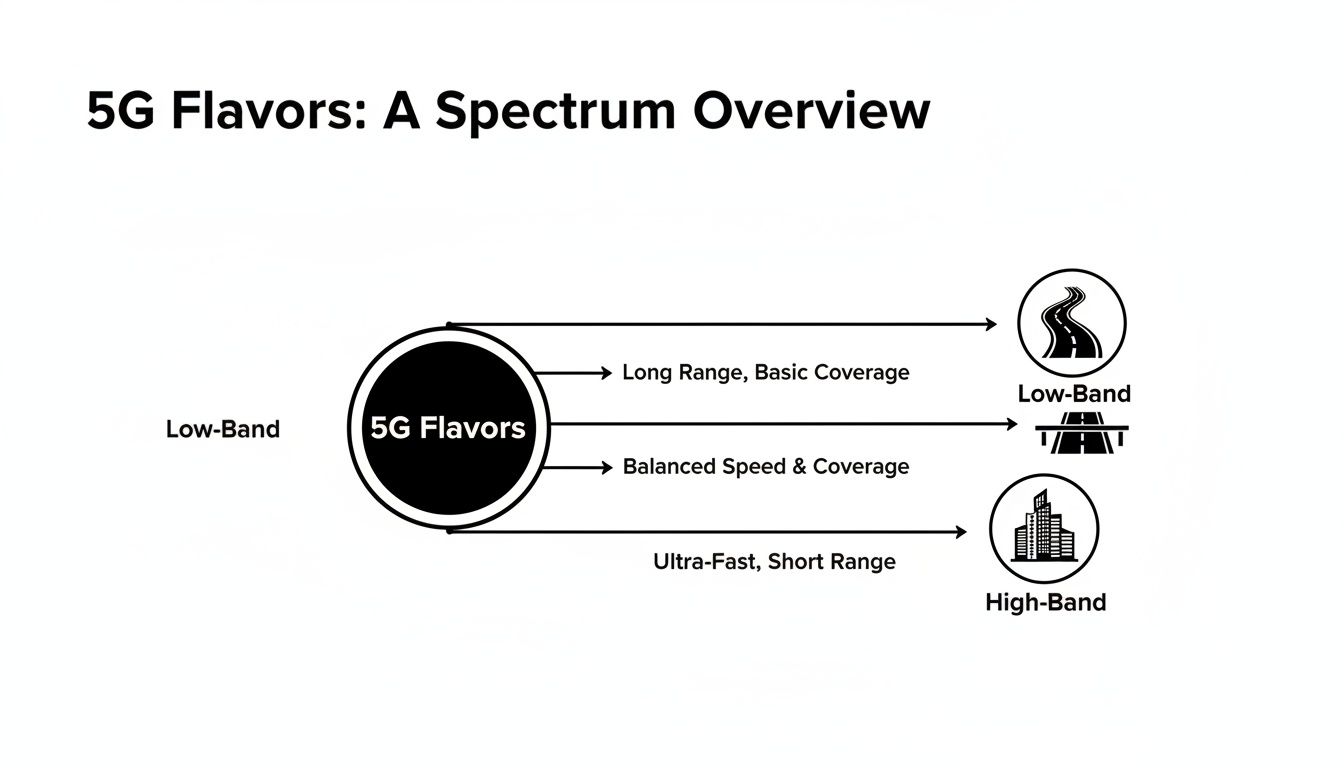
As you can see, there's a clear trade-off. High-band (our Ultra Wideband) is the super-fast expressway found in dense city areas, while low-band is more like a wider-reaching country road—slower, but it gets you almost anywhere.
Real-World Performance Benchmarks
So, how does all this stack up against the connection you're probably used to? The jump is massive.
In real-world tests, 5G Ultra Wideband connections consistently clock in with download speeds over 1 Gbps (that's 1,000 Mbps) and have even hit more than 4 Gbps under the right conditions. This is often 10 times faster than standard 5G and can be up to 25 times faster than a good 4G LTE connection.
Here's what that kind of power unlocks in your daily life:
- Instant App Downloads: Big apps and games are ready to go in seconds, not minutes.
- Buffer-Free 4K/8K Streaming: You can stream the highest quality video on multiple devices without a hiccup, even in a crowded stadium.
- Seamless Cloud Gaming: Play console-level games right on your phone with a response time that feels just like you’re hooked up to a dedicated gaming rig.
- Real-Time Collaboration: Upload and share enormous files instantly, making remote work and creative projects incredibly smooth.
This level of performance is also laying the groundwork for more advanced technologies. For instance, you can discover how this technology supports edge computing in our detailed guide, where processing data almost instantly is a necessity. In the end, 5G Ultra Wideband is about more than just making your phone faster—it’s opening the door to new experiences that were never possible on a mobile network before.
Decoding the 5G Icons on Your Phone
Ever look at your phone’s status bar and see "5G," only for it to change to "5G UW" or "5G UC" a few minutes later? It’s not a glitch. Those little letters are your carrier’s way of telling you what kind of 5G network you’re currently connected to—and what kind of performance you can expect.
Think of it like the different types of coffee at a cafe. The standard “5G” icon is your basic house blend. It gets the job done and is definitely a step up from yesterday's brew (4G LTE), but it's not the premium single-origin espresso. Those other icons? That's the good stuff.
What Carrier Icons Mean for Your Connection
Mobile carriers all have their own branding for their fastest 5G services, which run on high-performance mid-band and high-band spectrum. The names might be different, but they all promise the same thing: a serious jump in speed and a much more responsive connection.
Here’s a quick rundown of the icons you’ll see from the major U.S. carriers:
- 5G UW (Ultra Wideband): This is Verizon’s brand for its top-tier 5G. If you see this icon, you’re connected to either its blazing-fast high-band mmWave network or its powerful mid-band C-Band network.
- 5G UC (Ultra Capacity): T-Mobile uses this symbol to show you’re on its high-speed mid-band or high-band 5G. This means you’re getting a major performance boost over its standard nationwide 5G coverage.
- 5G+: This is AT&T's icon for its fastest 5G, which uses a combination of mmWave and mid-band C-Band spectrum to deliver the best speeds it has to offer.
The bottom line is this: if you see "UW," "UC," or "+" next to the 5G symbol, you’ve hit the jackpot. You’re on your carrier’s fastest network in that area, so expect much quicker downloads and flawless streaming.
These icons are really about setting expectations. A plain "5G" icon usually means you’re on a low-band network, which offers great coverage but speeds that aren't dramatically faster than 4G. Seeing one of those enhanced icons confirms you’re in a spot with true 5G Ultra Wideband performance. This distinction matters just as much whether you're using an Android or an iPhone. For a deeper dive on those platforms, check out our guide on the pros and cons of Android vs iPhone.
Why Is Ultra Wideband Coverage So Hard to Find?
If 5G Ultra Wideband is so blazing fast, you’re probably wondering: why isn’t it everywhere? The answer boils down to a classic trade-off between speed and reach. It's a fundamental principle of radio physics.
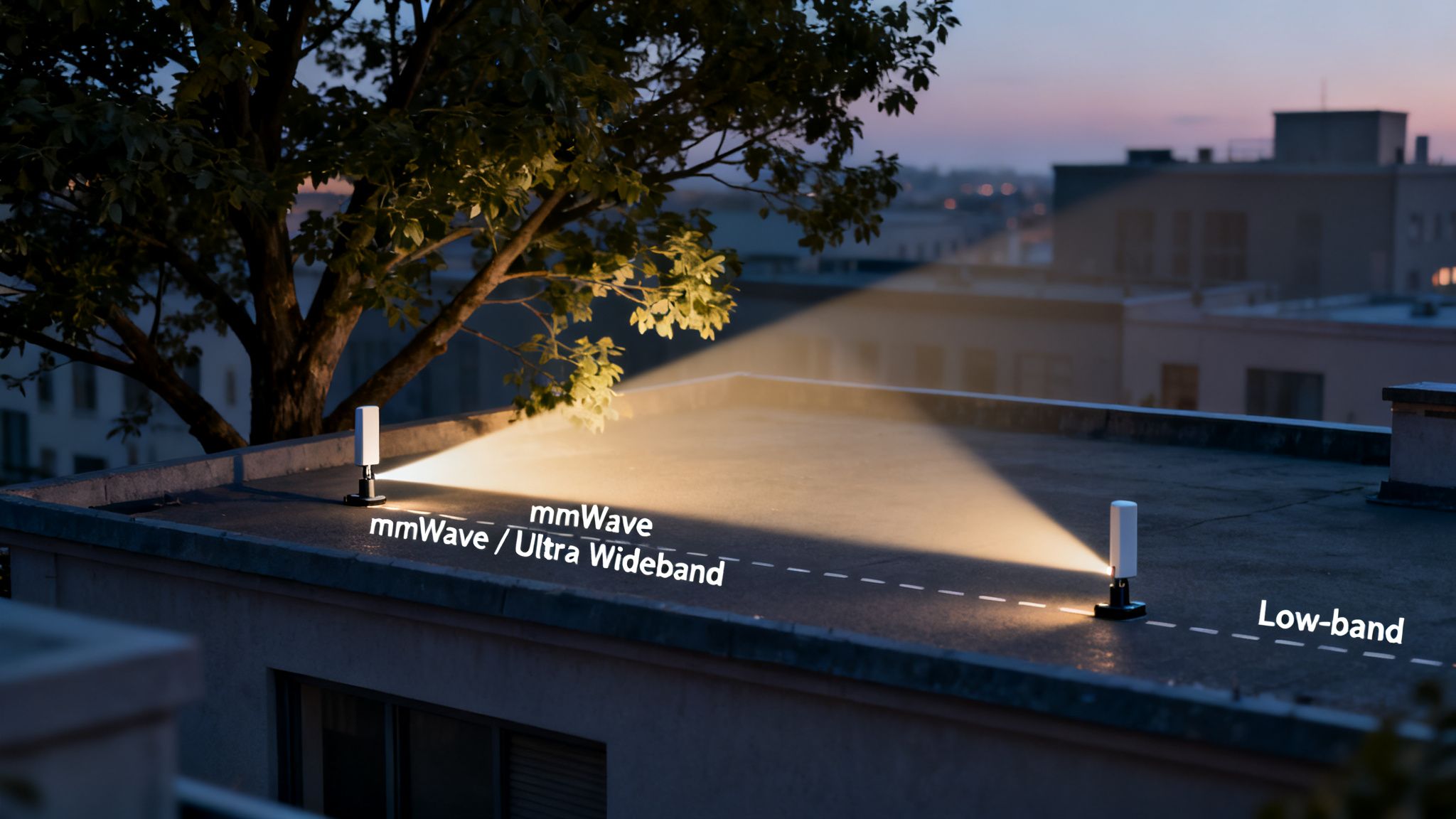
Think of it like this. You're trying to light up a huge backyard at night. You could use a laser-focused spotlight or a wide-angle floodlight. The spotlight is incredibly bright but only hits a tiny patch of grass. The floodlight is dimmer, but it manages to cover the whole yard.
5G Ultra Wideband is that powerful spotlight. It delivers an intense, high-speed connection but over a very short distance. Standard 5G, on the other hand, is the floodlight—its coverage is vast, but the performance isn't nearly as concentrated. This isn’t a flaw in the technology; it's just how the radio waves work.
The Problem with High-Frequency Signals
Ultra Wideband gets its incredible speed by using what are known as millimeter wave (mmWave) frequencies. These signals are like tightly coiled springs, packed with the potential to carry massive amounts of data. But that high energy comes with a price: they're fragile.
These mmWave signals have an extremely short range, sometimes just a few city blocks. They also have a tough time getting through physical objects. This is the main reason why when you ask what is 5g ultra wideband, the answer often involves spotty, limited coverage.
The very physics that make mmWave signals so fast also make them delicate. Their inability to pass through solid objects means you often need a clear, direct line of sight between your phone and the cell tower to get that top-tier speed.
What Stops the Signal in Its Tracks?
The lower-frequency signals used for 4G and regular 5G can sail right through walls, but mmWave signals get stopped by all sorts of everyday things. It’s a bit like sound. You can hear the deep thumping bass from a neighbor's stereo through the wall, but the higher-pitched treble gets muffled almost completely.
Here are some of the most common things that can block or weaken an Ultra Wideband signal:
- Buildings and Walls: Concrete, brick, and even certain types of energy-efficient glass can act like a brick wall to mmWave.
- Trees and Leaves: You might not think it, but the leaves and branches on a tree are surprisingly good at absorbing these high-frequency signals.
- Heavy Rain: A serious downpour can scatter and disrupt the signal's path to your phone.
- Your Own Hand: It sounds crazy, but sometimes just holding your phone the wrong way can block the antenna and kill your connection.
Because of these challenges, carriers have to build out a very dense network of small cell sites—you'll see them on lamp posts, traffic lights, and the sides of buildings. This is why you typically only find Ultra Wideband in packed urban areas, stadiums, and airports, where tons of people are crammed into a relatively small, open space.
How to Get 5G Ultra Wideband Access
So, you're ready to experience what the fastest 5G has to offer? Getting connected isn't just a matter of luck; it’s a three-part puzzle. You need the right device, the right mobile plan, and you have to be in the right location.
Think of it like trying to listen to a special HD radio broadcast. You can't just use any old radio. You need a specific HD-capable receiver, a subscription to the service that includes it, and you must be within range of the broadcast tower. Let's walk through each piece of the puzzle.
Check Your Device Compatibility
First things first: does your phone have the right hardware? To tap into Ultra Wideband, your smartphone needs the specific antennas to "hear" those high-frequency signals. Not all 5G phones are built the same, and many budget or older models only support the slower, more widespread versions of 5G.
To get the real speed, your device must support millimeter wave (mmWave) and C-Band frequencies.
Most flagship phones from Apple, Samsung, and Google released in the last couple of years are good to go. But how can you be sure about your specific model? The simplest way is to look up the official specs online. Just search for your exact phone model followed by "specifications" and scan the networking details for terms like "mmWave," "n260," "n261," or "C-Band." If you see those, you're in business.
Verify Your Mobile Plan
This is a big one. Carriers often position 5G Ultra Wideband as a premium perk, meaning it’s usually bundled with their more expensive, higher-tier unlimited data plans. If you're on an older, cheaper, or limited-data plan, you could be standing in the middle of a coverage zone with a compatible phone and still not connect.
You'll almost certainly need to be on one of your carrier's premium plans. For instance, Verizon bundles 5G Ultra Wideband with its "Unlimited Plus" and "Unlimited Ultimate" plans, while T-Mobile includes its "Ultra Capacity" 5G with plans like "Go5G Plus."
Pop open your carrier’s app or log into their website and take a close look at your current plan's features. If premium 5G access isn't listed, you'll likely need to upgrade to unlock those top speeds. While you're optimizing your mobile connection, it’s a great time to also learn how to improve your home Wi-Fi signal strength for faster speeds everywhere.
Confirm You Are in a Coverage Area
Finally, the most crucial step: you have to actually be where the signal is. Since Ultra Wideband coverage is still far from universal—especially the super-fast mmWave flavor—checking your carrier's official map is a must. Don't rely on word-of-mouth; the maps are your ground truth.
- Verizon Coverage Map: Pinpoints exactly where its 5G Ultra Wideband network is live.
- AT&T 5G+ Map: Lets you see the areas where its fastest "5G+" service is available.
- T-Mobile 5G UC Map: Shows off its massive "Ultra Capacity" 5G footprint.
These maps are interactive, so you can zoom right into your city, your neighborhood, or even your street to see if you're covered. As a rule of thumb, you'll have the best luck in dense urban centers, airports, and large public venues like sports stadiums.
Got Questions About 5G Ultra Wideband? Let's Clear Things Up
Alright, so we've covered the basics of what 5G Ultra Wideband is. But what does it actually mean for you and the phone in your pocket? Let's walk through some of the most common questions people have.
Do I Need a Special Phone for This?
The short answer is yes, you absolutely do. To tap into the super-high frequencies of mmWave and C-Band, your smartphone needs the right internal hardware—specifically, the right modem and antennas.
Most of the flagship phones from Apple, Samsung, and Google released over the past couple of years are ready to go. But if you have a budget 5G phone or an older model, it might only support the slower, low-band versions of 5G. The best way to know for sure is to check the official spec sheet for your device before you jump into a premium plan.
Think of it like a puzzle. You need three pieces to fit together perfectly: a compatible phone, the right data plan, and to be in an area with Ultra Wideband coverage. If one piece is missing, you won't get those top-tier speeds.
Is Ultra Wideband Going to Kill My Battery?
It's true that 5G, in general, can be a bit more power-hungry than 4G, and the high-performance nature of Ultra Wideband is no different. When your phone is working hard—say, downloading a huge file or streaming a 4K movie—it's going to use more juice.
The good news is that modern smartphones are pretty smart about managing power. They won't stay connected to the high-power Ultra Wideband signal all the time. For less demanding things like background notifications or light web browsing, your phone will automatically switch to a more energy-efficient connection. This helps strike a balance between getting incredible performance when you need it and preserving your battery life when you don't.
Is This Technology Actually Safe?
Worries about radio waves from phones have been around forever, but the global scientific and health communities have a pretty clear consensus on this. All 5G technology, including the Ultra Wideband variants, operates well within the safety limits set by international organizations.
The really high-frequency mmWave signals, which deliver the fastest speeds, are what's known as "non-ionizing." This just means they don't have enough energy to cause damage to your DNA. In fact, these signals are so weak at passing through solid objects that they struggle to even get through human skin. After decades of research into mobile phone signals, there's still no conclusive evidence pointing to health risks.
So, When Can I Expect Ultra Wideband Everywhere?
Patience is key here. While carriers are moving fast, blanketing the entire country with true Ultra Wideband is a massive job that will take years. It requires installing a huge number of small, densely packed cell sites.
Here’s a rough idea of the rollout timeline:
- Right Now: You’ll find the best coverage in busy urban centers, major airports, and big venues like stadiums or concert halls where lots of people gather.
- In the Next 1-3 Years: The expansion will push into more suburban neighborhoods and smaller cities. This phase will rely heavily on the more versatile C-Band spectrum.
- Longer Term (3+ years): We'll start to see much broader and more consistent coverage. However, due to the high cost of building out the infrastructure, rural areas will likely be the last to get the full Ultra Wideband experience.
For the time being, it's best to think of Ultra Wideband as a powerful boost you get in specific locations, not something you'll be connected to all day long.
At Simply Tech Today, we break down complex topics into simple, practical guides. Visit our blog for more clear explanations on the tech you use every day.
Member discussion