Wireless Earbuds Comparison The Ultimate Decision Guide
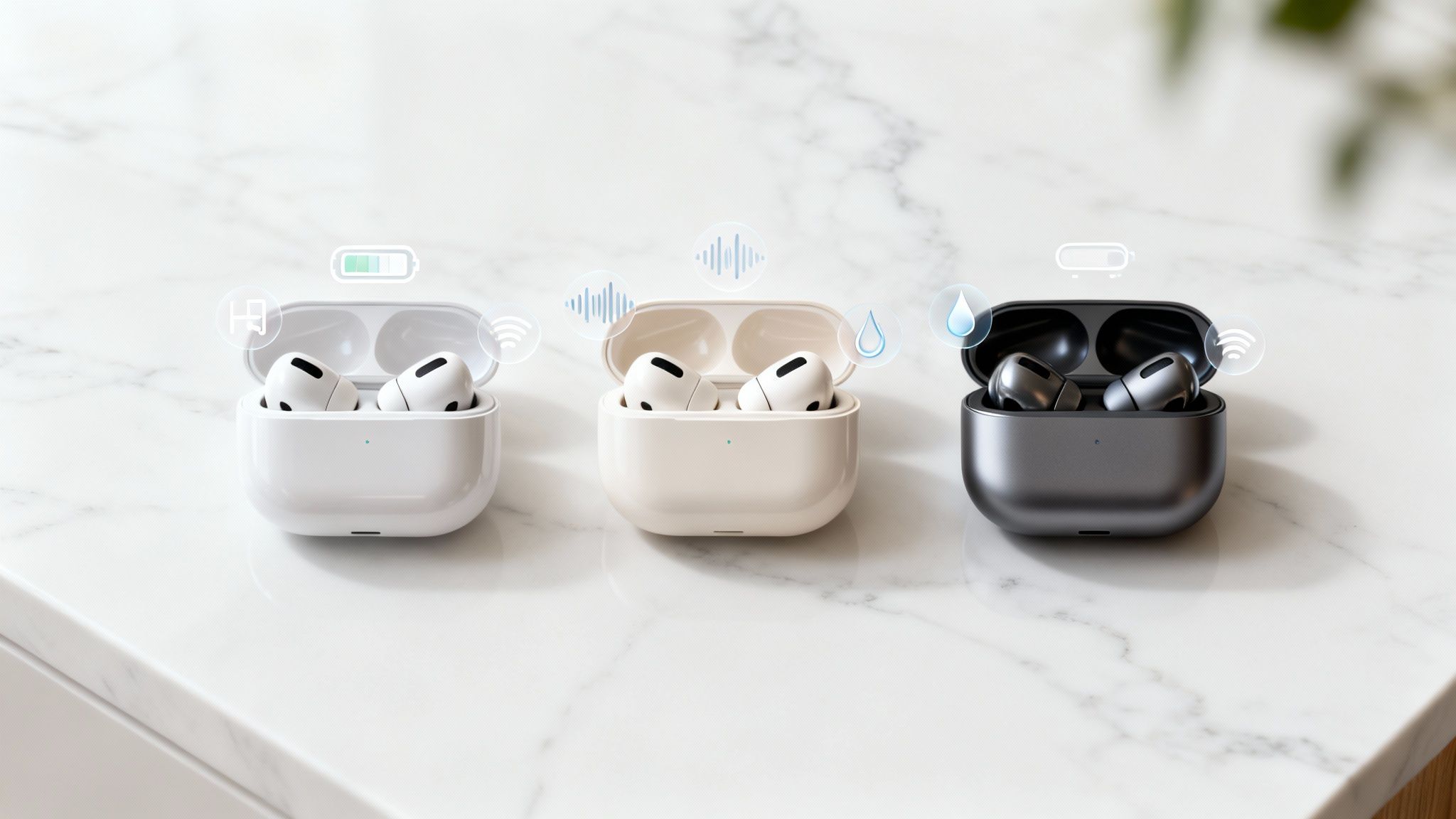
When you're comparing wireless earbuds, what really matters isn't just a list of specs—it's how they fit into your life. Are you looking for a quiet escape on your daily commute, or do you need a rock-solid, sweatproof pair for your morning run? This guide is here to help you zero in on the features that count for what you do.
How to Choose Your Perfect Wireless Earbuds
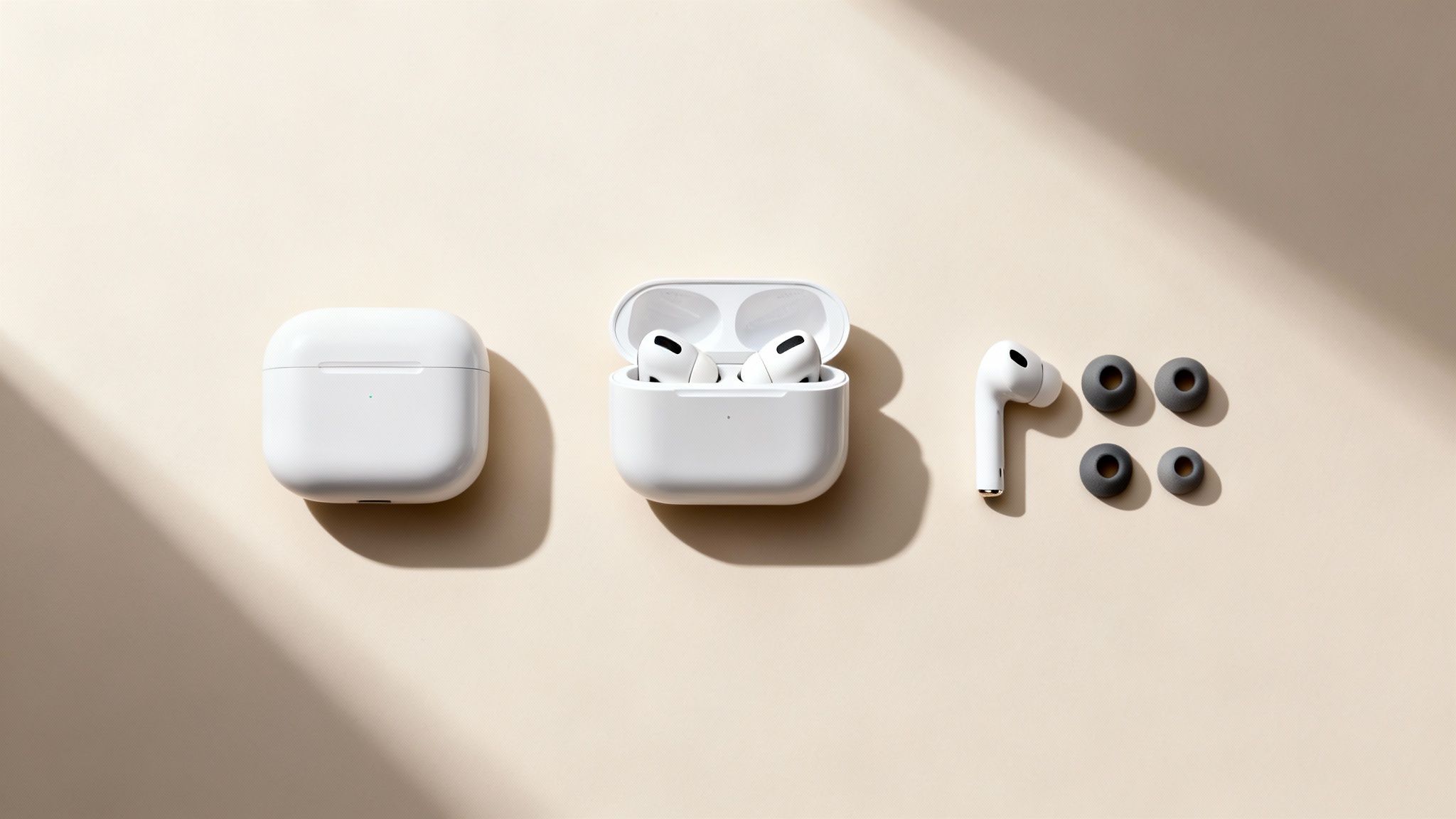
The market for earbuds is packed, and it's easy to get lost in the noise. We’re going to cut through the marketing hype and focus on the essentials: sound quality, noise cancellation, battery life, and all-day comfort. Think of it like learning how to choose the right laptop; the best choice always starts with what you'll be using it for every day.
Luckily, all that competition is fantastic for us. The global earbuds market was valued at an impressive $20 billion in 2023 and is on track to hit $50 billion by 2032. This boom is driving companies to innovate faster, which means better features and more affordable prices for everyone.
To get you started, the table below gives a quick overview of our top picks for different needs. It's a great way to find a few strong contenders before we get into the nitty-gritty of what makes each one tick.
Quick Picks: Best Wireless Earbuds at a Glance
| Category | Top Pick | Best For | Key Feature |
|---|---|---|---|
| Overall | Sony WF-1000XM5 | Commuters & Audiophiles | Industry-leading ANC & Sound |
| Apple Users | Apple AirPods Pro 2 | Seamless iOS Integration | Spatial Audio & Ecosystem Sync |
| Fitness | Jabra Elite 8 Active | Athletes & Gym-goers | Extreme Durability & Secure Fit |
| Budget | Anker Soundcore Liberty 4 NC | Value Seekers | Strong ANC at a Low Price |
This at-a-glance summary should help you identify which earbuds might be the right fit. Now, let’s dig deeper into what sets these and other top models apart.
Diving Into What Really Matters: The Core Features
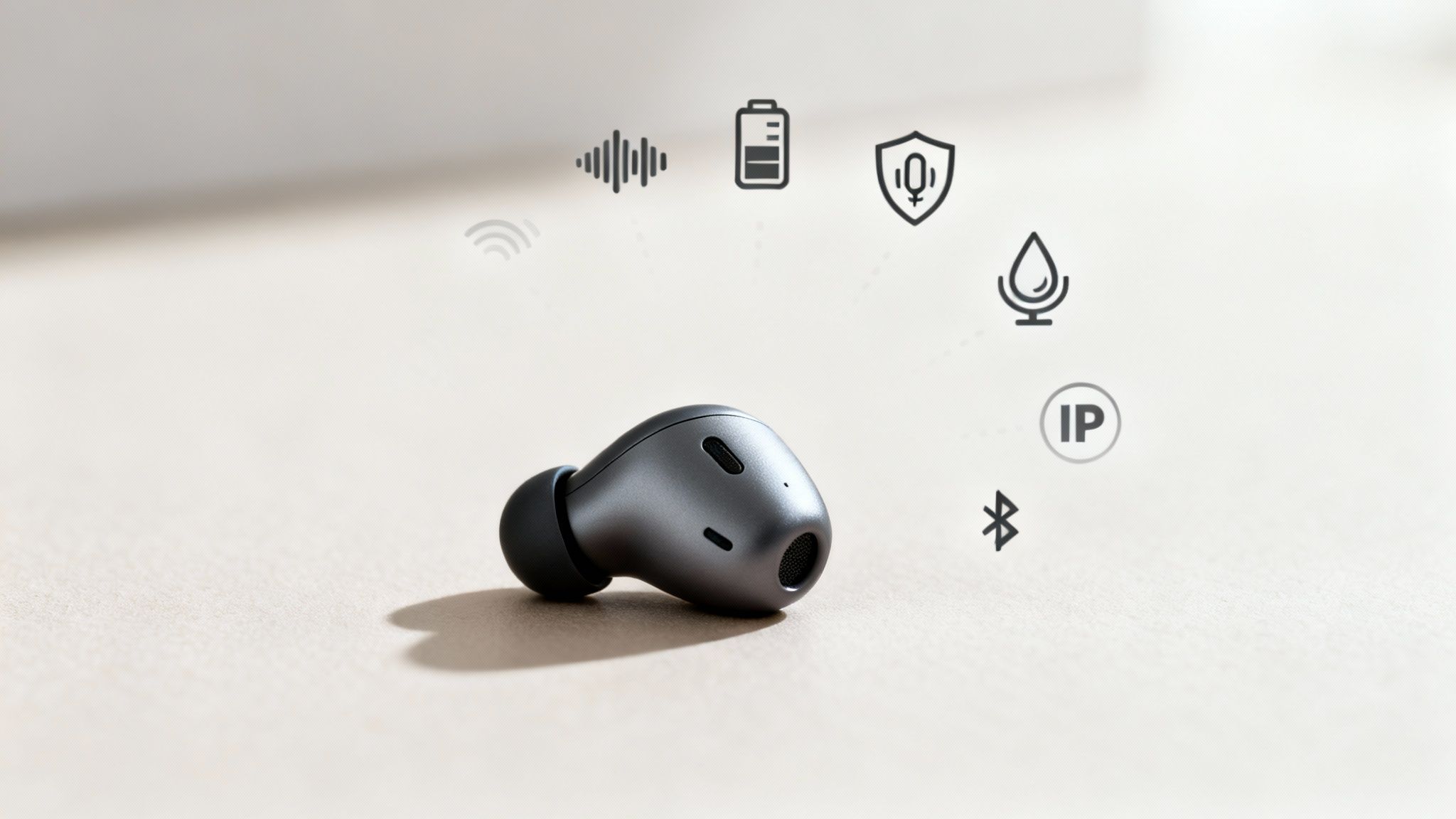
It’s easy to get lost in a sea of specs, but a truly great pair of wireless earbuds is defined by how they perform day-to-day. We’re going to look past the marketing hype and focus on the nine key areas that genuinely shape your listening experience. This is about finding earbuds that fit your life, not just ones that look good on a store shelf.
Think of it this way: a frequent flyer needs top-tier noise cancellation to drown out engine noise, while someone working from home needs crystal-clear microphones for endless Zoom calls. Everyone's needs are different, so let's break down what to look for.
H3 Sound Quality and Audio Fidelity
Let's start with the most important thing: how they sound. Great audio isn't about being the loudest; it's about balance and clarity. You want to hear the crisp snap of a snare drum, the warmth of a singer's voice, and deep, resonant bass that adds punch without turning everything into mud. It’s about experiencing music the way it was meant to be heard.
Many of the best earbuds come with companion apps that let you play with the equalizer (EQ). This is a fantastic feature because it puts you in the driver's seat, allowing you to boost the bass for your workout playlist or flatten the profile for a podcast. This kind of customization can turn a good pair of earbuds into your perfect pair.
H3 Active Noise Cancellation (ANC) Effectiveness
For anyone who commutes, flies, or just tries to focus in a noisy coffee shop, Active Noise Cancellation is a must-have. It works by using tiny microphones to listen to the world around you and then creating an opposite sound wave to cancel it out, giving you a pocket of peace and quiet. The best ANC systems are incredible at silencing low, droning sounds like airplane cabins or the rumble of a train.
But here’s the thing—not all ANC is created equal. High-end earbuds are wizards at blocking a wide spectrum of noise without creating that weird, pressurized feeling in your ears. Cheaper models might only manage to dull a low hum, while letting sharper sounds like conversations or keyboard clicks right through.
Key Differentiator: The cutting edge of ANC is "adaptive" technology. These earbuds are smart enough to adjust the level of noise cancellation on the fly, cranking it up on a busy street and then easing off when you're in a quiet library.
H3 Battery Life and Charging Convenience
There’s nothing worse than your music cutting out halfway through a workout. When you look at battery life, you'll see two numbers: how long the earbuds last on their own, and the total time you get with the charging case. A solid benchmark to aim for is 5-6 hours of continuous playback from the buds, with the case providing at least another 20-24 hours of juice.
Don’t overlook the little things that make charging easier, either.
- Wireless Charging (Qi-certified): Just drop the case on a charging pad. No more fiddling with cables.
- Fast Charging: A lifesaver when you're in a rush. A quick 5-10 minute charge can often give you an hour or more of listening time.
- USB-C Port: This is the standard now for a reason. It's faster and more reliable than the old micro-USB ports.
H3 Comfort and Secure Fit
The best-sounding earbuds in the world are useless if they hurt your ears. Fit is incredibly personal, which is why most earbuds come with a variety of silicone or foam ear tips. Finding the right size is crucial—it creates a tight seal that not only makes them more comfortable but also dramatically improves bass response and noise isolation.
If you’re a runner or a gym-goer, a secure fit is absolutely non-negotiable. Look for designs that include small wings or have an ergonomic shape that tucks securely into your ear. A loose fit doesn't just risk you losing an earbud; it also makes your music sound thin and lets all the outside noise in.
H3 Microphone Quality for Calls
With so many of us working remotely, the quality of the microphone on our earbuds has become a headline feature. You need to come through loud and clear on calls, whether you’re in a quiet home office or a windy park. A good set of earbuds will make your voice sound natural, not like you're talking from the bottom of a well.
The more advanced models use multiple microphones and clever software to zero in on your voice and filter out the background chaos. This is what separates the person on the other end hearing you from them hearing the barista shouting an order behind you.
H3 Bluetooth Codecs and Latency
Think of a Bluetooth codec as the language your phone and earbuds use to talk to each other. The codec determines how much data gets sent, which directly impacts audio quality. While every pair supports the basic SBC codec, you'll get a much better experience with more advanced ones:
- AAC: The go-to for Apple devices, offering a solid step up in quality from SBC.
- aptX/aptX HD: Widespread on Android phones, delivering higher-resolution audio.
- LDAC: Sony's codec, the choice for audiophiles wanting the absolute best wireless sound.
Latency—that tiny delay between what happens on screen and what you hear—is also a huge deal for watching videos or gaming. Earbuds with low-latency codecs like aptX are essential for making sure the sound is perfectly synced with the action.
A Detailed Side-By-Side Earbuds Comparison
Okay, let's cut through the noise. With so many earbuds on the market, the best way to make a decision is to see how the top models stack up against each other directly. This comparison goes beyond individual reviews to put the heavy hitters side-by-side, so you can clearly see the strengths and trade-offs of each.
We’ve handpicked a solid mix of premium champs, high-value mid-range contenders, and some seriously impressive budget options. This way, no matter your needs or wallet size, you can find a good fit.
This approach lets you zero in on what truly matters to you. Is it world-class noise cancellation for your daily commute? Or is crystal-clear microphone quality for endless work calls your top priority? Seeing it all in one place makes the right choice jump out.
Feature Showdown Across Price Tiers
Ever since Apple dropped the first AirPods back in 2016, the market has gone wild. It's gotten to the point where truly wireless models are projected to make up 73.55% of all earbud shipments by 2025. This intense competition has been great for us, sparking huge leaps in technology.
We're now seeing things like Bluetooth 5.3, which can slash latency by 30%, and active noise cancellation (ANC) that wipes out up to 98% of background noise. The best part? These high-end features aren't just for the most expensive models anymore.
This little decision tree is a great starting point. It helps you think about what you’ll actually be doing with your earbuds and which features you should prioritize.
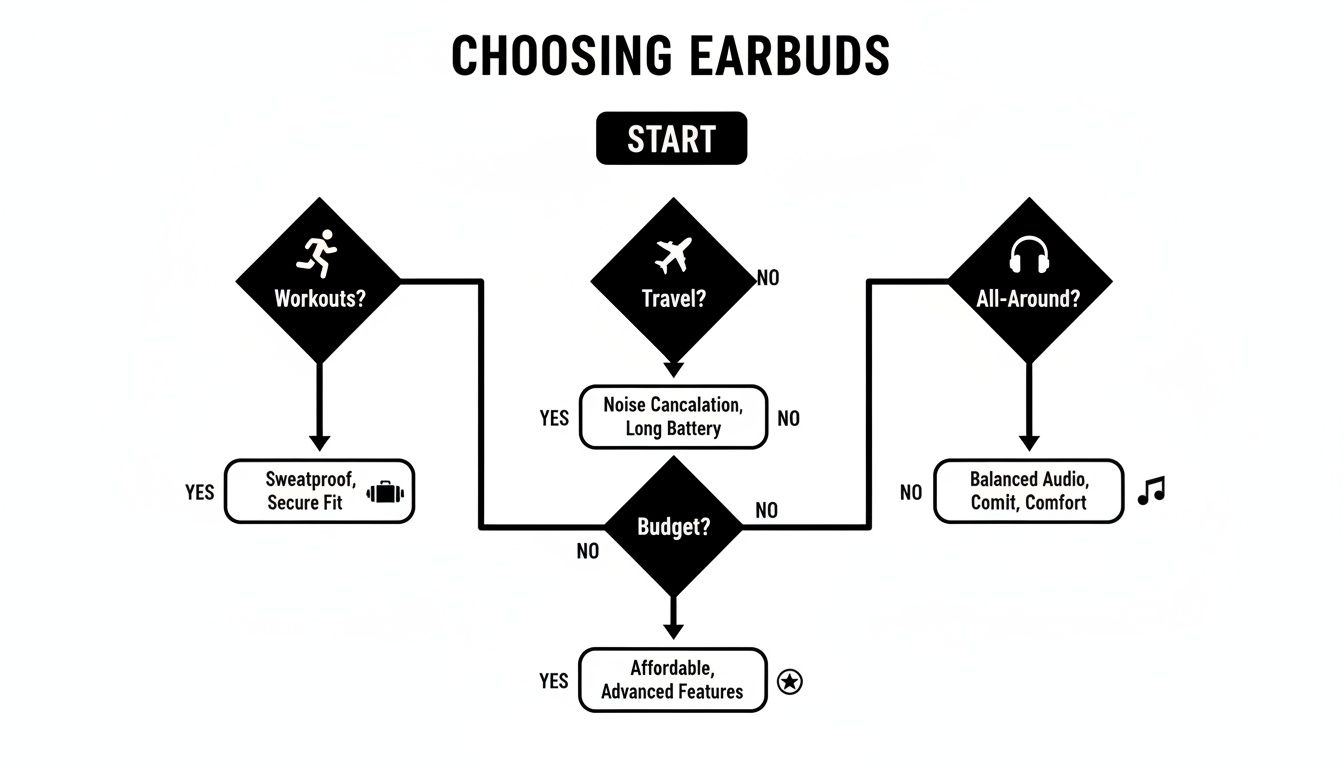
As the flowchart shows, what you do every day—whether you're a gym rat, a frequent flyer, or just a casual listener—should drive your choice from the very beginning.
Detailed Feature Showdown Top Wireless Earbuds
Now for the nitty-gritty. This table breaks down all the key specs, letting you compare everything from sound signature and ANC power to battery life and durability. Think of it as a spec sheet that helps you find the perfect balance of performance and price. It's a method we find really useful, much like in our smart speaker comparison, because it organizes all the critical details in one easy-to-scan spot.
| Model | Sound Profile | ANC Quality | Battery (Buds + Case) | Mic Performance | Key Codecs | IP Rating | Price Range |
|---|---|---|---|---|---|---|---|
| Sony WF-1000XM5 | Warm, detailed, bass-rich | Excellent | 8 + 16 hours | Very Good | SBC, AAC, LDAC | IPX4 | Premium |
| Apple AirPods Pro 2 | Balanced, clear, neutral | Excellent | 6 + 24 hours | Excellent | SBC, AAC | IP54 | Premium |
| Jabra Elite 8 Active | Punchy, customizable EQ | Very Good | 8 + 24 hours | Good | SBC, AAC | IP68 | Mid-Range |
| Anker Liberty 4 NC | V-shaped, bass-forward | Good | 10 + 40 hours | Good | SBC, AAC, LDAC | IPX4 | Budget |
| Nothing Ear (a) | Crisp highs, clear mids | Good | 9.5 + 32.5 hours | Good | SBC, AAC, LDAC | IP54 | Budget |
The data in the table really tells a story. You can quickly see which models prioritize battery life versus those that go all-in on sound or microphone quality.
Here’s a key insight: Look at how premium codecs like LDAC are now showing up on budget-friendly models from Anker and Nothing. This is a huge deal. It means you no longer have to pay top dollar for high-resolution audio, which is fantastic news if sound quality is your number one priority over things like the absolute best ANC or seamless ecosystem perks.
Matching Your Earbuds to Your Lifestyle
Specs on a box can only tell you so much. The real test of any wireless earbud is how well it fits into your actual life. A feature that’s a game-changer for one person is completely useless to another, so the smartest way to buy is to match the earbuds to what you do every day.
The "best" pair is rarely a single model; it completely depends on what you're doing. Are you sweating it out on a treadmill, trying to block out the roar of a jet engine, or leading a crucial conference call from your home office? When you focus on your own needs, you can find a pair that feels like it was made just for you.
For The Fitness Enthusiast
When you're pushing through a tough workout, the last thing you want is gear that can't keep up. For anyone who's active, the two most important things are a secure fit that won't budge and solid protection against sweat and water. Nothing kills your momentum faster than an earbud popping out mid-sprint.
This is where you need to look for specific design choices, like ear hooks or flexible wings. They provide the stability needed for running, jumping, and other high-impact movements. Just as important is a high IP (Ingress Protection) rating, which is your best indicator of durability.
- Top Priority: Look for an IPX7 rating or higher. This guarantees the earbuds can handle being fully submerged, so heavy sweat or a sudden rainstorm won't be an issue.
- Fit is King: Don't just stick with the tips that come on the earbuds. Experiment with different sizes and any included wing attachments to find a combination that locks in comfortably without feeling too tight.
For this category, the Jabra Elite 8 Active is a beast, with military-grade toughness and a fit that simply will not quit. If you're looking for something more budget-friendly, the Anker Soundcore Sport X10 is a great alternative that uses a secure over-ear hook design and has great water resistance.
For The Frequent Traveler and Commuter
If you spend a lot of your life on planes, trains, or buses, your main goal is to carve out a little slice of peace and quiet. That makes Active Noise Cancellation (ANC) your single most important feature. Top-tier ANC can turn a chaotic commute into a personal oasis, letting you enjoy music or podcasts at a much safer, lower volume.
Battery life is a very close second. You need earbuds that can last through a long flight and still have juice left for the ride to the hotel. Pay close attention to the total listening time you get when you include the charges from the case.
A compact case and fast charging are lifesavers for travelers. A quick 10-minute charge that gives you an hour or more of playback can be invaluable when you're hit with an unexpected delay.
The Sony WF-1000XM5 and Bose QuietComfort Ultra Earbuds are the undisputed champs here, with noise-canceling technology that is genuinely astonishing. For a more wallet-friendly option, the Anker Soundcore Liberty 4 NC delivers surprisingly effective ANC that performs way better than its price would suggest.
For The Remote Professional
In today's world of remote work, your earbuds are often your primary connection to your team. For professionals, microphone quality is everything. You need microphones that can zero in on your voice and cut out background noise, so you sound crisp and clear whether the dog is barking or the kids are playing in the next room.
Seamlessly switching between devices is also a must-have. Being able to go from a video call on your laptop to an incoming call on your phone without fumbling with Bluetooth settings is a massive productivity win. This is where ecosystem integration, like you see with Apple or Samsung, really proves its worth.
The wireless earbuds market is exploding, with an estimated 0.42 billion units shipped in 2025 and projections to hit 1.02 billion by 2030. This incredible growth is happening because these devices are becoming central to our daily routines, from the gym to the office, where dependable connectivity is no longer a luxury but an expectation. You can read more on the growth of the earbuds market at Mordor Intelligence.
This integration is also about how our devices talk to each other. For instance, you can see how audio gadgets fit into a larger network in our guide on how to set up a smart home. For pros, the Apple AirPods Pro 2 is unmatched for its microphone clarity and smooth experience for anyone using an iPhone and Mac. For the Android crowd, the Google Pixel Buds Pro offers fantastic voice pickup and reliable multipoint pairing.
How to Maximize Your Earbud Performance
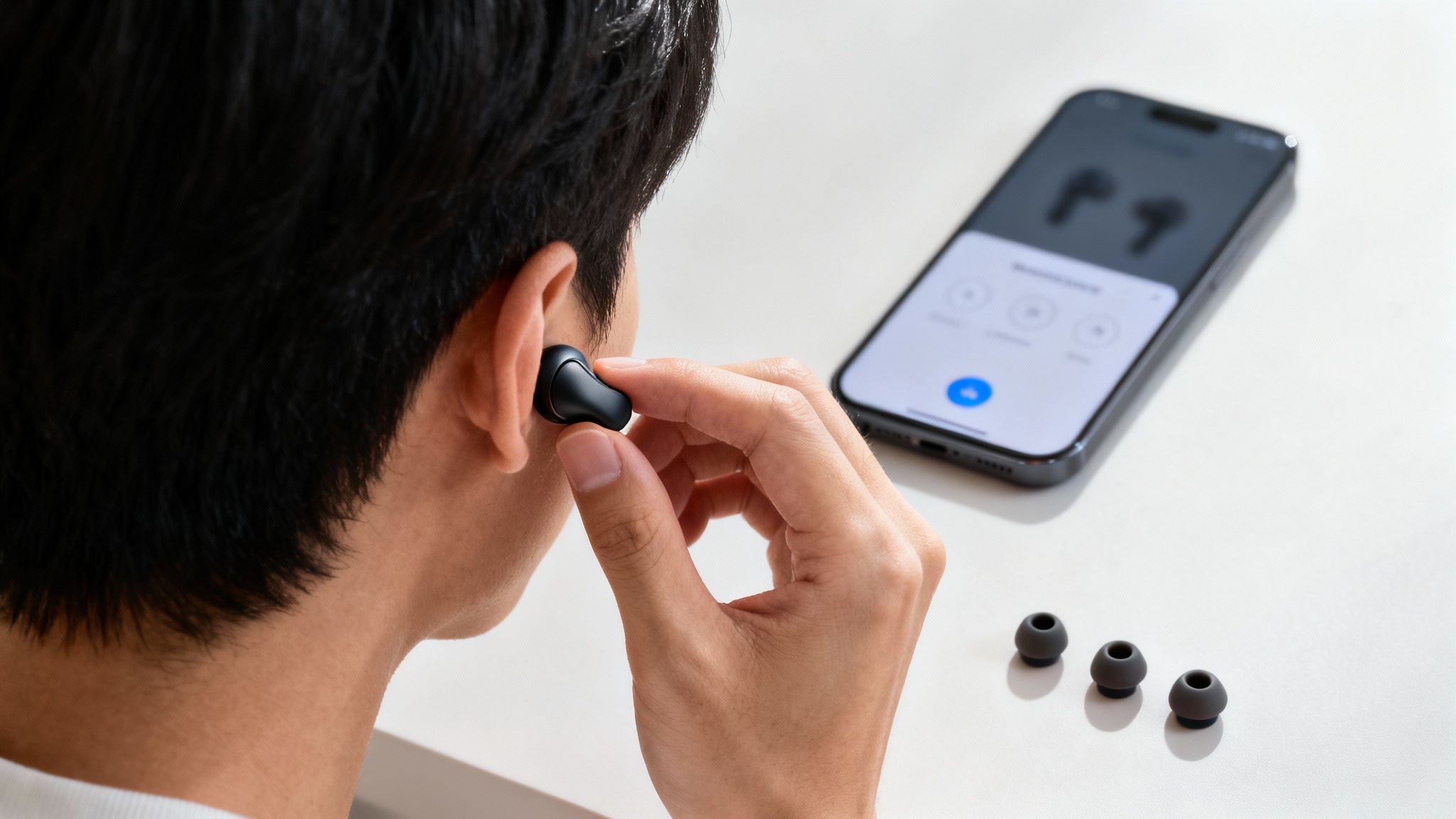
It’s always a great feeling to unbox a new pair of earbuds, but there are a few things you should do right away to get the best experience. Taking just a few minutes to dial in the setup and fit makes all the difference for sound quality, noise cancellation, and even connection stability.
Pairing them is usually a breeze. Most earbuds today will pop up on your phone's screen the moment you open the case nearby. If that doesn't happen, just head into your Bluetooth settings and select them from the list of available devices.
Dialing in Your Sound and Settings
Once you're connected, the very next thing you should do is download the manufacturer's companion app. So many people skip this step, but it’s basically the control panel for your earbuds. This is where you can truly make them your own.
Inside the app, you’ll find the equalizer (EQ), which lets you tune the audio exactly how you like it. You can pick from presets like "Bass Boost" or "Vocal," or get hands-on and create a custom sound profile. This is also where you’ll manage settings for ANC, transparency modes, and crucial firmware updates that often bring performance improvements.
Pro Tip: Take a moment to customize the touch controls. Being able to change the volume or skip a track with a simple tap—without it being something you do by accident—is a huge quality-of-life improvement. Set them up in a way that feels natural to you.
The Importance of a Perfect Seal
I can't stress this enough: a good fit is everything. If your earbuds don't seal properly in your ears, you'll get weak bass and lackluster noise cancellation, no matter how expensive they were. That’s why nearly all models come with a few different sizes of silicone or foam ear tips.
Experiment with them! A proper fit feels secure and comfortable, not painful. The earbud shouldn't feel like it's about to fall out, and it should create a seal that quiets the world around you even before you turn on the ANC.
If you're dealing with frustrating connection drops, try these quick fixes:
- First, try the classic fix: turn Bluetooth off and on again.
- Go into your Bluetooth settings, "Forget" the earbuds, and then pair them from scratch.
- Make sure your earbuds are fully charged. A low battery is a common culprit for unstable connections.
- Look for potential interference from other wireless devices. Some of the same ideas for boosting your router's signal apply here; you can learn more in our guide on how to improve WiFi signal strength.
Answering Your Top Wireless Earbud Questions
When you're staring down a dozen different earbud options, a few key questions always seem to pop up. Let's clear the air on the most common ones so you can pick the right pair with total confidence.
Is Active Noise Cancellation Really a Big Deal?
If you spend any time in noisy places, then yes, Active Noise Cancellation (ANC) is a game-changer. It's a must-have for daily train commutes, frequent flyers, or anyone trying to find a slice of quiet in a loud, open-plan office.
ANC uses microphones to listen to your surroundings and then creates an opposite sound wave to cancel out the background noise before it ever reaches your ears. This means you can listen to your music or podcasts at a lower, safer volume without cranking it up to drown out the world. If you only listen in quiet spots like your home office, you can probably skip it. But for commuters and travelers, it's a feature that makes a world of difference.
For many people, the difference is night and day. A good set of ANC earbuds can cut down ambient noise by up to 98%, effectively creating a personal bubble for you to focus or just relax.
What are Bluetooth Codecs, and Should I Care?
Think of Bluetooth codecs (like SBC, AAC, aptX, and LDAC) as the language your phone and earbuds use to talk to each other. They compress audio data to send it wirelessly, and the quality of that "language" absolutely impacts what you hear.
Every pair of Bluetooth earbuds supports the basic SBC codec, which gets the job done but isn't anything special. The better ones are what you want to look for:
- AAC: This is Apple's go-to. If you have an iPhone, earbuds that support AAC will give you a solid boost in clarity.
- aptX: This is the equivalent for the Android world, offering higher-quality, near CD-level sound.
- LDAC: Sony’s high-resolution codec is the top dog for audiophiles, delivering the best possible wireless audio quality, provided your phone and earbuds both support it.
The key takeaway? Your phone and your earbuds need to speak the same high-quality language to reap the benefits.
Can I Actually Use AirPods With My Android Phone?
You absolutely can. AirPods will pair with an Android phone or any other Bluetooth device just fine. The catch? You'll miss out on all the magic that happens inside the Apple ecosystem.
Things like one-tap pairing, automatic switching between your devices, and easy access to settings are all tied to using them with Apple products. For example, managing which devices are connected is seamless when you're using the same Apple account everywhere. If you ever need a hand with that, our guide shows you how to sign out of Apple ID properly.
So while they'll work, you don't get the full, effortless experience. It's always best to match brands if you want everything to work together perfectly.
Member discussion