
AI Privacy Concerns Explained and What You Can Do

Only 3% of Americans expected AI to make their personal information more secure, while roughly seven in ten expected it to make that information less secure, according to Pew Research Center's Americans and AI findings. That gap matters because people keep using chatbots, image generators, voice assistants, and AI-powered apps even while they remain unsure what happens to their data.
AI privacy concerns aren't just about dramatic hacks or secret government systems. They start with ordinary actions, such as pasting a work document into a chatbot, uploading a photo, asking a health question, or letting an app analyze your voice. The practical question is simple: after you press Send, where does that information go, who can access it, and how long might it remain useful to someone else?
Why AI Privacy Concerns Matter More Than Ever
AI privacy has moved from a specialist concern to a basic digital habit. If you use a chatbot to draft an email, a photo app to enhance an image, or a voice assistant to organize your day, you're creating data that may leave your device and enter a company's systems.
The public already had serious doubts about data handling before generative AI became mainstream. In 2023, 70% of Americans who had heard of AI said they had little to no trust in companies to make responsible decisions about AI use, while 81% believed collected information would be used in ways people weren't comfortable with. Pew's later findings show that this anxiety didn't fade as AI adoption expanded. Only 3% expected AI to make personal information more secure, compared with roughly seven in ten who expected it to become less secure. Those figures establish a durable trust gap, not a passing reaction.
Three pressure points make the issue urgent:
- Larger training datasets: AI developers need vast collections of text, images, audio, and code. The more material a system processes, the harder it becomes for individuals to understand whether their information is included.
- Opaque vendor policies: A privacy setting may control model training but not account storage, human review, abuse monitoring, or third-party service providers.
- More places to disclose information: One person may use several chatbots, productivity tools, smart devices, and social platforms. Each service can create another record of the same person.
You don't need to understand neural networks to make safer choices. A straightforward explanation of how artificial intelligence works helps, but the most useful skill is knowing which information should never enter a prompt.
Practical rule: Treat a public AI service like a helpful office outside your home. Don't hand it anything you wouldn't want copied, stored, reviewed, or accidentally shown to another person.
The rest of this guide focuses on the mechanics behind AI privacy concerns, the ways systems can leak information, and the controls ordinary users can switch on today.
What AI Privacy Concerns Actually Mean
Think of your online activity as a digital shadow. Every prompt, voice clip, uploaded document, and edited photo can leave a breadcrumb. One breadcrumb might seem harmless. Combined with an account, device identifier, location, writing style, or payment record, those breadcrumbs can reveal much more than you intended.
AI doesn't create every privacy risk from scratch. It amplifies familiar risks by processing information quickly, combining separate details, and generating conclusions that weren't explicitly written anywhere. A prompt saying, “Help me explain this diagnosis to my family,” may reveal a health concern even if you omit your name. An image can contain location metadata. A writing sample can identify an author through style and context.
Three parties handle the information
Every AI interaction usually involves at least three actors:
- You, the data supplier. You choose what to type, upload, record, or allow an app to access.
- The model provider. The company operates the chatbot or API, stores account data, applies safety filters, and sets retention rules.
- Downstream developers and service partners. Another app may send your prompt to a model provider, connect it to a search system, use analytics tools, or share outputs with an employer or advertiser.
That chain explains why a privacy label can feel reassuring while leaving important questions unanswered. “We don't sell your data” doesn't necessarily mean “we never store your prompt” or “no employee or contractor can review it.”
The vocabulary that causes confusion
Training data is material used to teach or improve a model. It may include public content, licensed material, synthetic examples, or user submissions, depending on the service and its policy.
Inference is the process of producing an answer from your input. An AI system can infer sensitive facts that you never stated directly, such as a likely location, profession, health concern, or relationship.
Model memorization happens when a model retains parts of its training material strongly enough to reproduce them. That doesn't mean every model stores every conversation verbatim, but it does mean “the model learned a pattern” and “the model cannot reproduce private material” are separate claims.
Encryption can protect data while it travels or sits on a server, but encryption doesn't automatically prevent an authorized service from processing the plaintext prompt. A plain-language guide to what end-to-end encryption means can help you distinguish protected transmission from complete provider blindness.
The Biggest AI Privacy Risks to Understand
AI privacy concerns become easier to manage when you separate the risks. They often overlap, so one dataset can support surveillance, inference, discrimination, and reidentification at the same time.
Six risks in everyday language
Data collection means a system gathers more information than you realize. A fitness app might receive heart-rate readings, exercise patterns, and location data. A company could use those signals to understand behavior beyond the feature you opened.
Inference means the system derives sensitive information from ordinary inputs. A smartwatch's activity and heart-rate patterns could contribute to an assessment of health or insurance risk, even when you never typed a medical detail.
Surveillance means observing people across places, devices, or activities. Facial recognition in public transit can connect a face to movement through a station or network, turning an anonymous journey into an identifiable record.
Bias means a model produces systematically unfair outcomes for certain groups. A hiring tool might downrank resumes mentioning women's colleges because historical hiring data taught it an association that reflects past discrimination rather than job ability.
Model inversion means an attacker tries to reconstruct sensitive characteristics or examples from a model's behavior. A language model that reproduces a memorized email signature could expose a person's name, job title, and contact details without their permission.
Reidentification means matching supposedly anonymous records with outside information. Location histories that lack names can become identifiable when patterns are compared with public posts, commuting routines, or other datasets.
These aren't merely theoretical categories. A Google-led study of GPT-2 found that more than 600 of 1,800 sampled candidate sequences were confirmed as memorized and recoverable from public training data, as described in Google's privacy discussion of large language models. The example shows why “publicly available” doesn't mean “safe to reproduce.”
For decision-makers who need a broader governance view, what decision-makers must know about privacy and technology offers useful context. Consumers can also reduce account compromise risks by learning how to spot phishing emails, since stolen credentials can expose AI history as well as ordinary files.
| Risk | What It Means | Real-World Example | Common Source |
|---|---|---|---|
| Data collection | Gathering inputs and related signals | A fitness app records activity and biometric patterns | Consumer apps |
| Inference | Deriving facts not directly provided | Health or financial risk inferred from behavior | Consumer and enterprise analytics |
| Surveillance | Tracking people across places or activities | Facial recognition used in public transit | Public systems and security tools |
| Bias | Unequal outcomes caused by data or design | A hiring model downranks resumes linked to women's colleges | Enterprise deployments |
| Model inversion | Recovering sensitive traits or examples from a model | A model reveals memorized contact details | Language models and APIs |
| Reidentification | Linking anonymous records to a person | Location patterns matched with public information | Data brokers and analytics |
How AI Systems Actually Leak Your Data
A useful analogy is a librarian who has read millions of books. You ask a question, and the librarian answers in their own words. But if the librarian memorized a restricted page, connected your request to a private archive, or followed a malicious note inserted into the catalog, the response could reveal information that should have stayed protected.
AI leakage can happen during training or during live use. Training-time controls, such as opting out of model improvement, may address one pathway but won't automatically prevent a connected application from exposing data during retrieval or tool use.
Training-time memorization
The GPT-2 research described above demonstrated that a language model could reproduce memorized sequences from its training material. The same Google-led research found that a 1.5-billion-parameter GPT-2 XL model memorized about 10 times more information than GPT-2 Small, showing that larger scale can create additional exposure rather than automatically making privacy safer.
Live retrieval and prompt leakage
Retrieval-augmented generation, or RAG, lets an assistant search connected documents before answering. That makes responses more useful, but it also creates a new boundary to protect. If an attacker poisons a retrieval index or crafts a prompt that manipulates the assistant, the system may echo proprietary content.
A recent empirical study of RAG-based personal assistants found that, without explicit safeguards, user secrets leaked in 16.31% of conversations. A separate clinical LLM study found that privacy instructions reduced leakage by 7.2 percentage points, but didn't remove it. Prompt rules help, yet they aren't a complete defense.
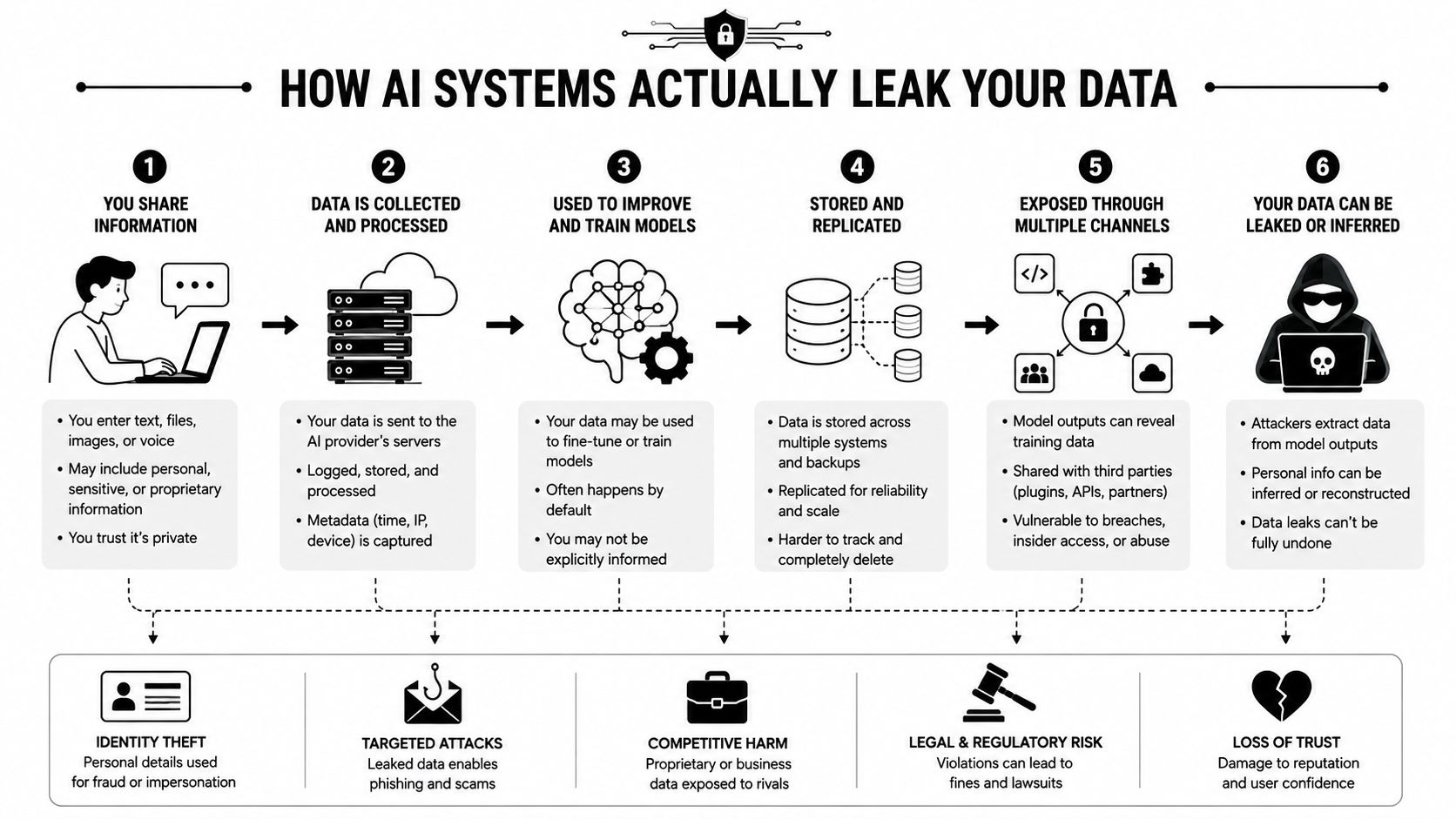
Three pathways deserve attention:
- Verbatim memorization: The model reproduces a learned sequence.
- Embedding inversion: An attacker analyzes representations used to search or classify data and attempts to recover information.
- Retrieval-time exfiltration: A connected assistant fetches or reveals content because access controls, prompts, or indexes fail.
Prompt injection defenses matter most when an assistant can read files or take actions. Guidance on prompt injection mitigations explains why access boundaries must sit outside the model's instructions. The same principle applies to cloud storage. Before uploading private files, understand how cloud storage works and which party controls the account.
Laws and Industry Practices Shaping AI Privacy
AI privacy law is a patchwork, not one universal rulebook. The European Union's AI Act uses risk categories, while the GDPR addresses data protection and automated decisions, including rules connected with Article 22. California's CCPA and CPRA give residents privacy rights that can include opting out of certain data uses. Illinois BIPA focuses on biometric information, including requirements around consent and handling.
Other jurisdictions take different approaches. China's PIPL governs personal information processing and sits alongside developing AI rules. Brazil's LGPD provides a general data protection framework. The practical result is that the same chatbot may face different obligations depending on the user's location, the provider's location, the data involved, and whether the system supports a high-impact decision.
Legal obligations versus voluntary controls
The laws below don't all apply in the same way to a casual consumer prompt and an enterprise hiring system. Read them as a map of accountability, not as a guarantee that every interaction receives identical protection.
| Regulation or Practice | Region or Scope | Enforcement | What It Means for You |
|---|---|---|---|
| EU AI Act | European Union | Regulatory enforcement and penalties | Providers and deployers may face duties based on system risk |
| GDPR Article 22 | European Union and covered processing | Data protection authorities and individual rights | Certain automated decisions may require safeguards and human involvement |
| CCPA and CPRA | California | State enforcement and consumer rights | You may have rights to access, delete, or limit certain data uses |
| Illinois BIPA | Illinois biometric data | Private and public enforcement mechanisms | Biometric collection can require notice and consent |
| PIPL | China | National data protection enforcement | Personal information processing faces consent and governance duties |
| LGPD | Brazil | Data protection authority oversight | Individuals receive rights over covered personal data |
| Differential privacy | Technical practice | Voluntary unless required by contract or law | Limits what an analysis should reveal about one person |
| Federated learning | Technical practice | Voluntary design choice | Keeps some training data distributed instead of centralizing it |
| Confidential computing | Technical practice | Voluntary technical control | Protects data during selected processing stages |
| Data clean rooms | Organizational and technical practice | Contractual and policy-based | Lets parties analyze restricted datasets under controlled conditions |
Industry response is growing. 90% of companies expanded privacy programs because of AI, 93% planned to add more privacy and data-governance resources, and 38% spent at least $5 million on privacy programs in the previous year, compared with 14% in 2024, according to Cisco's Data Privacy Benchmark Study. Those investments can improve governance, but a privacy program doesn't automatically make every product private.
For personal habits, how to protect your privacy online offers a useful foundation. Regulation can create rights and penalties, but you still need to check settings before sharing sensitive information.
Misconceptions That Leave Users Exposed
Many people treat an AI chat window like a private diary. That assumption is understandable, but it can be wrong. An independent consumer survey found that 53% of respondents didn't know, or weren't sure, that many chatbots train on conversations by default, while only 25% knew chats can be subpoenaed and 43% were unaware of six basic facts about how chats are stored, reviewed, or disclosed. The survey also found that 58% were uncomfortable with conversations being used to train AI. The education gap is part of the privacy problem.
Five myths to discard
Myth one: deleting a chat removes every copy. Deletion may remove the visible conversation from your account, but it may not instantly erase backups, safety logs, support records, or material already used in a training workflow. Read the provider's retention and deletion terms.
Myth two: incognito mode hides prompts. Private browsing can limit local browser history, but it doesn't stop the AI service from receiving your prompt. The provider still sees the request needed to generate a response.
Myth three: companies never share inputs. A provider may restrict sharing while still using contractors, subprocessors, security reviewers, or connected tools. The relevant question is what the policy permits, not what you hope the company does.
Myth four: an anonymous account makes you anonymous. Writing style, device details, payment information, uploaded files, and repeated topics can connect sessions. Removing your name is not the same as removing identifying signals.
Myth five: a smaller open-source model is automatically safer. Local operation can reduce exposure to a remote provider, but the model may still contain memorized training material. A self-hosted system also needs secure files, updates, access controls, and careful logging.
If you need to compare a service's retention, training, deletion, and disclosure language, you can check legal privacy info before entering personal details. Privacy loss usually accumulates through repeated small disclosures, not one dramatic mistake.
Practical Steps to Protect Your Privacy from AI
Use this checklist before your next AI session. Start with the settings that affect storage and training, then change the way you prepare prompts.
Turn off model training where available. Look in Privacy, Data Controls, or Settings for options such as “Improve the model” or “Use conversations for training.” This usually takes a few minutes, but check whether the setting applies to future chats only.
Disable chat history for sensitive work. Temporary or history-free modes may reduce account exposure, although you should still avoid placing confidential material into a service you don't trust.
Remove personal identifiers before pasting. Replace names, addresses, account numbers, medical record details, and internal project labels with placeholders. Ask the model to summarize a fictionalized version rather than the original.
Scrub files and photos. Remove metadata from images and documents before uploading. Metadata can include location, device information, author names, revision history, or hidden comments.
Use a separate alias for low-trust services. A secondary email address can limit account-linking, but it won't make you anonymous. Don't use aliases to bypass rules or conceal activity from an employer or service provider.
Review connected apps and permissions. Revoke access to tools that can read your email, cloud files, calendar, contacts, microphone, or camera when you no longer need them. A chatbot with broad tool access creates a larger blast radius if something goes wrong.
Choose local processing when the feature supports it. On-device transcription, photo analysis, and smaller local models can keep some inputs on your phone or computer. Verify that the app processes data locally and does not upload it for another feature.
Secure the account itself. Use a unique password, multifactor authentication, and phishing awareness. A privacy setting can't protect a conversation after an attacker gains access to your account.
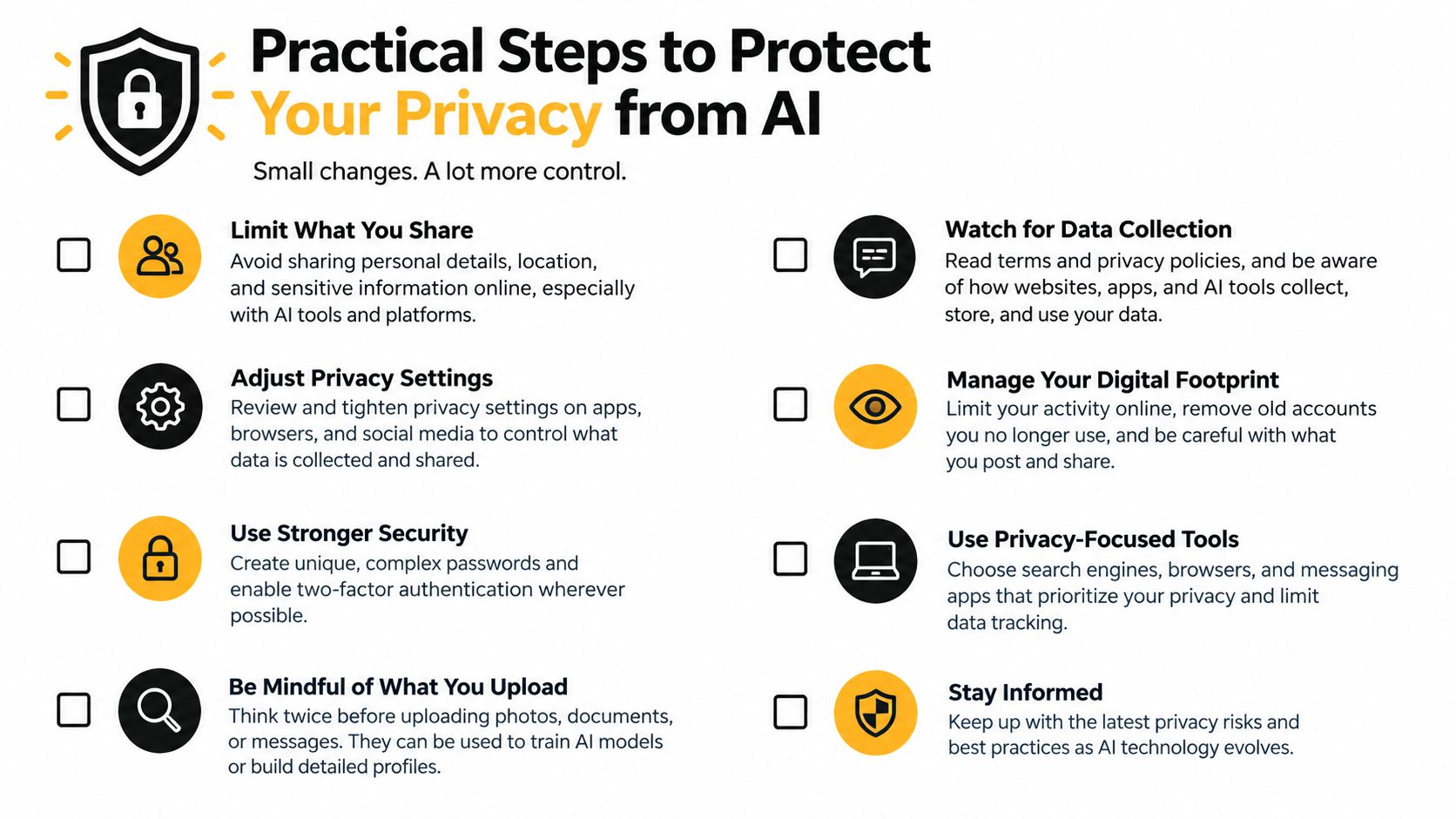
A VPN can reduce some network-level exposure, and a privacy-focused browser can limit tracking, but neither tool makes an AI prompt confidential by itself. The strongest habit remains data minimization: send the least sensitive version of the information needed to complete the task.
Future options such as on-device AI, local models, federated learning, and privacy-preserving inference may give people more control. Until those protections are standard and clearly explained, treat every prompt as information that deserves a deliberate destination.
Tech Today turns complicated technology topics into clear explanations and practical how-to guidance, including privacy settings, AI tools, and safer everyday device habits. Visit Simply Tech Today to learn what your tools do before you trust them with personal information.
Member discussion